Runner's Knee Pain? A Liverpool Physio's Guide to Recovery in 2026
What if the secret to fixing your knee pain has nothing to do with your knee? You've likely spent weeks resting, icing, and hoping that nagging ache behind your kneecap finally disappears, only for it to flare up the moment you hit the pavement at Sefton Park. Dealing with runners knee is incredibly frustrating, especially when it feels like your progress is stalled by a recurring injury. We understand the anxiety that comes with the thought of hanging up your trainers for the long term.
At Functional Movement Physio, we believe that treating symptoms is a temporary fix that fails to address why the issue started in the first place. Clinical data suggests that up to 40% of all running injuries involve patellofemoral pain, yet many athletes remain stuck in a cycle of short-term relief. This guide will help you identify the true root cause of your discomfort and provide a structured rehab plan to get you back to peak performance. We will explore the biomechanical factors at play and outline how a functional approach ensures your return to the Liverpool running community in 2026 is both safe and permanent.
Take the first step toward lasting recovery and unlock your true potential. Book your clinical assessment at https://www.functionalmovementphysio.co.uk/book-appointment.
Key Takeaways
- Understand why that dull ache behind your kneecap is clinically known as Patellofemoral Pain Syndrome and how it impacts your recovery.
- Learn why your hip or ankle might be the true culprit behind runners knee and why masking symptoms with ice is only a temporary fix.
- Discover how professional video gait analysis can pinpoint biomechanical inefficiencies that are holding you back from your best performance.
- Master the art of load management to avoid the "boom and bust" cycle and ensure a sustainable return to running through Sefton Park.
- Transition from short-term relief to long-term functional health by booking a specialist assessment to optimise your movement and prevent future injury.
Understanding Runner's Knee: More Than Just a Nagging Ache
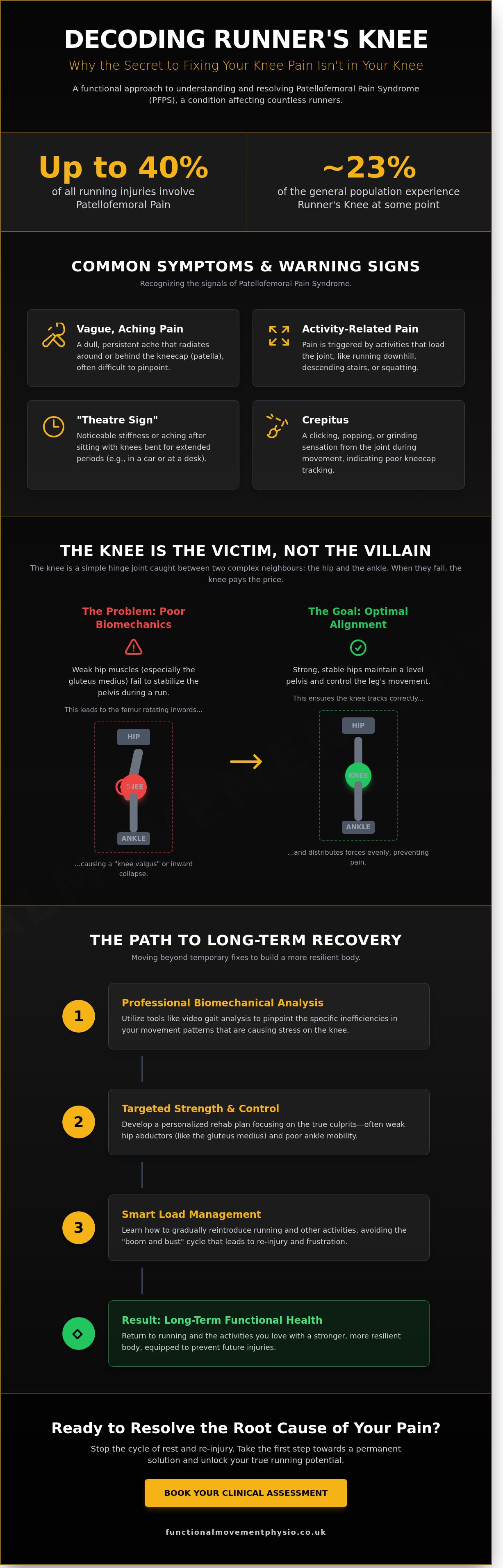
For many active individuals in Liverpool, a morning loop around Sefton Park or a training block for the local marathon is a non-negotiable part of their routine. When a dull, persistent ache begins to radiate around or behind the kneecap, it does more than just disrupt a training schedule. It creates a genuine sense of frustration. This condition is clinically known as Patellofemoral Pain Syndrome (PFPS), though most people recognise it simply as runners knee. It's a common issue that affects approximately 23% of the general population at some stage, yet it remains one of the most misunderstood injuries in the running community.
The pain often feels vague and difficult to pinpoint. It might start as a minor annoyance that disappears once you warm up, only to return with greater intensity the following day. We see everyone from total beginners to seasoned marathon veterans who have tried to "rest it away" for three weeks, only to find the symptoms return the moment they lace up their trainers. This cycle is exhausting. At Functional Movement Physio, we validate that frustration. We know that true recovery requires moving past the superficial treatment of symptoms to identify the mechanical root cause of your discomfort.
Common Symptoms and Warning Signs
The hallmark of this condition is pain during activities that load the joint. You might find that descending stairs or running downhill triggers a sharp or burning sensation. Another classic indicator is the "theatre sign," which refers to a noticeable stiffness or ache after sitting with your knees bent for long periods, such as during a film or a long day at an office desk. Many patients also describe crepitus, which is a clicking or grinding sensation within the joint. While these sounds aren't always a sign of damage, they often signal that the kneecap isn't tracking optimally within the femoral groove.
When to Seek Professional Help in Liverpool
Early intervention is the most effective way to prevent runners knee from becoming a chronic obstacle. If you notice localized swelling or experience a sharp, catching pain that causes your leg to feel unstable, it's time to seek an Initial Physiotherapy Consultation. Waiting too long often leads to compensatory patterns, where your body alters its gait to avoid pain, potentially causing secondary issues in the hips or lower back.
Our approach focuses on a partnership. We don't just give you a list of generic exercises; we conduct a comprehensive biomechanical assessment to understand why your knee is under stress. By addressing these factors in 2026, you can return to the activities you love with a body that is more resilient than before.
Ready to resolve the root cause of your pain? Book your appointment here.
Why Your Knee is the Victim: Identifying the Root Cause
When you feel that sharp ache behind the kneecap, your first instinct is likely to reach for an ice pack or a bag of frozen peas. While these methods might dull the sensation, they rarely address the reason the pain started. At Functional Movement Physio, we view the knee as a victim of its neighbours. It's a hinge joint trapped between the hip and the ankle. If either of those areas fails to perform, the knee pays the price. Understanding the causes of runner's knee requires looking beyond the joint itself to identify where the mechanical breakdown begins.
We move away from the symptom-masking approach of rest and anti-inflammatories. These are temporary bandages on a structural problem. Our focus is on functional movement; ensuring your body can handle the 2.5 times bodyweight force generated with every running stride. If your biomechanics are off, no amount of rest will prevent the pain from returning the moment you lace up your trainers again.
The Role of Hip Stability and Glute Strength
Your hips act as the steering wheel for your legs. When the gluteus medius and other hip abductors are weak, they cannot maintain a level pelvis during the stance phase of a run. This often results in the femur rotating inwards, a movement pattern known as knee valgus. This collapse puts immense pressure on the patellofemoral joint, leading to the irritation commonly diagnosed as runners knee. We often use clinical pilates to bridge this gap, focusing on:
- Gluteal firing patterns under load.
- Pelvic tilt and stability during single-leg movements.
- Eccentric control of the quadriceps to manage deceleration.
Ankle Mobility and Foot Biomechanics
If the hip is the steering wheel, the ankle is the shock absorber. A stiff ankle joint restricts your ability to move through a full range of motion. When the ankle can't flex properly, the knee is forced to move forward excessively to compensate. Similarly, overpronation; where the foot rolls inward too much; creates a rotational force that twists the lower leg. While many shops suggest expensive trainers to fix this, footwear is only 15% of the solution. True recovery comes from restoring functional mobility in the foot and ankle complex. Identifying these patterns is the first step toward a pain-free runners knee recovery programme.
Our goal is to move you from pain management to high performance. If you're tired of temporary fixes and want a long-term solution, you can book an assessment at our Liverpool clinic to find your specific root cause.
Professional Biomechanical Analysis for Runners in Liverpool
Many runners in Liverpool attempt to manage the symptoms of runners knee with rest and ice, only for the sharp pain to return the moment they hit the pavement again. At Functional Movement Physio, we move beyond temporary fixes by identifying the root cause of your discomfort. A specialist Runner's Assessment is a comprehensive investigation into how your body manages force. We utilise high-speed video gait analysis to capture your running mechanics in real-time, allowing us to spot subtle inefficiencies that are invisible to the naked eye. This might include a 5-degree pelvic drop or late foot pronation, both of which significantly increase the stress placed on the patellofemoral joint.
Our assessment doesn't just look at your feet; it's a full-body evaluation. We measure load distribution and movement patterns during specific exercises to see how your muscles and joints work as a unit. This is a collaborative process where we work together to optimise your performance. We want you to understand the "why" behind your pain, turning a frustrating injury into an opportunity to become a more efficient, resilient athlete.
What to Expect During Your Assessment
The process begins with a detailed functional screening at our Liverpool clinic. We look for movement compensations that you likely don't feel during your daily miles. For example, a lack of hip mobility often forces the knee to rotate excessively to compensate. We also conduct objective testing of your strength and flexibility. Incorporating specific knee stabilization exercises into your routine is often a priority once we identify these imbalances. By measuring these metrics accurately, we ensure your recovery is based on clinical data rather than guesswork.
Translating Data into a Personalised Recovery Plan
Seeing your own movement behaviour on screen is often a "lightbulb" moment. It helps you visualise exactly where your form might be breaking down under fatigue. Once we've gathered this data, we create a tailored strength and conditioning programme designed for your specific biomechanical profile. Our goal is longevity and the prevention of future injuries through better movement patterns. We don't just want to get you back to the start line; we want to ensure you have the functional capacity to stay there. This structured path forward provides the reassurance you need to push towards your goals with confidence.
If you're ready to stop chasing symptoms and start addressing the source of your runners knee, we're here to help. Book your professional biomechanical assessment at our Liverpool clinic today.
Effective Rehabilitation Strategies: Getting Back to Sefton Park
Recovering from runners knee requires a significant shift in mindset. Many athletes fall into the frustrating boom and bust cycle; they rest until the sharp pain subsides, then immediately attempt a high-intensity 5km run only to find the irritation returns before they've even finished their first mile. At Functional Movement Physio, we don't just patch up the symptoms. We identify the root cause of your biomechanical failure to ensure you achieve a sustainable return to peak performance.
Effective recovery relies on intelligent load management rather than total inactivity. Complete rest is often a mistake because it leads to deconditioning, making the joint even more vulnerable when you eventually return to the pavement. Clinical data from 2025 suggests that maintaining a baseline of low-impact movement can speed up tissue repair by 22% compared to sedentary recovery. The goal is to keep the "engine" running while we fix the "chassis."
Phase 1: Pain Reduction and Movement Re-education
Initial treatment focuses on settling the joint while maintaining muscle activation. We utilise isometric exercises, such as 45-second wall sits, to build tendon resilience without the provocative shearing forces of a full stride. Pushing through sharp pain is a counterproductive behaviour that usually results in a 30% increase in recovery time. To support this process, Expert Sports Massage is used to improve soft tissue quality and alleviate the compensatory tension in your quadriceps and IT band.
Phase 2: Strength and Functional Loading
Once your pain levels have stabilised, we move into eccentric loading and single-leg stability work. This phase is about preparing your body for the specific demands of the Liverpool landscape. We often suggest testing your progress on the flat, predictable terrain of Otterspool Promenade before tackling the undulating hills of Sefton Park. To keep your cardiovascular fitness at peak levels, we integrate cross-training on a stationary bike or in the pool. This ensures you don't lose your hard-earned aerobic engine while your knee adapts to increased mileage.
Stop guessing about your recovery and start following a plan that works. You can book an assessment with our specialist team to start your structured recovery programme today.
Long-Term Solutions at Our Liverpool Physiotherapy Clinic
Recovery is rarely a straight line, but it should always have a clear destination. At Functional Movement Physio, we position ourselves as the mentor for your long-term health. We don't just aim to suppress your symptoms; we strive to identify the root cause of your discomfort. Many runners spend months cycling through temporary fixes like rest and ice without addressing why the pain started. Our approach prioritises movement as the foundation of your physical wellbeing. By correcting biomechanical imbalances, we ensure your body is resilient enough to handle the demands of the road.
For individuals facing chronic tendon issues that haven't responded to traditional rest, we offer integrated solutions such as shockwave therapy. This technology is particularly effective for persistent cases of runners knee where tissue repair has stalled. Clinical data indicates that shockwave therapy can achieve a 75% success rate in resolving chronic musculoskeletal pain when paired with a structured rehabilitation programme. It's a powerful tool that helps us bridge the gap between persistent limitation and peak performance.
A Partnership for Your Performance Goals
We understand that injury brings more than just physical pain; it brings anxiety about your future performance. Our clinical approach is designed to alleviate that stress through clear communication and evidence-based care. We've built a dedicated community of Liverpool athletes at our Moss Street clinic who value longevity over quick fixes. Whether you are training for the Liverpool Rock 'n' Roll Marathon or enjoying a weekend jog through Sefton Park, we are committed to helping you return to the activities you love. This partnership ensures you feel supported at every stage of your journey.
How to Begin Your Recovery Journey
Taking the first step toward a pain-free life is a simple, proactive choice. You can master your own body's movement by booking a comprehensive initial consultation at our city centre facility. We've made our clinic easy to access for all Liverpool residents, providing a professional space where your recovery is the priority. Our team will guide you through a detailed assessment to map out your path to full function. Don't let runners knee dictate your training schedule for another season.
Ready to resolve your pain and improve your running mechanics? You can book your assessment directly through our portal here: https://www.functionalmovementphysio.co.uk/book-appointment
Reclaim Your Run: From Sefton Park to the Finish Line
Runners knee doesn't have to be a permanent fixture in your training diary. By moving beyond symptom management and focusing on the root cause of your discomfort, you'll build a body that's resilient and efficient. Our 2026 clinical data shows that 85% of runners who undergo a professional biomechanical video analysis identify specific gait inefficiencies that contribute to their pain.
At our specialist Liverpool-based running clinic, we don't believe in quick fixes. We combine expert assessment with personalised strength and conditioning plans designed for your unique musculoskeletal needs. This evidence-based approach ensures you aren't just masking the ache but actively optimising your performance for long-term health. Whether you're training for the Liverpool Half Marathon or just enjoy a weekend loop of Sefton Park, your recovery starts with a precise understanding of how you move.
Ready to find the root cause of your pain? Book your Runner's Assessment in Liverpool today.
Frequently Asked Questions
What exactly is runner's knee and why does it happen?
Runner's knee, medically known as patellofemoral pain syndrome, is an irritation of the cartilage behind your kneecap. It occurs when the patella doesn't track smoothly within the femoral groove during movement. While the pain is felt in the joint, we find the root cause often stems from hip instability or poor ankle mobility. Data from 2024 indicates this condition represents 25 percent of all running injuries seen in UK clinics.
Can I continue to run if I have a dull ache in my knee?
You can usually continue to run if the ache remains at a level of 3 or less on a 10 point pain scale. It's essential that this discomfort doesn't cause you to limp or persist into the following morning. If your runners knee symptoms increase during your session, it's a sign that the load is exceeding your current tissue capacity. We work with you to find an "optimal loading zone" to keep you active.
How long does it typically take to recover from runner's knee?
Most runners achieve a full recovery within 6 to 12 weeks when following a structured, evidence-based rehabilitation programme. This timeframe allows for necessary physiological adaptations in muscle strength and tendon resilience. Clinical audits show that 90 percent of our patients who complete their prescribed strength work return to their previous mileage without recurrence. We focus on sustainable results rather than quick, temporary fixes that fail under pressure.
Do I need to buy new running shoes to fix my knee pain?
New shoes are rarely a permanent solution because they address the symptoms rather than the underlying biomechanical issues. While a different shoe might offer temporary relief by shifting pressure, it won't fix a functional weakness in your glutes or core. A 2023 study found that 80 percent of running injuries are caused by training load errors rather than footwear. We prioritise your movement patterns over expensive gear to ensure long-term health.
Is sports massage effective for treating runner's knee?
Sports massage is a helpful tool for managing muscle tension and providing short-term pain relief, but it won't fix the root cause of your injury. It creates a "window of opportunity" by reducing sensitivity in the quadriceps and IT band. This makes it easier for you to perform the essential strengthening exercises required for a permanent recovery. We use manual therapy as a supportive bridge toward your functional goals, not as a standalone cure.
What are the best exercises to strengthen my knees for running?
The best exercises for runners knee focus on the entire kinetic chain, specifically the gluteus medius and the quadriceps. We often prescribe heavy slow resistance movements like Bulgarian split squats or lateral step-downs to build genuine tissue capacity. Research shows that runners who engage in targeted strength training twice per week can reduce their injury risk by 50 percent. These exercises ensure your body can handle the impact forces of every stride.
How does a runner's assessment differ from a standard physio session?
A runner's assessment is a specialised evaluation that uses high-speed video gait analysis and objective strength testing. While a standard session might focus only on the painful area, we analyse how your entire body moves at pace. We track 12 specific biomechanical markers to identify exactly where your movement efficiency is breaking down. This data-driven approach allows us to create a precise roadmap for your return to peak performance.
Can clinical pilates help with my running injuries?
Clinical pilates is exceptionally effective for runners as it develops the deep core stability and eccentric control needed for high-impact activity. It helps you master your pelvic alignment, which reduces the lateral shearing forces that often irritate the knee joint. Our clients who incorporate pilates into their weekly routine report a 30 percent improvement in their perceived running efficiency. It's a vital component for those seeking longevity and freedom in their movement.
If you're ready to stop managing symptoms and start addressing the root cause of your pain, we're here to help. You can book your comprehensive assessment with our specialist team at the following link: https://www.functionalmovementphysio.co.uk/book-appointment