Gait Analysis for Runners in Liverpool: Finding the Root Cause of Your Pain

What if the recurring shin splints stopping your training have nothing to do with your fitness and everything to do with a single millisecond of your stride? You've likely tried resting for three weeks or switching to the latest stability trainers, only to find the same familiar ache returning as soon as you hit the pavement at Sefton Park. Investing in a clinical gait analysis for runners is the first step toward understanding why these injuries persist despite your best efforts to recover.
It's frustrating to feel like your body is holding you back when you're following every generic recovery protocol available. We move beyond simple symptom management by identifying exactly how your unique biomechanical patterns are creating unnecessary stress on your musculoskeletal system. You'll discover how to fix these movement errors for good, moving from a cycle of pain to a state of functional freedom.
This article explains how a clinical assessment uncovers the root cause of your discomfort and provides the long term solution you need to train for the Liverpool Half Marathon or your local parkrun with complete confidence.
Key Takeaways
- Understand why retail shoe fittings often fail to address the underlying biomechanical issues that cause persistent running injuries.
- Discover how a clinical gait analysis for runners uses video technology to map your entire kinetic chain from head to toe.
- Learn why pain in one area, such as your knee, is frequently caused by a lack of stability in your hips or core.
- Identify actionable ways to reduce joint impact and improve your running efficiency through specific cadence and strength adjustments.
- Explore how a specialist assessment provides a clear, long-term plan to move beyond temporary fixes and master your movement.
What is Gait Analysis for Runners in Liverpool?
If you have ever felt a nagging ache in your knee while circling Sefton Park or wondered why your shins throb after a session on the Waterfront, you are likely dealing with a biomechanical inefficiency. A clinical gait analysis for runners is a comprehensive assessment of your running mechanics. It moves beyond simply looking at your feet; it examines how your entire musculoskeletal system coordinates movement from your hips to your toes.
At Functional Movement Physio, we use advanced video technology to capture your stride in real-time. This allows us to slow down your movement and identify subtle deviations that the naked eye misses. What is Gait Analysis? In a clinical sense, it is the systematic study of human motion. Our goal is to understand how your body handles impact and generates force, ensuring you aren't just moving, but moving efficiently. By pinpointing exactly where your form breaks down, we can identify the root cause of your pain before it leads to a long-term injury.
The difference between walking and running gait
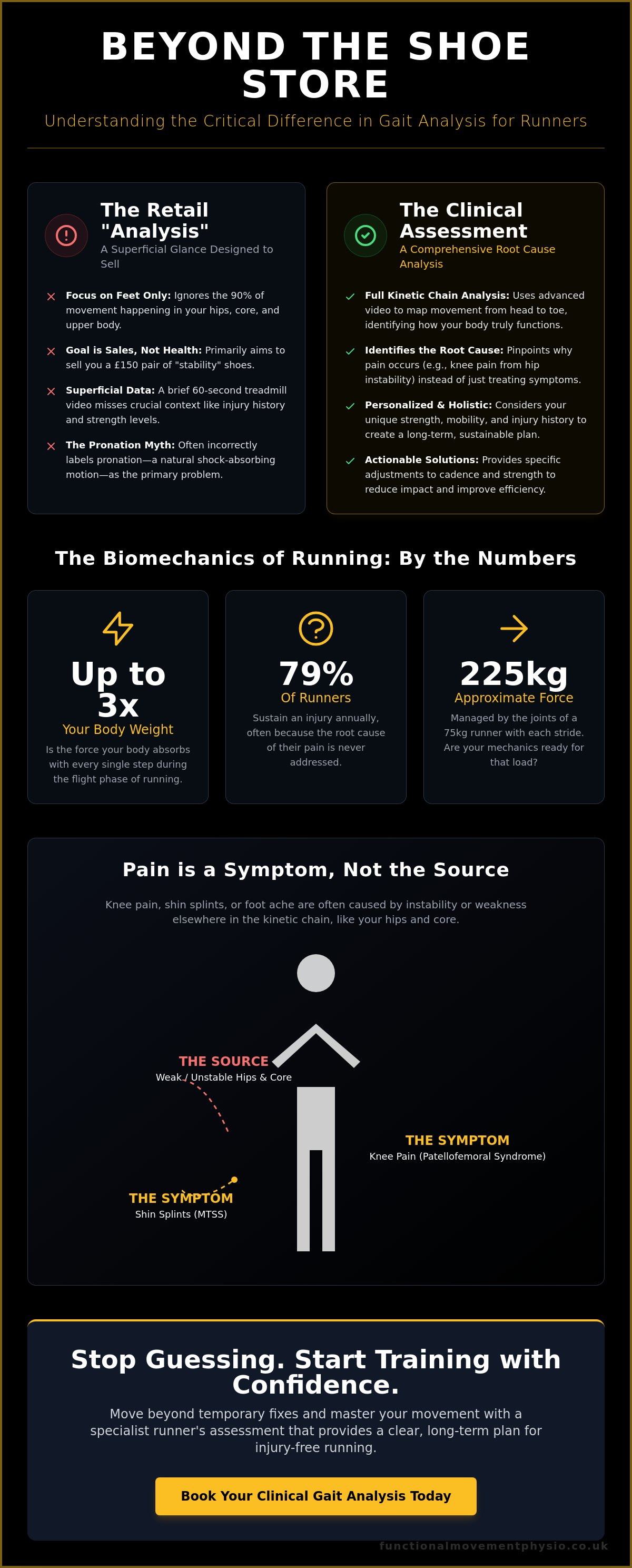
Many people assume that running is just walking at a faster pace, but the biomechanics are fundamentally different. Running involves a flight phase where both feet are off the ground simultaneously. This means that when you land, your body must absorb up to three times its total weight with every single step. If you weigh 75kg, your joints are managing approximately 225kg of force repeatedly. A specialist assessment identifies if your joints are prepared for these specific loads or if your current mechanics are placing undue stress on your tissues.
Why Liverpool runners need a professional assessment
Preparing for the Liverpool Half Marathon requires high mileage and significant repetitive strain. Local terrain variations, from the flat stretches of the Promenade to the hilly suburbs of Woolton, demand a lot from your body. Relying on a retail store's treadmill test is often insufficient because those tests focus on selling footwear rather than clinical health. Specialist physiotherapy in Liverpool provides the clinical oversight necessary to keep you on the road. We look at your strength, range of motion, and injury history to ensure your gait analysis for runners leads to a plan that is sustainable for the long term.
By investing in a professional assessment, you stop guessing and start training with confidence. We focus on the functional capacity of your body, ensuring you can navigate the 13.1 miles of a half marathon or a simple 5k loop without the fear of your body letting you down.
The Problem: Why Your Retail Gait Analysis Failed You
Many runners in Liverpool start their recovery journey at a local sports shop. You spend 60 seconds on a treadmill while a retail assistant films your ankles from behind. They point to a few degrees of inward roll and tell you that you "over-pronate," before suggesting a pair of stability shoes costing £150. While this feels like a professional service, it's often a superficial look at a complex physical process. Retail assessments are designed to sell shoes, not to fix the musculoskeletal imbalances that cause your knee or hip pain.
A systematic review on running gait analysis highlights that clinical accuracy requires sophisticated technology and a deep understanding of biomechanical variables. Most shop-based tests ignore your injury history, your current strength levels, and how your body manages load. When you rely on a 2D video of your heels, you miss the 90% of the movement happening above the ankle. This is why many runners find that their new, expensive footwear only masks the pain for a few weeks before the familiar ache returns.
The myth of the perfect running shoe
Shoes are tools for comfort and protection, but they aren't a cure for physical dysfunction. You can buy the most advanced carbon-plated shoe on the market, but it won't fix a dormant gluteus medius or a stiff thoracic spine. If your hip drops every time your foot hits the pavement, a stability shoe won't stop that force from travelling into your knee joint. Research suggests that up to 79% of runners sustain an injury annually; many of these individuals are wearing the "correct" shoes for their foot type. Fixing the movement pattern is always more sustainable than simply changing the equipment.
Why pronation is not the enemy
Pronation has been unfairly demonised in the running community. In reality, it's a natural and necessary movement that allows your foot to absorb shock. When you run, your body must manage forces equivalent to 2.5 to 3 times your body weight with every stride. Pronation is your body's built-in suspension system. Over-correcting this movement with rigid "motion control" shoes can sometimes cause more harm than good, often leading to issues like lateral knee pain or stress fractures. A clinical gait analysis for runners looks at why you might be over-pronating, such as weak hip stabilisers, rather than just trying to wedge the foot into a neutral position.
Generic retail fixes fail because they don't address how your hips and core function during the gait cycle. If you've already tried multiple pairs of shoes without lasting relief, it's time to examine your movement patterns more closely to find a permanent solution.
The Root Cause Approach: Looking Beyond Your Feet
Most runners assume that their foot strike is the only factor determining their injury risk. It is a common misconception that leads to recurring frustration. We look at the entire kinetic chain from your head to your toes. Your body functions as a single, integrated unit; a restriction in your upper back or a lack of stability in your core can manifest as pain in your ankle or foot. If one link in this chain is weak, another part must overwork to compensate.
Take your knees, for example. Pain in your knee is frequently caused by a lack of stability in your hips rather than a problem with the joint itself. Our comprehensive gait analysis for runners identifies the specific muscle weaknesses that lead to poor form. We don't just want to stop the pain today. We focus on your long-term movement health rather than immediate symptom relief, ensuring you don't end up back on the treatment table three months later.
The role of hip and pelvic stability
If your pelvis drops or tilts excessively when you run, your knees and ankles pay the price. This lack of control, often referred to as a pelvic drop, puts immense stress on the lower limbs with every stride. Weak gluteal muscles are a primary driver of common issues like runners knee. A specialist assessment tracks these subtle movements that a standard treadmill camera might miss. By identifying these imbalances, we can create a targeted strengthening programme to stabilise your foundation.
Biomechanical efficiency and performance
Efficiency is the secret to longevity in running. Efficient runners use less energy and can run further with less fatigue because they aren't fighting their own bodies. We analyse your cadence and stride length to find your most efficient rhythm. Clinical research suggests that increasing your step rate by just 5% to 10% can significantly reduce the impact forces on your hip and knee joints. Our gait analysis for runners helps you reach your performance goals faster and more safely by refining these technical elements. Improving your form isn't just about injury prevention; it's about unlocking your true potential on the road or trail.
Actionable Steps to Improve Your Running Form
Once your gait analysis for runners has identified specific inefficiencies, the next step is implementation. Improving your form isn't about a complete overhaul overnight. It's about making deliberate, incremental adjustments that reduce the mechanical stress on your musculoskeletal system. When you understand how your body moves, you can transition from reactive treatments to proactive performance.
One of the most effective changes you can make is increasing your running cadence. Research suggests that increasing your step rate by just 5% to 10% can significantly decrease the impact forces on your hip and knee joints. This small shift helps you land with your foot closer to your centre of mass, preventing the heavy braking force associated with overstriding. You should also focus on a soft landing. If your feet make a loud slapping sound against the pavement, you're likely absorbing too much shock through your bones rather than your muscles. Aim for a quiet, light footfall to engage your natural shock absorbers.
Preparation is equally vital for long-term health. A dynamic warm-up primes your nervous system and increases blood flow to your muscles. Spending 8 to 10 minutes on active movements ensures your body is ready for the specific demands of running, which reduces the risk of acute strains. By priming your glutes and core before you hit the road, you ensure your primary movers are doing the heavy lifting.
Simple drills for better mechanics
Drills are essential for rewiring your movement patterns and improving leg cycle efficiency. Incorporate high knees and butt kicks into your pre-run routine for 20 metres each to encourage a more fluid stride. Practise single-leg balance exercises, aiming for 30-second holds on each side, to build essential stability in your ankles and hips. To maintain a consistent rhythm, use a metronome app set to your target cadence. This provides a clear auditory cue that helps you stay on track, especially when fatigue sets in during the final miles of your run.
Strength and conditioning for longevity
Building a resilient body is the only way to ensure long-term health. Your gait analysis for runners might reveal that your glutes or core muscles aren't providing enough support, leading to compensations that cause pain. Focus on functional movements like lunges and step-ups that mimic the single-leg nature of running. Consistency is the priority here; performing two 20-minute strength sessions per week is far more effective for injury prevention than sporadic, high-intensity workouts. By mastering your own body through targeted conditioning, you move beyond symptom management toward true physical freedom.
If you're ready to stop guessing and start moving with confidence, our team is here to help you bridge the gap between pain and performance.
Book your clinical gait analysis today to begin your journey toward sustainable, pain-free running.
Master Your Movement with a Specialist Runner’s Assessment
A standard gait analysis for runners often stops at the ankle. At Functional Movement Physio, we believe your movement deserves a more comprehensive approach. Our Specialist Runner’s Assessment Package isn't a retail gimmick designed to sell you shoes. It's a clinical evaluation designed to identify the specific biomechanical inefficiencies that lead to injury. We focus on the root cause of your discomfort so you can stop guessing and start progressing. By looking at the entire kinetic chain, we help you understand why a certain muscle or joint is overloaded. This clarity is the foundation of your long-term health and performance.
We provide more than just a basic video analysis. You receive a full biomechanical screen that assesses how your body functions as a complete system. Most running injuries are the result of repetitive stress on tissues that aren't prepared for the load. By identifying these weak links, we can create a tailored strength plan that addresses your specific needs. This isn't about generic exercises; it's about targeted interventions that build resilience. We want to empower you to take control of your recovery so you can run freely without the constant fear of a flare-up.
What is included in our assessment?
Our process is thorough because sustainable recovery requires precision. We don't just watch you run; we analyze how your body handles the stress of every stride. Your assessment begins with a detailed clinical history and physical examination of your joints and muscles. We look for subtle compensations or mobility restrictions that often go unnoticed in a standard gym setting. We then conduct a video gait analysis for runners using professional software to provide real-time feedback on your unique technique. Finally, you receive a personalised roadmap. This plan is designed to bridge the gap between your current pain and the activities you love, ensuring you have a clear path back to peak performance.
Book your gait analysis in Liverpool today
Don't let a small niggle turn into a long-term injury that stops you training. Resilience isn't about running through pain; it's about addressing underlying dysfunction before it limits your lifestyle. Our clinic is conveniently located for runners across the Liverpool area who are tired of temporary fixes and want a professional, evidence-based approach to recovery. We're here to provide the clinical authority and support you need to master your movement and achieve your goals.
You don't have to settle for conflicting advice or the frustration of recurring injuries. You can book your appointment online to start your recovery journey today. Take the first step toward pain-free running and sustainable progress with a team that values your long-term wellness as much as you do.
Reclaim Your Running Potential
Running shouldn't be a cycle of recurring injury and frustration. Most retail assessments only look at your shoes, but a clinical gait analysis for runners identifies exactly how your body moves from your hips to your toes. By shifting the focus from temporary symptom relief to addressing your specific biomechanical imbalances, you can finally stop guessing and start progressing. You deserve a movement strategy that's as dedicated as your training plan.
Our approach combines expert clinical biomechanical analysis with personalised strength and conditioning plans. We don't just want to get you back on the pavement; we focus on specialist long-term injury prevention so you can stay there. It's time to move with confidence and build a body that's resilient enough for every mile ahead. Mastering your movement is the foundation of peak performance and longevity.
Book your specialist gait analysis in Liverpool today and take the first step toward pain-free, functional movement. We're here to help you master your form and get back to doing what you love.
Frequently Asked Questions
What should I wear for a gait analysis for runners?
You should wear form-fitting athletic clothing such as shorts and a technical t-shirt or vest. This allows the clinician to clearly observe the movement of your hips, knees, and ankles during the assessment. Loose-fitting joggers or baggy hoodies can hide subtle biomechanical errors, so choosing clothing that reveals your joint alignment is essential for an accurate and professional evaluation.
How long does a clinical gait analysis take?
A clinical gait analysis for runners usually takes 60 minutes to complete. This hour is divided into a detailed discussion of your training history, a physical movement screening, and a video analysis on the treadmill. We ensure the session is never rushed, allowing us to identify the root cause of your discomfort and provide a clear, evidence-based explanation of the findings.
Do I need to bring my old running shoes to the appointment?
You must bring your current running shoes and any previous pairs you still have available. The wear patterns on the outsoles of your shoes provide 100 percent objective data about your foot strike and loading patterns over hundreds of miles. This evidence helps us understand how your footwear interacts with your unique anatomy and whether your current shoes are supporting your long-term goals.
Can gait analysis help if I am not currently injured?
Yes, a gait analysis for runners is highly effective for performance optimization and proactive injury prevention. You don't need to be in pain to benefit from a deeper understanding of your biomechanics. By identifying small inefficiencies now, we can implement a strength strategy that reduces your risk of future injury, especially as 50 percent of runners experience injury annually.
Is gait analysis only for professional athletes?
Professional gait analysis is for every runner, regardless of your pace, age, or experience level. While elite athletes use this data to find marginal gains, recreational runners benefit significantly as they often lack the same strength foundations. Given that 80 percent of running injuries are caused by repetitive strain, having a professional assess your mechanics is a smart move for anyone wanting to stay active.
What happens if the analysis shows I have poor running form?
If the analysis reveals inefficiencies, we will create a structured plan to improve your technique. We don't believe in changing your form for the sake of it. Instead, we focus on 1 or 2 specific cues or exercises that reduce the load on vulnerable tissues. This targeted approach ensures you can make sustainable changes to your movement without feeling overwhelmed or losing your natural rhythm.
How often should a runner have their gait analysed?
We recommend having your gait analysed every 12 months or whenever you significantly change your footwear or training volume. If you are currently working through a rehabilitation programme, a follow-up session after 6 to 8 weeks is often beneficial. This allows us to track your progress and ensure that your movement patterns are successfully adapting to the corrective exercises we have implemented for you.
Will I get a specific exercise plan after my assessment?
You will receive a bespoke exercise programme designed to address the specific imbalances identified during your session. This plan typically includes 3 or 4 high-impact exercises that focus on the root cause of your issues rather than just the symptoms. By following this tailored advice, you can build the resilience needed to return to the road and achieve your personal performance milestones with confidence.