Shockwave Therapy for Plantar Fasciitis in Liverpool: Resolving the Root Cause

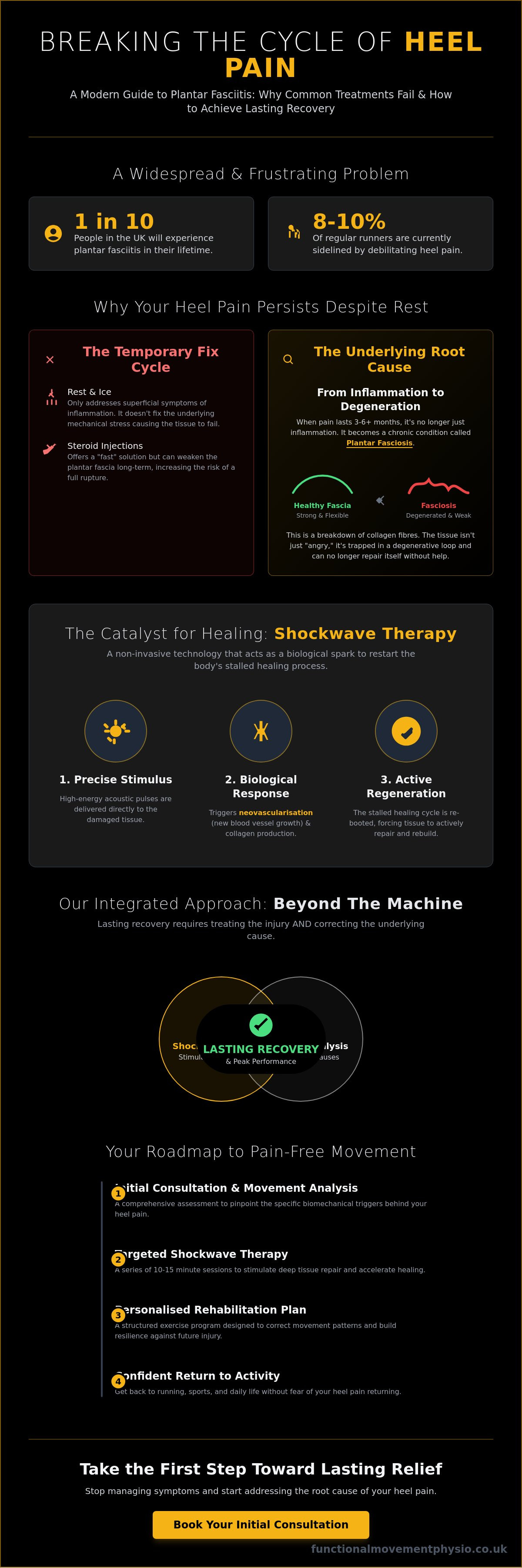
Approximately 1 in 10 people in the UK will experience the debilitating sting of plantar fasciitis at some point in their lives. For the 8% to 10% of regular runners currently sidelined, the frustration of sharp heel pain during those first morning steps is a daily reality. You have likely tried rest and ice, or perhaps researched shockwave therapy for plantar fasciitis, only to find yourself limping again after a walk through Liverpool. It's disheartening when generic advice fails to provide the long term relief you need to stay active.
You deserve more than a temporary fix. You need to understand why this pain started and how to stop it for good. This article explores how shockwave therapy acts as a biological spark for healing, particularly for refractory cases. While NICE guidance 200, which was migrated to updated recommendations in January 2026, notes that evidence for efficacy can be inconsistent, we've found that combining this technology with a functional movement approach is the key to lasting recovery.
We will outline how to identify your specific biomechanical triggers and create a clear roadmap to get you back to peak performance. We're moving beyond symptom management to ensure you can return to the activities you love with total confidence in your body's resilience.
Key Takeaways
- Learn how shockwave therapy for plantar fasciitis uses acoustic energy to stimulate tissue repair; this provides a non-invasive alternative to injections or surgery.
- Understand why resting and icing often fail to provide lasting relief by only treating symptoms rather than the underlying mechanical causes.
- Discover how movement analysis identifies hidden contributors like calf tension and ankle stiffness to prevent your heel pain from returning.
- See how a structured recovery plan and a thorough Initial Physiotherapy Consultation provide the clarity you need to return to the gym or running.
What is shockwave therapy for plantar fasciitis?
Shockwave therapy for plantar fasciitis is a non-invasive medical treatment that uses high-energy acoustic pulses to stimulate healing in the soft tissues of the foot. It's a sophisticated method of delivering mechanical energy directly to the site of injury. Extracorporeal shockwave therapy acts as a biological catalyst for tissue repair, effectively triggering the body's natural healing response in areas where recovery has stalled. This approach provides a powerful alternative to invasive options like corticosteroid injections or surgery, which often come with longer recovery times and greater risks.
For many, heel pain is a transient issue that resolves with basic stretching. However, data suggests that approximately 20% of cases become chronic, lasting well beyond the typical healing window. If you've reached the six-month mark without progress despite trying rest and ice, your body may need an external stimulus to restart the repair cycle. We use this technology to bridge the gap between failed conservative care and the need for more drastic surgical measures. It's about moving from managing pain to actively facilitating recovery.
The science of healing: How it works
The mechanical stimulus provided by the shockwaves triggers a physiological process called neovascularisation. This is the growth of new blood vessels within the damaged plantar fascia, which significantly improves nutrient delivery and waste removal in the area. By increasing local circulation and stimulating the production of collagen, the therapy helps the body repair the microscopic tears that characterise chronic heel pain. In many long-term cases, the healing process has effectively stalled because the tissue has become stuck in a degenerative loop. The therapy re-boots this process. It forces the tissue back into an active state of regeneration.
Why Liverpool runners choose shockwave
Active individuals across Liverpool, from those training for the half marathon to weekend walkers at Sefton Park, value this treatment because it fits seamlessly into a busy lifestyle. A typical session lasts between 10 and 15 minutes. Because it's non-invasive, there is no downtime. You won't need to worry about the limping or prolonged rest periods that follow surgical interventions. The treatment is highly focused. It targets the specific area of pain where the fascia attaches to the heel bone. This precision allows us to address the injury directly, helping you stay active in the local community while your body rebuilds itself.
The problem: Why your heel pain persists despite rest
You have likely spent weeks resting your foot, icing the heel every evening, and hoping the pain will simply vanish. It is a common story in our Liverpool clinic. The reality is that resting and icing only address the superficial symptoms of inflammation. They don't touch the underlying mechanical stress causing the tissue to fail. If your heel pain has persisted for more than three months, it's likely transitioned from a simple inflammatory response to a degenerative condition known as plantar fasciosis. In this state, the tissue isn't just "angry"; it's actually breaking down.
Many people mistake this for a constant state of acute inflammation. However, chronic cases involve the actual degeneration of collagen fibres within the fascia. Masking this pain with anti-inflammatory medication or relying on generic, over-the-counter insoles often does more harm than good. These interventions function as temporary crutches. They allow you to continue walking with poor mechanics without addressing the movement dysfunction that caused the micro-tears in the first place. By the time you seek shockwave therapy for plantar fasciitis, your body has usually reached a point where it can no longer repair itself without a specific external stimulus.
The failure of quick fixes
Steroid injections are frequently offered as a "fast" solution, but they come with a significant catch. While they might provide short-term relief, repeated injections can actually weaken the plantar fascia and increase the risk of a full rupture. Similarly, stretching your calves in isolation rarely fixes the issue if your overall gait and foot strike are the primary drivers of the stress. To get back to your weekend runs at Sefton Park or your sessions at the gym, you need a strategy that looks at how your whole body moves. When standard conservative treatments fail after six months, the NICE guidelines on shockwave therapy suggest it as a viable and safe intervention for refractory cases.
The frustration of chronic heel pain
Dealing with chronic heel pain is physically and mentally exhausting. It doesn't just stay in your foot; it changes how you walk. You might find yourself shifting your weight to the other side or walking on the outside of your foot, which eventually leads to secondary issues like hip or lower back pain. This cycle of compensatory movement creates a genuine fear of activity. Many of our patients stop exercising because they are afraid of worsening the injury. This deconditioning makes the recovery process even longer and harder. We understand the mental toll of feeling stuck and unable to move freely. If you're ready to stop guessing and start a structured recovery, you can book a thorough assessment to find the true source of your pain.
The root cause approach: Beyond the shockwave machine
Many clinics treat shockwave as a standalone magic wand. We take a different approach. We use shockwave therapy for plantar fasciitis to effectively dampen your pain and restart the healing process, but we rely on comprehensive movement analysis to ensure that pain stays away. Your foot doesn't operate in a vacuum. It is the final link in a complex kinetic chain that starts at your hips and moves through your knees and ankles. If you only treat the heel, you are ignoring the biomechanical engine that likely drove the injury in the first place.
Identifying the "why" behind your condition requires looking further up the body. Often, persistent heel pain is rooted in restricted ankle mobility or excessive calf tension that forces the plantar fascia to work significantly harder than it was designed to. By utilising gait analysis liverpool, we can pinpoint exactly where your movement patterns are failing and identify the root cause of the mechanical overload. This data-driven approach moves you away from guesswork and toward a targeted solution.
Functional movement and foot health
Our assessment examines how your entire body coordinates during movement. If your glutes aren't firing correctly or your hips are unstable, your feet often compensate by absorbing excessive force. This constant overloading leads to the degenerative micro-tears we discussed earlier. Integrating pilates liverpool into your rehabilitation can be a vital tool. It helps build the core stability and functional strength needed to support your feet, ensuring your movement is efficient rather than destructive. We focus on making you a more resilient mover, not just a patient with less pain.
Integrating shockwave into a wider plan
Shockwave therapy for plantar fasciitis provides a crucial window of relief. In chronic cases, the pain is often so severe that performing necessary corrective exercises feels impossible. By reducing sensitivity in the heel, the therapy allows you to engage with a personalised loading programme without the debilitating sting of every step. This isn't a generic set of stretches; it is a progressive roadmap designed to build actual tissue resilience. We don't just want to get you back to the gym; we want to ensure your body is strong enough to handle the demands of your lifestyle long-term. Recovery here is a journey from limitation to total functional mastery.
What to expect: Your shockwave journey in Liverpool
Understanding the logic behind your recovery is essential, but knowing what happens during the actual appointment helps alleviate any lingering anxiety. A standard course of shockwave therapy for plantar fasciitis typically involves three to five sessions. We space these appointments approximately seven days apart to allow your tissues enough time to respond to the mechanical stimulus and begin the regenerative process. Each session is efficient. The shockwave delivery itself takes between 10 and 15 minutes, making it easy for you to prioritise your health without disrupting your entire day.
During the treatment, you will feel a rhythmic tapping or pulsing sensation against your heel. While this can be slightly uncomfortable, it is entirely manageable and should never feel unbearable. We don't believe in a one size fits all approach to intensity. Instead, we constantly communicate with you to adjust the energy levels based on your feedback. This ensures the treatment is powerful enough to trigger a healing response while remaining within your comfort zone. It's a collaborative process designed to get you back to peak performance.
Step-by-step treatment process
We begin by applying a clear conducting gel to the skin over your heel and arch. This gel is necessary to ensure the acoustic energy waves travel efficiently from the machine into your injured tissue without losing power. Once the area is prepared, we use a hand-held probe to deliver the energy directly to the site of the micro-tears. The focus is always on the specific points of tenderness we identified during your assessment. We conclude the session by reviewing your movement homework. These specific exercises are vital because they guide the newly stimulated tissue to heal in a way that supports functional movement.
Preparation and aftercare
To make the most of your appointment, we recommend wearing comfortable clothing and footwear that allows easy access to your feet. One of the most important preparation steps is to avoid taking anti-inflammatory medication, such as Ibuprofen, for at least 48 hours before your session. These medications can dampen the natural inflammatory response we are trying to restart to jump-start your healing. After the session, you can walk normally and go about your daily routine. However, we advise avoiding high-impact exercise, such as running or heavy gym work, for 48 hours. This rest period allows the treated area to settle and begin the repair cycle effectively. If you are ready to start your recovery, you can book your shockwave consultation today.
Taking the first step toward pain-free movement
Your recovery doesn't begin with a machine; it begins with a conversation. The first step in our process is a comprehensive Initial Physiotherapy Consultation. During this session, we look far beyond the localised pain in your heel to understand your injury history, your daily movement habits, and your specific athletic goals. We don't just treat the foot; we assess you as a complete individual. Whether you are a marathon runner aiming for a personal best or a gym-goer who simply wants to stand without a sharp sting, our approach is tailored to the life you want to lead.
Sustainable results are never the product of a passive treatment. They come from a dedicated partnership between your commitment to the process and our clinical expertise. Our Liverpool clinic is a space designed for empowerment. We provide the technical tools, such as shockwave therapy for plantar fasciitis, to resolve the biological stall in your healing. However, the true transformation happens when we help you master your own movement patterns. This ensures that once the pain is gone, it stays gone. We are here to help you regain the confidence to move at full capacity without the fear of a relapse.
Why choose our Liverpool clinic?
Our team consists of specialists in sports injuries and chronic pain rehabilitation. We have spent over 10 years refining our methods to move away from the "revolving door" model of healthcare, where patients often return for the same issue every three to four months. By focusing on long-term solutions, we help you build a body that is more resilient than it was before the injury. We are conveniently located for residents across Liverpool, providing a modern, professional environment where high-performance movement is the standard. Our goal is to move you from a state of limitation to one of total functional freedom.
Book your assessment today
It's time to stop letting heel pain dictate your training schedule or your weekend plans. You don't have to accept a life of limping or "managing" discomfort with temporary fixes. Taking the first step is simple. Book a consultation to determine if shockwave therapy for plantar fasciitis is the right intervention for your specific case. We will provide you with a clear, evidence-based roadmap to full recovery. Visit our booking page to secure your appointment and start your journey back to pain-free movement.
Reclaim your active lifestyle in Liverpool
Chronic heel pain shouldn't be the reason you stop running or attending the gym. You now understand that while shockwave therapy for plantar fasciitis is a powerful tool to restart the healing process, it is only one part of a successful recovery. Lasting relief comes from identifying the specific biomechanical imbalances that caused the initial stress on your fascia. By combining advanced technology with our evidence-based root cause approach, we move beyond temporary fixes to ensure you achieve sustainable movement.
Our expert Liverpool physiotherapy team is dedicated to providing more than just symptom management. Through specialist runner assessments and personalised loading programmes, we help you master your body's mechanics and build genuine resilience. You don't have to navigate this journey alone or rely on conflicting advice that leads to further frustration. We focus on the transition from limitation to peak performance.
Take the first step toward lasting recovery today. Book your initial consultation and shockwave assessment in Liverpool to finally resolve the source of your pain. We look forward to helping you return to the activities you love with total confidence in your body.
Frequently Asked Questions
Is shockwave therapy for plantar fasciitis painful?
Shockwave therapy for plantar fasciitis is generally described as slightly uncomfortable rather than painful. You will feel a rhythmic tapping sensation that can be intense, but it shouldn't be unbearable. We constantly adjust the settings based on your feedback during the 15 minute session. Most patients find the discomfort subsides quickly once the treatment ends, leaving a dull ache similar to the feeling after a deep tissue massage.
How many sessions of shockwave therapy will I need?
You will typically need between three and five sessions to achieve the best results. We space these appointments approximately seven days apart to ensure your body has sufficient time to respond to the mechanical stimulus. While some patients notice a change after two visits, completing the full course is essential for long term tissue remodelling. If your condition is particularly chronic, we may extend the plan to six sessions.
When will I start to feel an improvement in my heel pain?
You might experience a temporary reduction in pain immediately after your first session due to the analgesic effect of the acoustic waves. However, the actual biological repair of the tissue is a slower process. Most individuals report a significant, lasting improvement in their symptoms approximately 8 to 12 weeks after their final treatment. This timeline reflects the time your body needs to produce new collagen and strengthen the fascia.
Are there any side effects to shockwave therapy?
Side effects are generally mild and resolve within a few days. You might notice some slight reddening of the skin, minor swelling, or small bruises around the heel area. Some patients experience a temporary increase in their usual pain or a dull ache for 24 to 48 hours following the procedure. These are normal signs that the body's inflammatory healing response has been successfully restarted to facilitate repair.
Can I run or exercise between shockwave therapy sessions?
You must avoid high impact activities like running or jumping for 48 hours after each session. This rest period is vital because the therapy temporarily increases the sensitivity of the tissue as it begins the repair process. You can continue with low impact activities such as swimming or light cycling. We will provide you with specific, progressive loading exercises to perform between sessions to build resilience without overloading the heel.
Is shockwave therapy covered by private health insurance?
Many major UK private health insurance providers cover shockwave therapy for plantar fasciitis when it's part of a physiotherapy treatment plan. Policies vary, so it's important to contact your insurer and mention extracorporeal shockwave therapy to confirm your level of cover. We can provide any clinical receipts or treatment reports you need to facilitate your claim and ensure a smooth reimbursement process for your sessions.
Who should not have shockwave therapy?
Shockwave therapy is not suitable if you are pregnant, have a blood clotting disorder, or are taking anticoagulant medication. It's also contraindicated if you have an active infection or tumour in the foot area. If you have received a corticosteroid injection in your heel within the last 6 weeks, you must wait until that period has passed before starting shockwave to ensure the tissue is ready to respond.
What is the success rate of shockwave therapy for plantar fasciitis?
Clinical research shows that shockwave therapy has a success rate of 70% to 80% for patients who haven't responded to other conservative treatments. These results are most consistent when the procedure is integrated into a wider rehabilitation plan. By addressing the calf tension and ankle mobility issues found in 90% of our chronic cases, we help you achieve the long term results that the machine alone cannot provide.