Achilles Tendonitis Recovery: A Specialist Liverpool Physio Guide
What if the very stretches you are doing to fix your achilles tendonitis are actually the reason your recovery has plateaued for the last 12 weeks? You've likely spent your mornings gingerly hobbling through those first few steps or felt the frustration of missing another session at the gym because your heel just won't cooperate. It's deeply discouraging to follow conflicting online advice only to find yourself stuck in a cycle of temporary relief and recurring flare-ups. We understand that you don't just want the pain to stop; you want to regain your lifestyle without the constant fear of a setback.
At Functional Movement Physio, we believe you deserve a solution that looks beyond the surface. We promise to help you move beyond short-term fixes and resolve the true biomechanical root cause of your pain through specialist Liverpool-based physiotherapy. This guide provides a clear, evidence-based roadmap to get you back to running in Sefton Park or training at full intensity with the clinical confidence that your injury is a thing of the past. We'll explore the specific rehabilitation phases required to transition from limitation to peak functional performance.
If you're ready to stop managing symptoms and start your recovery today, book your appointment here: https://www.functionalmovementphysio.co.uk/book-appointment.
Key Takeaways
- Understand why complete rest often delays healing and how a structured loading programme builds the resilience your tendon requires.
- Identify the specific movement compensations and calf muscle weaknesses that act as the underlying root cause of your achilles tendonitis.
- Discover how Extracorporeal Shockwave Therapy (ESWT) can stimulate healing in chronic cases where traditional methods have failed.
- Follow a proven two-phase roadmap designed to transition you from initial pain management to full athletic performance.
- Learn how our specialist Liverpool clinic focuses on treating your unique biomechanics rather than just addressing your symptoms.
Understanding Achilles Tendonitis: Why Your Heel Pain Persists
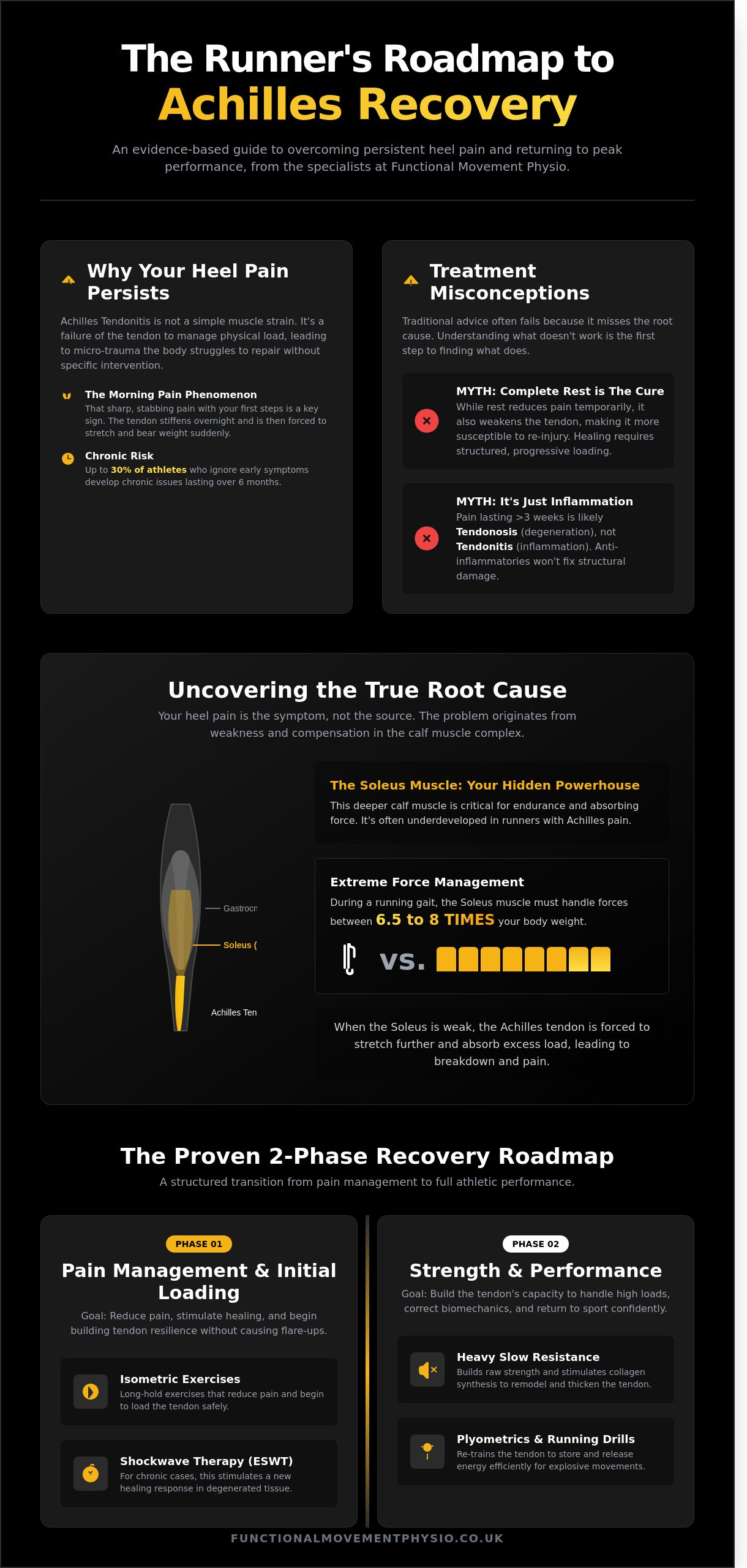
Achilles tendonitis isn't just a minor niggle that goes away with a few days of rest. For many Liverpool runners and gym-goers, it's a persistent barrier that halts progress and creates a cycle of frustration. This condition occurs when the tendon fails to manage the physical load placed upon it, leading to micro-trauma that the body struggles to repair without specific intervention. It's a common issue, yet many people misunderstand why the pain lingers long after they've stopped their sport.
To better understand this concept, watch this helpful video:
Many people adopt a "wait and see" approach, hoping the pain will subside naturally. However, clinical data suggests that up to 30% of athletes who ignore early symptoms develop chronic issues that last for more than six months. Resting might provide temporary relief, but it doesn't address the underlying biomechanical issues. At Functional Movement Physio, we focus on identifying the root cause of your dysfunction rather than just masking the symptoms. For a deeper look at the clinical background, you can review this Achilles tendinopathy overview which details the various stages of the condition.
The Morning Pain Phenomenon
The sharp, stabbing sensation you feel during those first few steps out of bed is a hallmark of achilles tendonitis. During sleep, the tendon remains in a shortened position and lacks consistent blood flow. When you stand up, you're asking a stiff, cold tissue to stretch and bear your full body weight immediately. While you might find that you can "walk it off" after ten minutes, this isn't a sign of recovery. It's simply the tendon warming up through movement. Relying on this temporary loosening is a dangerous strategy that often leads to further structural damage and long-term limitation.
Tendonitis vs Tendonosis: Why It Matters
The distinction between these two terms is vital for your recovery path. Tendonitis implies an acute inflammatory response, typically occurring within the first 48 to 72 hours of an injury. In contrast, tendonosis refers to the chronic degeneration of the tendon's collagen fibres. If your pain has persisted for more than three weeks, you're likely dealing with structural changes rather than simple inflammation. This is why anti-inflammatory medications often fail to provide long-term results; they're attempting to treat a chemical problem when the actual issue is mechanical. A tailored rehabilitation programme is necessary to stimulate the tendon to rebuild its strength and capacity.
If you're tired of temporary fixes and want to return to peak performance, we're here to help you master your movement. You can book a comprehensive assessment to find your long-term solution here: https://www.functionalmovementphysio.co.uk/book-appointment
Beyond the Symptoms: Finding the Root Cause of Achilles Pain
Many patients arrive at our Liverpool clinic having already tried ice, rest, or generic stretching without success. This cycle of temporary relief followed by a return of pain is frustrating. It happens because traditional approaches often focus on the site of pain rather than the mechanical source of the dysfunction. Achilles tendonitis is rarely an isolated issue; it is typically the final result of movement compensation elsewhere in your body.
When one part of your kinetic chain underperforms, the Achilles tendon is forced to absorb the excess load. This is why our assessments in Liverpool look far beyond the heel. We examine how you move as a complete system to identify why the tendon became overloaded in the first place. You can speak with a specialist to begin this comprehensive diagnostic process and move towards a long-term solution.
The Calf Complex and Power Generation
The calf is not a single muscle but a complex system consisting of the gastrocnemius and the soleus. These muscles have different roles in how they manage force. The soleus is particularly critical for endurance; it can handle forces between 6.5 and 8 times your body weight during a running gait. If the soleus lacks the necessary strength, the Achilles tendon must compensate by stretching further and working harder to provide propulsion.
Many rehabilitation programmes fail because they rely solely on standing calf raises. While these are useful, they primarily target the gastrocnemius. To truly resolve the issue, we must incorporate bent-knee loading to isolate the soleus. Current evidence-based Achilles treatment suggests that a failure to address these specific strength deficits is a leading cause of injury recurrence. We ensure your loading plan is tailored to these anatomical nuances to build genuine resilience.
Biomechanical Links: From Hip to Heel
Your hip stability dictates how your foot interacts with the pavement. If your gluteal muscles are unable to control your thigh bone, the entire leg may rotate inward. This internal rotation creates a twisting force on the Achilles tendon rather than a clean, vertical pull. Over time, this mechanical stress leads to micro-tears and chronic inflammation that won't resolve with rest alone.
We also evaluate how your footwear and foot mechanics play into this equation. While orthotics can provide temporary support, they are often a temporary fix if the underlying movement patterns aren't corrected. Common triggers we identify include:
- Poor pelvic control that leads to an uneven stride length and asymmetrical loading.
- Reduced ankle dorsiflexion which forces the foot to pronate excessively to find range.
- Inadequate gluteal activation during the "toe-off" phase of running, placing 20% more strain on the lower leg.
By identifying these specific faults, we move from simply managing your pain to mastering your movement. This holistic approach ensures that once you return to the gym or the track, you have the functional capacity to stay there. We focus on your unique biomechanical profile to ensure your recovery is sustainable and effective.
If you're ready to stop chasing symptoms and start addressing the root cause of your pain, we're here to help. You can book your full biomechanical assessment at our Liverpool centre via the link below.
Shockwave Therapy vs Traditional Rest: What Actually Works?
Many runners and gym-goers in Liverpool are told that total inactivity is the only way to heal. This advice is often well-intentioned, but it frequently leads to a frustrating cycle of recurring pain. If you have spent weeks on the sofa waiting for your pain to vanish, you have likely noticed that the first mile of your return run feels just as sharp as before. Understanding Achilles Tendonitis requires a shift in perspective. We don't just want to settle the symptoms; we want to build a resilient tendon that can handle the demands of your lifestyle.
The Problem with Prolonged Rest
Tendons are dynamic structures that thrive on tension. When you opt for complete rest, the achilles tendon begins to lose its structural integrity. This deconditioning means the tissue becomes less capable of absorbing force. Research indicates that even two weeks of total inactivity can significantly decrease tendon stiffness. Without mechanical stimulus, the root cause of your weakness remains unaddressed.
Optimal loading is the modern solution. We replace total rest with structured, progressive movements that challenge the tendon without overloading it. This approach ensures you don't lose muscle mass in your calves or functional range in your ankle. It's the difference between a temporary patch-up and a long-term recovery. We focus on transitioning you from rest to movement safely, ensuring every step is a move toward restoration rather than re-injury.
How Shockwave Therapy Accelerates Healing
Extracorporeal Shockwave Therapy (ESWT) provides a powerful biological boost for chronic cases of achilles tendonitis. It works by delivering acoustic energy through the skin to the site of the injury. This process stimulates mechanotransduction, which essentially tells your cells to start the repair process. It also increases local blood flow and desensitises overactive pain fibres.
- Ideal Candidates: Individuals who have experienced persistent pain for more than 12 weeks.
- The Process: A typical course involves 3 to 5 sessions, each lasting roughly 15 minutes.
- The Expectations: Clinical data shows a success rate of over 70 percent for chronic tendon issues when integrated with a loading programme.
At our Liverpool clinic, we don't use Shockwave as a standalone "magic wand." We combine it with bespoke rehabilitation to ensure we are stimulating the tissue while simultaneously teaching you how to move better. This combined approach is the gold standard in sports physiotherapy. It moves you away from passive treatments that only offer short-term relief and toward a solution that offers longevity. We want to empower you to master your own body and get back to the activities you love without the fear of a setback.
Take the first step towards a pain-free future and book your assessment here: https://www.functionalmovementphysio.co.uk/book-appointment
The Liverpool Runner’s Roadmap to Achilles Recovery
Recovery from achilles tendonitis is not a linear process of waiting for pain to vanish. It is a proactive, structured journey that shifts the focus from managing symptoms to rebuilding the structural integrity of the tendon. Many runners spend months in a cycle of rest and re-injury because they fail to address the root cause of their dysfunction. Our roadmap ensures you don't just return to the pavement; you return with a body that is more resilient than before your injury began.
The path to high-performance running involves four distinct stages designed to restore your functional capacity:
- Phase 1: Pain Management and Pattern Identification. We prioritise calming the irritated tissue. During these initial 14 days, we identify the specific biomechanical errors, such as over-pronation or poor hip stability, that are overloading the tendon.
- Phase 2: Progressive Loading. Tendons require mechanical tension to heal. We implement heavy slow resistance programmes, typically starting with three sets of 10 repetitions, to stimulate collagen repair and increase the tendon's "spring" capacity.
- Phase 3: Sports-Specific Drills. We transition you from the clinic to the track. This phase involves plyometric work and interval sessions along your favourite Liverpool routes, such as the flat stretches of the Otterspool Promenade.
- Phase 4: Long-Term Prevention. We solidify your gains. By maintaining a twice-weekly functional strength routine, you ensure the tendon can handle the 20% increase in volume often seen during peak marathon training.
The Importance of a Specialist Runner’s Assessment
Generic exercises found on the internet often fail because they don't account for your unique gait. Our specialist Runner’s Assessment service utilises high-definition video gait analysis to capture your movement at 60 frames per second. This allows us to spot subtle flaws in your foot strike or knee tracking that the naked eye misses. A bespoke plan isn't just a list of movements; it's a precise intervention tailored to your anatomy and your 2024 running goals.
Strength and Conditioning for the Long Term
Building a bulletproof Achilles requires a sophisticated blend of eccentric and isometric loading. These techniques don't just strengthen the muscle; they change the physical properties of the tendon itself. We often integrate Sports Massage into this phase to manage soft tissue tension in the gastrocnemius and soleus, ensuring your recovery isn't hindered by muscular knots or restricted blood flow.
This comprehensive preparation is vital if you are targeting the Liverpool Half Marathon or regular weekend loops around Sefton Park. A 2023 clinical review indicated that runners who follow a structured loading programme reduce their risk of recurrence by 65%. We empower you to master your own body, moving beyond temporary fixes to achieve lasting athletic longevity.
Ready to stop guessing and start your structured recovery today? Book your specialist assessment at our Liverpool clinic
Specialist Achilles Treatment at Functional Movement Physio Liverpool
We don't just treat the image on a scan. Clinical evidence suggests that many people have structural changes visible on an ultrasound that cause no pain at all. This is why our philosophy at the Moss Street clinic is to treat the person, not just the pathology. We focus on identifying the root cause of your achilles tendonitis rather than simply masking the symptoms with temporary fixes.
Your initial 60 minute consultation is a deep dive into your history and physical capabilities. We analyse your biomechanics to see how your whole body moves. Often, a calf issue is actually the result of poor hip stability or improper foot mechanics. By addressing these underlying factors, we provide a long term solution that prevents the injury from returning.
Our approach is built on a genuine partnership. We provide the clinical expertise and manual therapy, while you bring the commitment to your bespoke recovery programme. This collaboration is what allows our patients to move from a state of limitation to one of high performance. We're here to ensure you get back to doing what you love without the constant fear of re-injury.
Your Journey with Us
Your recovery follows a structured path from initial diagnosis to functional movement mastery. We use a multidisciplinary approach that combines expert physiotherapy with strength and conditioning principles. Liverpool residents trust our clinic because we understand the local sporting landscape, from the docks to the local running clubs.
We don't just want you to walk without pain. Our goal is to help you master your own body. Whether you're a marathon runner or a weekend gym enthusiast, we ensure your tendon is robust enough to handle the specific demands of your sport. We focus on 100% functional restoration, giving you the confidence to push your limits again.
Take the First Step to Pain-Free Movement
Early intervention is the most effective way to prevent acute pain from becoming a chronic condition. Data shows that 80% of patients who seek specialist help within the first month of symptoms experience a significantly faster return to sport. You don't have to accept Achilles pain as a permanent part of your life.
Our team is ready to guide you through every stage of your rehabilitation. We offer a supportive environment where your goals are our priority. It's time to stop guessing and start a professional recovery plan tailored to your unique needs. We provide the quiet confidence you need to overcome physical limitations.
Take the first step toward lasting relief and peak performance. You can book your assessment at our Liverpool clinic by visiting our booking page: https://www.functionalmovementphysio.co.uk/book-appointment.
Take the First Step Back to Peak Performance
Persistent achilles tendonitis shouldn't be the reason you hang up your running shoes or avoid the gym. True recovery requires moving past temporary fixes like ice and rest to address the actual root cause of your dysfunction. By identifying specific biomechanical triggers through our 4-stage assessment process, we ensure your rehabilitation is built on a foundation of long-term functional health rather than just short-term symptom relief.
Our Liverpool clinic provides targeted interventions designed for active individuals. We utilise Specialist Runner’s Assessment packages that include detailed gait analysis to pinpoint movement flaws. For those struggling with chronic issues, our expert Shockwave Therapy offers a clinically proven method to accelerate tissue repair, often showing significant improvement within 3 to 5 sessions. We also incorporate Clinical Pilates into our programmes to develop the core stability and strength needed for lasting resilience.
It's time to stop managing pain and start mastering your movement. Our team is ready to help you transition from limitation to freedom, ensuring you return to your sport stronger than before. Book your initial consultation at our Liverpool clinic today and regain control over your physical potential.
Frequently Asked Questions
How long does it take for Achilles tendonitis to heal with physio?
Most patients experience significant tissue remodelling and a return to full function within 12 to 16 weeks of starting a structured loading programme. While initial pain often subsides within the first 21 days, we focus on the root cause of your achilles tendonitis to ensure the tendon can handle high-impact forces again. This timeframe allows for the physiological changes required to strengthen the collagen fibres and prevent future flare-ups.
Can I keep running while recovering from Achilles tendonitis?
You can usually continue running if your pain levels remain below a 3 out of 10 on a visual analogue scale during and 24 hours after the session. We use biomechanical assessments to modify your gait or volume rather than forcing you into total rest. Research from 2023 indicates that complete inactivity actually weakens the tendon, so maintaining a managed level of activity is essential for your long-term recovery and performance.
Is stretching good or bad for Achilles tendonitis?
Static stretching is often counterproductive, especially in the 25% of cases involving insertional tendonitis where compression against the heel bone worsens the injury. We prioritise progressive loading over stretching because it addresses the underlying weakness rather than just masking the symptoms. Focusing on eccentric calf raises and isometric holds provides the structural integrity your body needs to move without restriction or recurring discomfort.
What is the best footwear for someone with Achilles pain?
Footwear with a 10mm to 12mm heel-to-toe drop is typically the most effective choice during the early stages of rehabilitation. This specific elevation reduces the tensile load on the tendon by approximately 15% compared to flat shoes or "minimalist" trainers. Our goal is to use this temporary support as a bridge while we work on your foot biomechanics, eventually allowing you to wear any footwear you choose with total confidence.
How many sessions of Shockwave Therapy will I need?
Clinical evidence suggests that 3 to 5 sessions of Extracorporeal Shockwave Therapy (ESWT), spaced 7 days apart, yield the best results for chronic tendon issues. This technology stimulates a pro-inflammatory response that jumpstarts healing in stagnant tissues. We combine this with manual therapy to ensure we aren't just treating the site of pain but are also addressing the movement patterns that caused the stress in the first place.
Why does my Achilles hurt more after I exercise?
Tendons have a unique latent response to load, which means pain often peaks 24 hours after your workout rather than during the activity itself. This delayed reaction occurs because the chemical irritants within the tendon take several hours to accumulate after mechanical stress. Monitoring this 24 hour window is a vital part of our partnership, as it tells us exactly how much load your body is currently able to tolerate.
What happens if I leave Achilles tendonitis untreated?
Leaving the condition unmanaged can lead to tendinosis, a degenerative state that increases the risk of a full tendon rupture by roughly 15%. Over time, your body will naturally compensate for the pain by altering your gait, which often leads to secondary issues in the hip or lower back. Addressing the root cause now protects your longevity and ensures you don't face a much longer, more complex rehabilitation process in the future.
Can Clinical Pilates help with my Achilles recovery?
Clinical Pilates is an exceptional tool for recovery because it addresses the 40% of Achilles injuries that stem from hip and pelvic instability. By improving your core control and gluteal strength, we reduce the "whipping" effect on the lower leg during movement. This holistic approach ensures your entire kinetic chain is functioning optimally, allowing you to get back to doing what you love with a body that feels resilient and empowered.
If you are ready to stop managing symptoms and start fixing the root cause of your pain, we are here to guide you. You can book your comprehensive assessment at our Liverpool clinic by visiting https://www.functionalmovementphysio.co.uk/book-appointment.