Ankle Sprain Recovery Liverpool: A Professional Rehab Guide

What if the standard advice to "just rest it" is actually the reason your ankle sprain keeps coming back? You have likely spent weeks on the sofa with an ice pack, only to feel that familiar, sickening instability the moment you try to return to the pavement or the pitch. It is incredibly frustrating to feel stuck in a cycle of "giving way" while trying to navigate conflicting advice from the internet that never seems to address why the injury happened in the first place.
We understand the fear that your ankle might never feel stable again, but recovery should be about more than just waiting for the swelling to go down. This guide will show you why standard rest often fails and how a root cause approach to ankle sprain recovery Liverpool can get you back to peak performance safely. By moving beyond symptom management, you can rebuild the resilience needed for a full return to running and sport.
In the following sections, we will break down the mechanics of chronic ankle instability and preview the professional rehab strategies that bridge the gap between physical limitation and optimized movement. You deserve a clear, evidence based path that restores your confidence and gets you back to the activities you love.
Key Takeaways
- Understand why traditional rest and icing often fail to address the underlying structural weaknesses that lead to recurring injuries.
- Learn how identifying the root cause of your pain, such as hip instability, is essential for a successful ankle sprain recovery Liverpool.
- Discover the three phase rehabilitation process designed to transition you from initial swelling relief to high performance strength.
- Explore how integrating clinical pilates and progressive loading can restore your confidence and stop your ankle from giving way.
Understanding the Reality of Ankle Sprain Recovery in Liverpool
A Sprained ankle involves stretching or tearing the lateral ligaments that provide essential support to your joint. The anterior talofibular ligament is the most frequently injured structure in these cases, typically damaged during a sudden roll or twist. While the immediate sharp pain and swelling are hard to ignore, they're only the beginning of the story. Professional ankle sprain recovery Liverpool focuses on more than just waiting for the discomfort to subside. It's about restoring your full functional capacity so you can move with complete confidence again.
In Liverpool, we frequently encounter active individuals and weekend warriors who are eager to get back to their sport or gym routine as quickly as possible. Rushing this process is a common mistake that often leads to long term issues. Returning to high impact activities before the ligaments have properly healed or the supporting muscles have been strengthened leads to chronic instability. This makes you much more likely to suffer a repeat injury, creating a frustrating cycle of "giving way" that keeps you sidelined for months at a time.
The Three Grades of Ankle Sprains
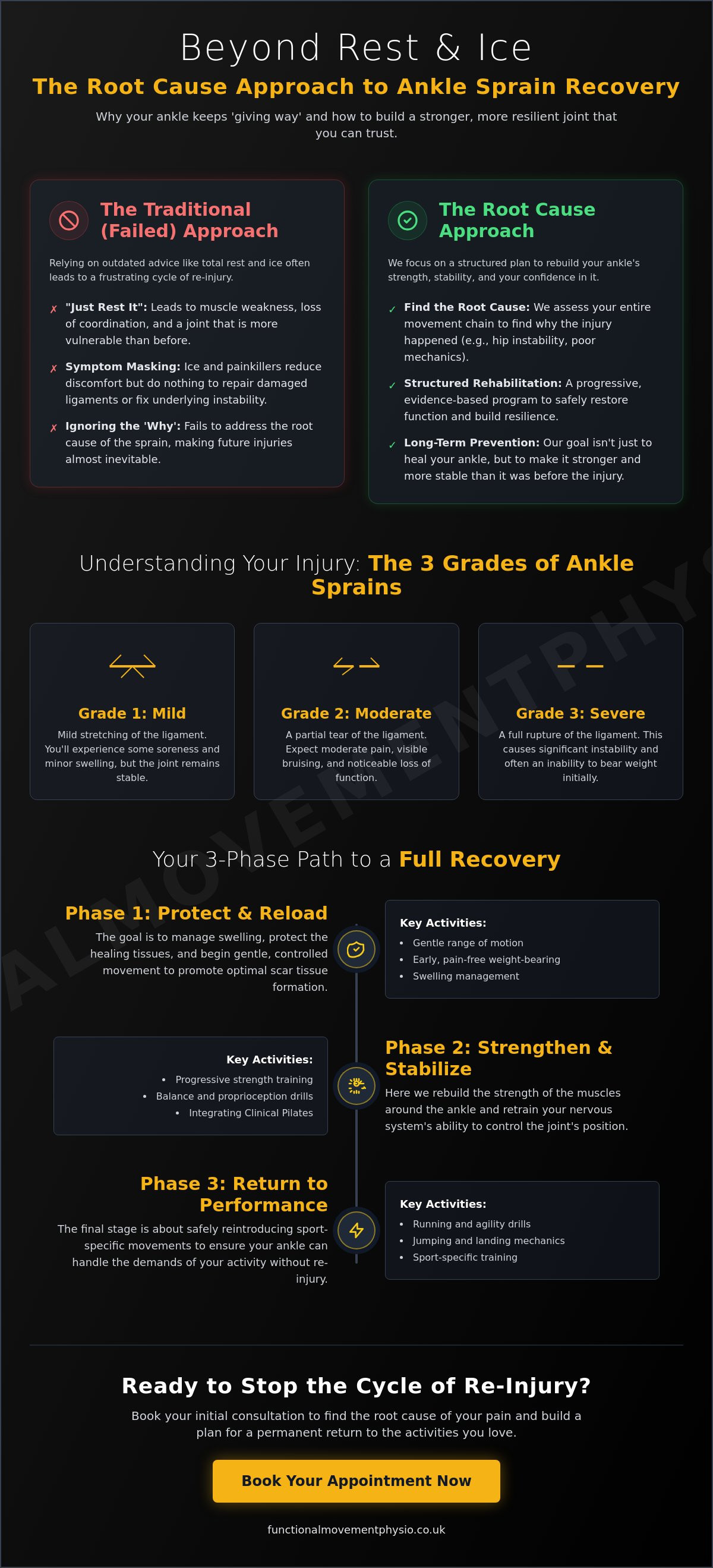
- Grade 1: This involves mild stretching of the ligament fibers without joint instability. You'll likely feel some soreness and minor swelling, but the structural integrity of the joint remains intact.
- Grade 2: This is a partial tear of the ligament. You'll experience moderate pain, visible bruising, and a noticeable loss of function during the initial weeks of your recovery.
- Grade 3: A full rupture of the ligament that often requires a longer, more structured rehabilitation process to regain stability. This level of injury involves significant instability and an inability to bear weight, necessitating a careful balance between protected healing and early mobilization.
Why Your Recovery Timeline is Personal
Your path to health depends on your unique history and physical baseline. If you've sprained the same ankle before, your nervous system's ability to sense your ankle's position may be compromised, requiring more focus on balance training. Your specific goals also dictate the intensity of your rehab. Training to return to running on the Liverpool waterfront requires a different level of lateral stability than simply walking to the office. Your baseline fitness acts as the foundation for this progress; a regular runner with strong calf and hip musculature may move through the early phases of rehab faster than someone who is less active.
The average recovery window for a Grade 2 sprain is typically six to twelve weeks. Successfully navigating ankle sprain recovery Liverpool means respecting these biological timelines while proactively challenging your body to adapt. Identifying the specific nature of your injury through an Initial Physiotherapy Consultation is the first step toward a permanent return to activity. We focus on the underlying mechanics of your movement to ensure your ankle doesn't just feel better, but actually becomes more resilient than it was before the injury.
The Problem: Why Resting and Icing Your Ankle is Not Enough
You have likely been told that Rest, Ice, Compression, and Elevation are the gold standards for injury care. While these steps might make the initial throbbing more bearable, they do very little to actually repair the damaged tissues. Total rest is often the enemy of a successful ankle sprain recovery Liverpool. By avoiding movement entirely, you are essentially telling your nervous system that the joint is no longer safe to use. This leads to a rapid decline in coordination and strength, leaving you more vulnerable than before the injury occurred.
Symptom based treatment fails because it views the injury in isolation. Taking ibuprofen might mask the pain so you can walk to your car, but it does nothing to address the underlying mechanical issue that caused your foot to roll in the first place. Quick fixes ignore how your body moves as a whole. If you don't address why your stability failed, you are simply waiting for the next sprain to happen. Without a structured rehabilitation program, your body will develop compensations that can lead to knee or hip pain further down the line.
The Downside of Prolonged Immobilisation
Keeping your ankle completely still for too long interferes with the natural healing process. Healthy scar tissue requires gentle, controlled stress to align its fibers correctly. Without this load, the tissue forms in a chaotic, weak pattern. Your balance and coordination, known as proprioception, begin to decline within just a few days of an injury. Muscle inhibition occurs almost instantly. Your brain may "turn off" the muscles in your calf and glutes to protect the area. This significantly weakens your leg and makes re-injury much more likely when you finally try to run again.
Moving from RICE to PEACE and LOVE
Modern sports medicine has moved away from RICE in favour of a more active framework. This approach is a critical turning point in your ankle sprain recovery Liverpool, shifting the focus from passive waiting to proactive rebuilding. If you are ready to move beyond ice packs and start a proactive recovery, an Initial Physiotherapy Consultation is the most effective way to begin. The framework is divided into two distinct phases:
- PEACE (Immediate Care): This stands for Protect, Elevate, Avoid anti-inflammatories, Compress, and Educate. It focuses on managing the initial trauma without hindering the natural inflammatory process that starts the healing.
- LOVE (Long-term Recovery): This stands for Load, Optimism, Vascularisation, and Exercise. This phase prioritises active recovery, using progressive movement to restore blood flow and build psychological confidence in your joint's stability.
This modern framework recognises that your mind plays a huge role in recovery. Optimism isn't just a "feel good" concept; it is a physiological requirement for a full return to sport. By loading the joint early and safely, you encourage the ligaments to heal stronger and ensure your nervous system remains integrated with your movement patterns.
The Root Cause Approach: Looking Beyond the Ankle Joint
Most clinics view an ankle injury as a localized event, focusing solely on the site of pain. At our clinic, we recognize that your body functions as an integrated kinetic chain. If you are struggling with recurring issues, the true culprit is often found further up the leg. Effective ankle sprain recovery Liverpool requires an investigation into how your hips, knees, and feet work together to manage load. By addressing only the ligament, you are ignoring the "software" issue of how your brain coordinates movement, which is why so many people feel like their ankle is constantly on the verge of giving way.
Your foot strike and gait biomechanics play a massive role in how you land and pivot. If your foot is too rigid or collapses too easily, it changes how force is distributed through your lateral ligaments. We look at these patterns to ensure you aren't just healing a tear, but actually fixing the mechanical flaw that caused the tear to begin with. This holistic view is what separates a professional rehab plan from a generic list of exercises found online.
The Role of Proximal Stability
The gluteus medius is a critical muscle for controlling the alignment of your entire lower limb. When this muscle is weak or slow to engage, your knee often collapses inward during dynamic movements like running or jumping. This inward collapse places excessive lateral stress on the ankle joint, making a roll almost inevitable. During an Initial Physiotherapy Consultation, we use specific biomechanical assessments to check if your hip strength is actually protecting your ankle. Without proximal stability, even the strongest ankle ligaments will struggle to withstand the forces of high performance sport.
Proprioception: Your Ankle's Internal GPS
When you damage a ligament, you also disrupt the tiny sensors that tell your brain where your foot is in space. This sense, known as proprioception, acts as your ankle's internal GPS. Without retraining these sensors, you are effectively "flying blind" when running on uneven surfaces or changing direction quickly. This lack of awareness is a primary reason for the fear of re-injury and the feeling of instability. Specialist rehab for ankle sprain recovery Liverpool must include balance challenges that mimic real-world activities to recalibrate this system.
- Single leg balance: Training on unstable surfaces to wake up dormant sensors.
- Reactive drills: Forcing your brain to adjust your foot position in milliseconds.
- Dynamic landing: Building the power and control needed to absorb impact safely.
By focusing on these deeper issues, we move beyond mere symptom management. We help you master your own physical capabilities, turning a point of weakness into a foundation of strength.
Actionable Advice: Three Phases for Sustainable Recovery
Sustainable progress is built on a structured, phased approach. Rushing back to activity before you are ready is the fastest way to trigger a setback. For a successful ankle sprain recovery Liverpool, you must respect the biological healing times of your ligaments while gradually reintroducing stress to the joint. Consistent, small wins are far more valuable for long term results than attempting to return to full intensity in a single week. Each phase serves a specific purpose in restoring your physical capacity.
Phase 1: Early Mobilisation and Protection
In the first few days, your goal is to manage swelling while maintaining tissue health. Perform gentle ankle circles and pumps multiple times a day to encourage blood flow without overstressing the damaged fibers. We advocate for "optimal loading," which means walking as much as your pain levels allow. Early weight bearing is proven to speed up the return to work and sport. This keeps your bones and muscles active while your ligaments begin their repair process. It is a vital step in preventing the stiffness that often follows prolonged rest.
Phase 2: Strength and Balance Retraining
Once the initial sharp pain subsides, we shift focus to building a protective "sleeve" of muscle around the joint. Incorporate calf raises into your routine to build the power needed for propulsion. Single leg stand drills are vital for re-establishing the proprioceptive control we discussed earlier. We also prioritise eccentric strengthening, where you slowly lower your heel from a raised position. This helps your ligaments and tendons handle the high forces generated during deceleration and landing, which is where most re-injuries occur.
Phase 3: Impact and Sport-Specific Drills
The final stage is about bridging the gap between rehab and performance. We gradually introduce hopping and jumping to test your ankle's ability to absorb shock effectively. If you play football, netball, or enjoy high intensity gym classes, practicing change of direction drills is essential to ensure your joint can handle lateral forces. Before you hit the pitch or the pavement at full speed, ensure you pass a return to sport assessment Liverpool. This provides the objective data needed to confirm your ankle is truly resilient enough for your specific activity.
If you are ready to stop guessing and start a structured plan designed for your specific goals, you can book an Initial Physiotherapy Consultation today. We will help you navigate these phases with confidence, ensuring you achieve a sustainable return to movement without the fear of your ankle giving way again.
Expert Ankle Rehabilitation at Functional Movement Physio Liverpool
Choosing the right partner for your journey is the difference between a temporary fix and permanent resilience. At Functional Movement Physio, we provide a thorough assessment to pinpoint exactly why your injury occurred. We believe you shouldn't have to settle for a "weak ankle" or live with the constant fear of the next roll. Our approach to ankle sprain recovery Liverpool is built on clinical authority and empathetic support, ensuring you feel professionally guided at every stage of your recovery. We don't just treat the site of pain; we help you master your movement for the long term.
Every plan we create is tailored to your specific lifestyle and sport. Whether you are a casual jogger aiming to get back to the parkrun or a competitive athlete looking to dominate on the pitch, we adapt our interventions to meet your unique physical demands. Our team uses a combination of manual therapy, clinical pilates 1:1, and strength coaching to ensure you don't just return to activity, but you return better than before.
Personalised Assessment and Biomechanics
To break the cycle of recurring injuries, we must understand how your body moves as a whole. We look at your movement patterns from the hip down to the toes to find the hidden imbalances that place excessive stress on your ligaments. A comprehensive gait analysis in Liverpool can reveal subtle mechanical flaws that a standard physical exam might miss. Understanding your unique biomechanics is the key to preventing the "chronic instability" cycle and building a truly resilient foundation.
Your Path to Full Purposeful Movement
Our ultimate goal is the restoration of full, purposeful movement in your daily life. We want you to resume your meaningful personal activities without that nagging fear of another "pop" or "snap." To achieve this, we offer dedicated 1:1 support to ensure your technique is perfect as we progress through the phases of loading and impact. This partnership ensures you aren't just doing exercises; you are learning how to control your body with precision and power. We bridge the gap between physical limitation and peak performance, helping you build a body that supports your long term wellness.
You have the potential to move better than you did before your injury. Stop letting conflicting internet advice and recurring instability hold you back from the sports you love. If you are ready to experience a root cause approach to ankle sprain recovery Liverpool, the next step is simple. You can book an Initial Physiotherapy Consultation at Functional Movement Physio today. Let's unlock your physical potential and get you back to the activities that define your lifestyle with total confidence.
Take Control of Your Physical Resilience Today
You don't have to live with the constant worry of your ankle giving way. By moving beyond the outdated RICE method and embracing a structured, three phase loading program, you can rebuild the stability your body needs for high performance sport. We have explored how identifying root causes, such as hip instability or gait imbalances, is the only way to break the cycle of recurring injury. You deserve a recovery process that looks at the whole picture rather than just a single joint in isolation.
Our approach to ankle sprain recovery Liverpool combines Expert Root Cause Analysis with Specialist Sports Injury Rehabilitation to ensure you achieve sustainable, long term results. Through Personalised High-Performance Mentoring, we help you bridge the gap between physical limitation and full, purposeful movement. Whether you are returning to the gym or preparing for a marathon, our goal is to restore your absolute confidence in every step you take.
Book your initial physiotherapy consultation in Liverpool today to start your journey back to the activities you love. You have the potential to move with more power and precision than before your injury. Let's build that resilient foundation together.
Frequently Asked Questions
How long does it take to recover from a sprained ankle?
Recovery timelines depend on the severity of the ligament damage. A Grade 1 sprain might resolve in one to three weeks, whereas a Grade 3 rupture can take several months of structured rehab. It's vital to focus on functional milestones rather than just the calendar. You should be able to bear weight without pain and demonstrate controlled balance before returning to high impact sports.
Should I wear a brace while recovering from an ankle sprain?
Braces are useful tools for protection during the very early stages of healing or when returning to high risk sports. However, relying on them long term can lead to muscle weakness and reduced coordination. Our goal is to build your own internal brace by strengthening the surrounding muscles. Use external support as a temporary safety net while we work on your functional stability.
Is it okay to walk on a sprained ankle if it still hurts?
Early weight bearing is generally encouraged if the pain is manageable and not sharp. Walking helps maintain bone density and muscle activation, which are essential for a successful ankle sprain recovery Liverpool. If you find yourself limping significantly, you may need to reduce your load or use a supportive aid temporarily. We prioritise optimal loading to ensure the tissue is stimulated without being overwhelmed.
Why does my ankle keep rolling even after it has healed?
Recurring rolls often happen because the software of your joint hasn't been updated. While the ligament may have physically healed, the sensors that tell your brain where your foot is are likely still dormant. This lack of proprioception, combined with underlying issues like hip weakness, creates a cycle of instability. We fix this by retraining your balance and addressing the root mechanical cause further up the leg.
Can physiotherapy help with an old ankle injury that still feels weak?
Yes, it's never too late to address chronic instability or persistent weakness. Even years after an injury, your nervous system and muscles can be retrained to provide better support. We use targeted strength coaching and clinical pilates to wake up dormant muscles and improve joint mechanics. This process helps you regain the confidence to return to the activities you've been avoiding due to fear of re-injury.
What is the difference between a high ankle sprain and a normal one?
A normal sprain involves the lateral ligaments on the outside of the ankle. A high ankle sprain involves the syndesmosis, which is the tissue connecting the two long bones of your lower leg. These injuries typically happen during forced outward rotation and require a longer period of protection. They are more complex and necessitate a specific, expert led rehabilitation plan to avoid long term joint widening.
When should I see a physiotherapist in Liverpool for my ankle?
You should seek a professional assessment as soon as possible after the injury occurs. Early intervention allows us to rule out fractures and implement a plan that prevents the development of poor movement habits. If you experience persistent swelling, a feeling of instability, or pain that prevents you from training, an Initial Physiotherapy Consultation is the most effective way to ensure your ankle sprain recovery Liverpool stays on track.
Are there specific exercises to prevent future ankle sprains?
Prevention focuses on building a resilient kinetic chain. Exercises like single leg deadlifts and weighted calf raises are excellent for building the strength needed to resist rolling. We also incorporate reactive balance drills, where you must adjust your foot position quickly in response to a challenge. These movements ensure your body is prepared for the unpredictable nature of running on uneven surfaces or changing direction during sport.