Golfer’s Elbow Specialist Liverpool: Fixing the Root Cause of Your Pain

Resting your arm for several weeks won't fix your golfer's elbow if the true problem starts in your shoulder or mid-back. You've likely tried the ice packs, the anti-inflammatories, and the generic stretches, yet the sharp inner-elbow pain returns the moment you step back onto the course or reach for a heavy set of weights. Finding a golfer's elbow specialist Liverpool can trust means looking beyond the immediate site of pain to understand why your body is overloading that specific tendon in the first place.
It’s incredibly frustrating to receive conflicting advice while your progress stalls and the NHS waiting list for orthopaedic care in Liverpool stretches toward 20 weeks. You want to regain your grip strength and your confidence without resorting to invasive surgery or temporary steroid injections. This article shows you how a specialist root-cause approach can resolve your discomfort and return you to peak performance by addressing your unique movement patterns.
We’ll explore why symptom-based treatments often fail and how identifying the underlying mechanical drivers of your injury leads to a sustainable recovery. You'll discover a clear path toward a diagnosis that makes sense and a plan that keeps you active for the long term.
Key Takeaways
- Understand why complete rest often weakens tendons and how a golfer's elbow specialist Liverpool provides a more effective path to recovery.
- Discover how addressing mechanical issues in your shoulder and wrist can finally stop the cycle of recurring inner elbow pain.
- Learn to use progressive loading to rebuild your physical capacity and return to sport with a resilient, pain free arm.
- Find out how evidence based tools like Shockwave Therapy and Medical Acupuncture can trigger healing in stubborn, long term injuries.
Golfer’s Elbow Specialist Liverpool: A Direct Path to Recovery
Living with persistent inner elbow pain is more than a minor inconvenience. It’s a barrier to your performance in the gym and your precision on the golf course. Medial epicondylitis, commonly known as golfer's elbow, is a condition involving the flexor tendons that attach to the bony bump on the inside of your elbow. While the name suggests an athletic injury, it often affects anyone performing repetitive gripping or wrist movements. You can find a detailed Golfer's elbow overview to understand the pathophysiology, but the reality for most people is a frustrating cycle of rest followed by immediate flare-ups.
Seeking a golfer's elbow specialist Liverpool ensures you aren't just managing the ache but actually resolving the structural issue. Many patients feel stuck because they’ve been told to just rest it or take anti-inflammatories. These approaches treat the elbow as an isolated part rather than a link in a functional chain. Our clinical focus shifts away from temporary relief toward long term performance. We look at how your body distributes force, ensuring your recovery is built on a foundation of resilient movement.
What Does a Golfer’s Elbow Specialist Do?
The difference between a generalist and a sports-focused specialist lies in the depth of the assessment. A generalist might offer a generic set of forearm stretches; a specialist examines your entire upper limb kinetic chain. We analyze your grip mechanics and how your tendons respond to specific loading patterns. The goal isn't just to stop the pain. It is to restore full, purposeful movement so you can return to your daily life and sport without the fear of re-injury. We prioritize understanding your physical capacity and then systematically increasing it.
When to Seek Professional Help in Liverpool
Early intervention is critical to prevent a simple tendon irritation from becoming a degenerative issue. If you notice a significant drop in your grip strength or if the pain has started to interfere with your sleep, it’s time to act. Waiting often leads to compensatory patterns where you strain other muscles to protect your elbow. Engaging with expert physiotherapy Liverpool provides a structured environment for early-stage recovery. This proactive approach helps you avoid the trap of chronic pain and reduces the likelihood of needing surgical intervention, which should always be a last resort for this condition.
The Problem: Why Traditional Treatments Often Fail
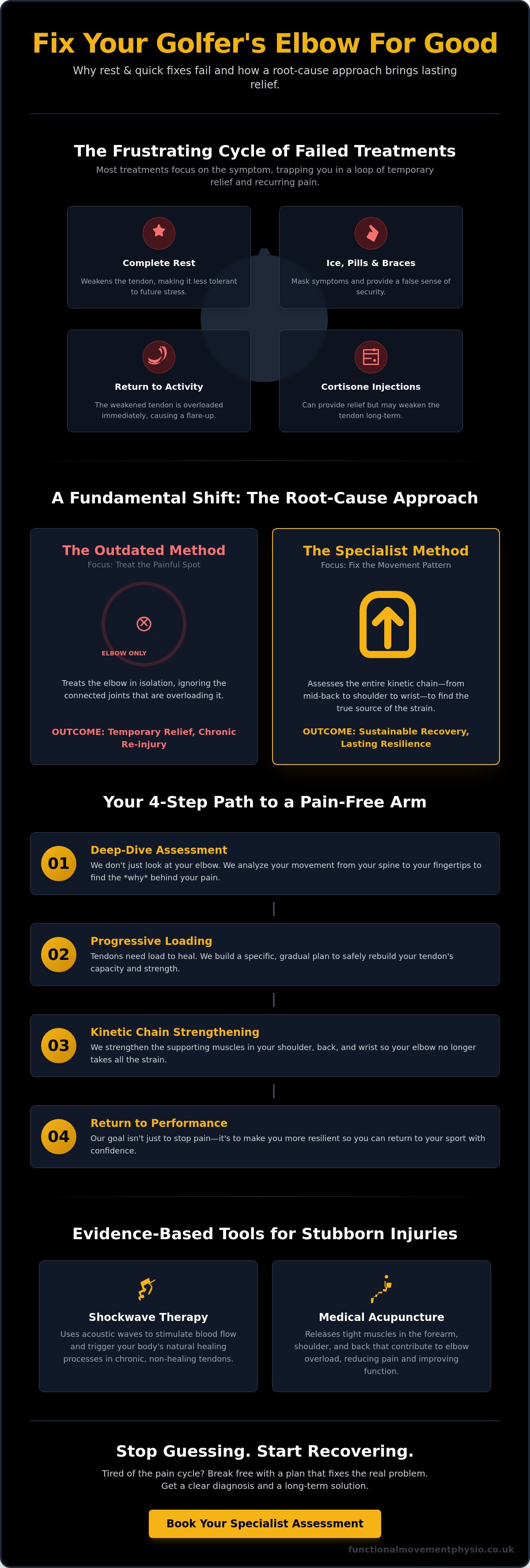
Most people follow a predictable path when elbow pain starts. They stop lifting, they apply ice, and they wait. While this might quieten the initial inflammation, complete rest is often the worst thing you can do for a tendon. Tendons require specific, controlled loading to maintain their structural integrity. When you stop moving entirely, the tissue becomes less tolerant to stress. A golfer's elbow specialist Liverpool understands that this rest and wait approach simply prepares your arm to fail again the moment you return to the driving range or the gym.
Traditional medical interventions often focus solely on the site of the pain. Cortisone injections are a classic example. While they can provide rapid relief by suppressing inflammation, they don't address the underlying mechanical flaws. In fact, repeated injections can actually weaken the tendon over time, making it more susceptible to future tears. Similarly, anti-inflammatory medications mask the symptoms without solving the causes of medial epicondylitis, which are usually rooted in how you move.
The Trap of the "Quick Fix"
Rubbing the area or performing aggressive generic stretches often feels helpful in the moment, but it can actually irritate the sensitive tendon further. This creates a cycle where you feel slightly better, return to sport too early, and then experience a sharp flare-up. Passive treatments like heat or ice have their place for temporary comfort; however, they do nothing to rebuild the tendon's capacity to handle weight. You need a plan that moves beyond these short term fixes to ensure your recovery is permanent.
Why Your Elbow Brace is Not a Cure
Many individuals turn to counterforce braces to get through a round of golf or a workday. While these devices can redistribute force away from the painful attachment point, they are not a cure. Relying on an external support can lead to muscle atrophy in the forearm, as the brace is doing the work your muscles should be doing. True stability must come from within your own body. If you feel like you are stuck in a loop of temporary relief, it may be time to book an assessment to find a sustainable solution.
The biggest failure of traditional treatment is ignoring the kinetic chain. Your elbow is caught in the middle between your wrist and your shoulder. If your shoulder blade isn't stable or your wrist mobility is restricted, your elbow has to work twice as hard to compensate. Treating the elbow in isolation is like fixing a flat tyre without checking if the axle is bent. A golfer's elbow specialist Liverpool will look at your entire movement profile to identify where the system is breaking down.
The Root Cause Approach: Why the Elbow is Rarely the Only Issue
The elbow is often the victim of dysfunction elsewhere in the body. While you feel the sharp twinge on the inside of your arm, the actual mechanical failure frequently begins in your shoulder, wrist, or even your mid-back. When you consult a golfer's elbow specialist Liverpool, the goal is to identify which part of your kinetic chain is failing to pull its weight. If your shoulder lacks stability, your forearm muscles must work significantly harder to control the weight of a club or a dumbbell. This excessive demand eventually leads to the micro-tears and irritation characteristic of medial epicondylitis.
A comprehensive Golfer's elbow diagnosis and treatment plan must look at how these joints interact during movement. We apply the same logic found in a runner's assessment to the upper limb. Just as a foot issue can cause knee pain in a runner, a lack of wrist mobility or shoulder blade control can manifest as elbow pain. By fixing the source of the load, we ensure the elbow can finally heal without being constantly re-irritated by poor mechanics.
Assessing the Kinetic Chain
Our evaluation process involves looking "upstream" at the shoulder and "downstream" at the wrist. Many golfers don't realize that thoracic spine stiffness is a major contributor to their pain. If your mid-back doesn't rotate properly during your swing, your body compensates by pulling harder with the trailing arm. This places an immense amount of eccentric stress on the inner elbow. We also use grip strength as a vital diagnostic marker. It isn't just about how hard you can squeeze; it’s about how your forearm muscles coordinate with your shoulder to stabilize the entire limb under load.
Personalised Biomechanical Analysis
Your daily habits play a massive role in how your tendons handle stress. For many, "desk posture" is a hidden culprit. Hours spent with rounded shoulders and a forward head carriage create tension through the entire flexor chain, making the tendons at the elbow more vulnerable to injury when you finally hit the gym or the course. Every case we see has a unique movement signature. We identify the specific patterns that are overloading your tendon, whether it’s a technical flaw in your bench press or a lack of wrist extension. This level of specificity is what allows a golfer's elbow specialist Liverpool to create a plan that doesn't just mask the pain but actually changes how your body moves for the better.
Actionable Advice: Practical Steps for Long-Term Progress
You don't need to wait for your pain to vanish completely before you start moving again. In fact, waiting for zero pain often leads to a weaker tendon that's more likely to fail when you finally return to your sport. A golfer's elbow specialist Liverpool will guide you through a phased approach where we use movement as the primary tool for healing. The secret lies in progressive loading, which means gradually increasing the stress on the tendon to build its resilience and load-bearing capacity.
This process is about finding the "sweet spot" where you're doing enough work to stimulate repair without doing so much that you cause further irritation. It's a delicate balance, but it's the only way to achieve a sustainable recovery that lasts beyond a few days of rest. By following a structured framework, you take the guesswork out of your rehab and move toward peak performance with confidence.
Step 1: Managing the Initial Load
The first phase of your recovery is about finding your entry point for exercise. We use the 24-hour pain rule to monitor your progress. It's a simple, objective way to know if you've done too much. Your pain levels can increase slightly during or immediately after activity, but they must return to your baseline within 24 hours. If they don't, you've exceeded your current capacity and need to adjust your volume or intensity the next time.
Isometric exercises are your best friend during this stage. These are static holds where the muscle works without the joint moving. For golfer's elbow, this usually involves holding a weight with your wrist in a neutral position for 30 to 45 seconds. Isometrics have a unique pain-relieving effect on tendons, helping you manage discomfort while maintaining strength. Focus on modifying your activity rather than stopping entirely. For example, you might reduce the weight in the gym or shorten your range of motion on the golf course while your tendon adapts.
Step 2: Building Progressive Strength
Once you can handle isometrics comfortably, we transition to isotonic exercises. This involves moving through a full range of motion with both concentric and eccentric phases. Heavy, slow loading is the gold standard for tendon remodelling. By moving slowly under a significant load, you stimulate the tendon to lay down new, stronger collagen fibres. This is what ultimately fixes the structural issue at the root of your pain.
Total body integration is also essential to ensure the elbow isn't working in isolation. This is where clinical pilates Liverpool can be a game changer. It helps you develop the core and shoulder stability needed to distribute force effectively through your entire arm. If you're ready to move beyond temporary fixes and want a plan tailored to your specific goals, you can book an appointment to start your journey back to full performance. This structured progression is what sets a golfer's elbow specialist Liverpool apart from generic advice.
Specialist Physiotherapy in Liverpool: Your Recovery Plan
Clinical tools serve as the catalyst for your recovery. While progressive loading builds the foundation of strength, advanced interventions can significantly shorten your timeline to pain free movement. As a golfer's elbow specialist Liverpool, we provide access to evidence based treatments that go beyond standard exercise prescription. This includes Medical Acupuncture to modulate pain and Shockwave Therapy to address chronic tissue changes that haven't responded to traditional care. These tools are designed to work in tandem with your movement plan, ensuring every session moves you closer to your goals.
The journey from your first assessment to your full functional return is a structured progression. We move from settling the initial irritation to rebuilding your capacity for high intensity activity. This isn't just about getting you through the day without an ache; it’s about ensuring your body is robust enough to handle the specific demands of a 300 yard drive or a heavy session of deadlifts. We bridge the gap between clinical rehabilitation and peak performance.
Advanced Treatment: Shockwave Therapy
Extracorporeal Shockwave Therapy (ESWT) is a non-invasive procedure that uses acoustic pressure waves to stimulate healing in damaged tendons. For many with chronic medial epicondylitis, the tendon has entered a degenerative state where the body's natural repair process has stalled. Shockwave Therapy Liverpool restarts this healing process by increasing blood flow and metabolic activity in the affected area. It’s a powerful alternative for those who want to avoid the risks and lengthy recovery times associated with surgical intervention.
The success rate for ESWT in chronic tendon cases is notably high, providing a solution for individuals who feel they’ve exhausted all other options. It works by creating micro-trauma at the site of the injury, which triggers the body to lay down new, healthy collagen fibres. This process doesn't just mask the pain; it physically changes the quality of the tendon tissue. Combined with Medical Acupuncture to relax tight forearm muscles, it provides a comprehensive approach to local tissue healing.
Booking Your Specialist Consultation
Your journey begins with a comprehensive initial physiotherapy consultation. We don't just look at your elbow; we assess your entire movement profile. We'll discuss your training history, your desk ergonomics, and your specific goals for returning to sport. This isn't a one size fits all approach. We identify the unique mechanical drivers of your pain to create a sustainable plan that works for your lifestyle. We're committed to finding the root cause of your pain, ensuring you aren't just another patient on a waiting list.
The focus is always on long term results. We want to ensure that when you return to the gym or the golf course, you have the strength and the technical proficiency to stay there. If you're tired of temporary fixes and want to address the root cause of your discomfort, it’s time to take the next step. You can book an appointment today to begin your tailored recovery plan with a golfer's elbow specialist Liverpool. We're here to help you move from physical limitation back to peak performance with confidence and clarity.
Take Control of Your Recovery and Return to Performance
You don't have to accept chronic elbow pain as a permanent part of your life. By moving beyond symptom management and addressing the mechanical flaws in your shoulder and wrist, you can finally break the cycle of recurring injury. A golfer's elbow specialist Liverpool provides the expert analysis and advanced tools, such as Shockwave Therapy, needed to rebuild your tendon's resilience. Our root cause diagnostic approach ensures that your recovery plan is tailored to your unique movement signature, focusing on long term strength rather than temporary relief.
Our expert team is dedicated to helping you master your own physical capabilities and return to the activities you love. Whether you're aiming for a pain free round of golf or a heavy set in the gym, we provide the structured guidance to get you there safely. Ready to stop the guesswork and start moving with confidence? Book your specialist Golfer’s Elbow assessment in Liverpool to begin your journey back to peak performance. We're here to support you every step of the way toward a stronger, more resilient future.
Frequently Asked Questions
How long does golfer’s elbow take to heal with specialist treatment?
Most patients experience significant improvement within 6 to 12 weeks of starting a structured loading programme. While the initial pain often settles in the first few weeks, remodeling the tendon tissue to handle high loads takes longer. Your specific timeline depends on how long you've had the injury and your commitment to the rehabilitation exercises designed by your golfer's elbow specialist Liverpool.
Can I still play golf while recovering from golfer’s elbow?
You can often continue playing golf as long as we can manage your total weekly load and modify any technical flaws in your swing. Complete rest is usually counterproductive because it leads to muscle weakness and reduced tendon resilience. We'll work with you to find a "safe" level of play that doesn't trigger a pain flare-up lasting more than 24 hours.
Is golfer’s elbow permanent if it has lasted for months?
No, chronic pain is not permanent; it's simply a sign that your tendon is stuck in a state of failed healing. Even if you've dealt with discomfort for a year, the tissue can still be stimulated to repair through progressive loading and advanced treatments. By identifying why the elbow is being overloaded, we can restart the healing process and achieve a full recovery.
What is the difference between tennis elbow and golfer’s elbow?
The primary difference is the location of the pain and the specific muscles involved. Golfer's elbow affects the medial epicondyle on the inner side of the elbow where the wrist flexors attach. Tennis elbow occurs on the lateral epicondyle on the outer side. While both are tendon issues, they require different mechanical assessments to understand why those specific tissues are failing under load.
Does Shockwave Therapy work for golfer’s elbow?
Shockwave Therapy is an excellent option for golfer's elbow, especially when the condition has become chronic and resistant to other treatments. It uses acoustic pressure waves to increase local circulation and stimulate the body's natural repair mechanisms. As a golfer's elbow specialist Liverpool, we use this non-invasive technology to help patients avoid the need for more invasive procedures like surgery or repeated injections.
Do I need an MRI scan before seeing a specialist in Liverpool?
You don't need an MRI scan before your initial consultation. A detailed clinical assessment of your movement, strength, and history is usually sufficient to provide an accurate diagnosis. We only suggest imaging if your symptoms are atypical or if you aren't progressing as expected, but for the vast majority of cases, a physical examination provides all the information we need to start treatment.
Can golfer’s elbow be caused by my neck or shoulder?
Yes, issues in your neck or shoulder are often the hidden drivers of elbow pain. Nerve irritation in the cervical spine can refer pain to the arm, while a lack of shoulder stability forces the forearm muscles to overwork. Our root cause approach always involves checking these "upstream" joints to ensure we aren't just treating the site of the pain while ignoring the source.
Will I eventually need surgery for my elbow pain?
It's very unlikely that you'll need surgery for golfer's elbow. Over 90% of cases resolve with high-quality conservative care that focuses on progressive loading and biomechanical correction. Surgery is considered a last resort and is only discussed if a comprehensive, specialist-led rehabilitation plan has failed to produce results after several months of consistent effort.