Pre-habilitation Before Knee Surgery in Liverpool: Why Waiting is a Mistake

What if the most critical phase of your surgical journey happens months before you ever enter the operating theatre? If you are currently facing the average 24 week wait for orthopaedic treatment at Liverpool University Hospitals, you likely feel stuck in a cycle of anxiety and physical decline. It's common to worry about muscle atrophy or feel confused by conflicting advice regarding whether to rest or exercise a painful joint. You want to protect what mobility you have left, yet the fear of making things worse often leads to stagnation.
Choosing pre-habilitation before knee surgery Liverpool experts recommend is the most effective way to reclaim control over your recovery timeline. This proactive approach does more than just maintain strength; it identifies and corrects the faulty movement patterns that contributed to your injury. In this article, you will discover how proactive training significantly reduces post-operative pain and ensures a faster return to the running track or the gym. We will break down the mechanics of knee failure and outline a sustainable, evidence based strategy to transform your waiting time into a period of physical optimization.
Key Takeaways
- Learn why total rest while on a waiting list often causes more harm than good by allowing muscle wasting and joint stiffness to set in.
- Understand how pre-habilitation before knee surgery Liverpool experts provide builds a physical buffer that significantly accelerates your post-surgical recovery.
- Discover why addressing hip and ankle mobility is essential to fixing the underlying movement patterns that caused your knee injury in the first place.
- Get a structured framework for building strength and range of motion safely without increasing your current pain levels.
- See how a personalised plan ensures a seamless transition into post-operative rehabilitation for a faster, more sustainable return to the gym or running.
The Problem with the Wait and See Approach to Knee Surgery
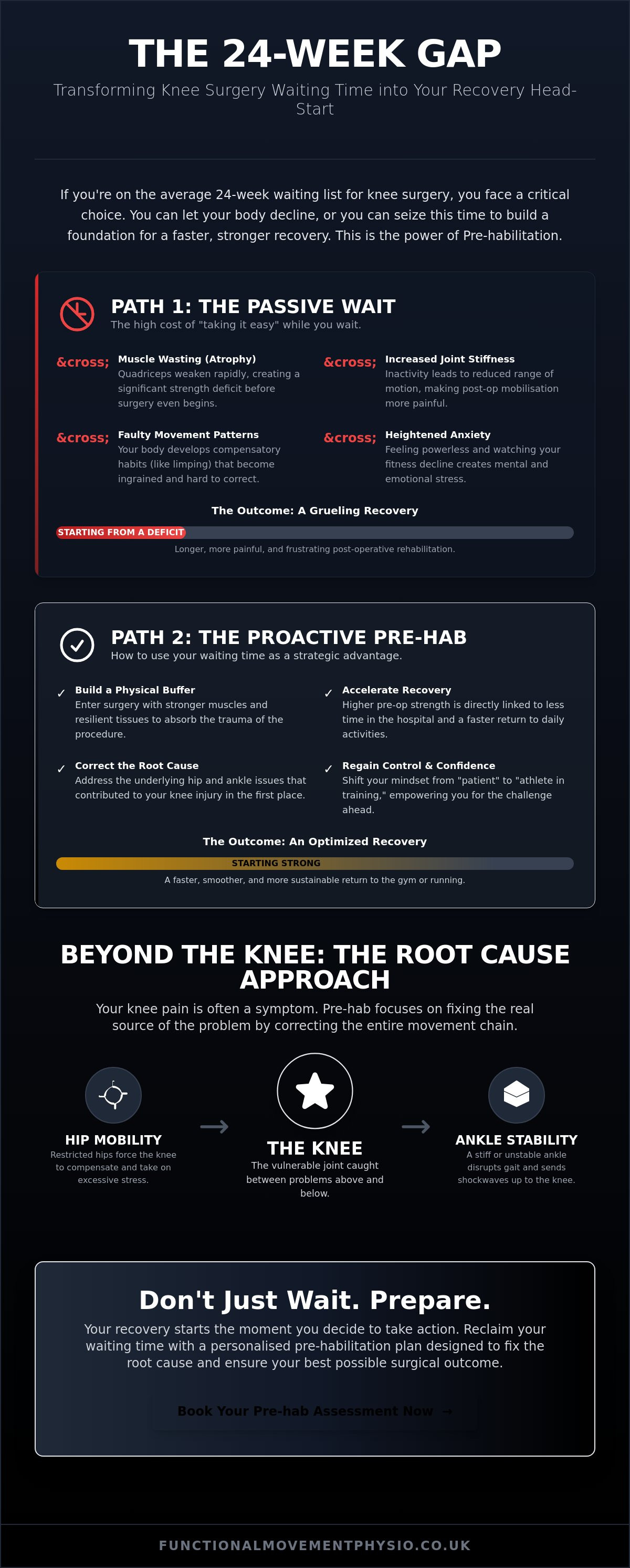
Being stuck on a 24 week waiting list at Liverpool University Hospitals often feels like being in physical limbo. You might have been told to "take it easy" or "wait for the consultant," but this passive approach is where the real damage begins. Doing nothing isn't a neutral choice; it's a decision that allows your body to deteriorate while you wait. By engaging in pre-habilitation before knee surgery Liverpool patients can effectively halt this decline and start building a foundation for success.
The Hidden Cost of Pre-Operative Inactivity
When you stop moving, your muscles don't just stay the same size; they begin to waste away with alarming speed. The quadriceps, which are vital for knee stability, are usually the first to go. This isn't just about lack of use. It's often caused by arthrogenic muscle inhibition, a process where your brain actively prevents your muscles from firing to protect the injured joint. If your brain "shuts down" the quad, no amount of rest will bring that strength back.
Entering theatre with a weak, stiff leg is a recipe for a grueling recovery. Research into what is pre-habilitation shows that patients with higher baseline strength spend less time in the hospital and return to their daily activities much faster. If you wait until after the operation to start your training, you're starting from a significant deficit. This physical debt makes the initial weeks of post-operative rehab much more painful and frustrating than they need to be.
Why Symptom Masking Fails Long Term
Relying on rest and painkillers might make your day-to-day life more bearable, but it does nothing to prepare your joint for the trauma of surgery. Masking symptoms often leads to a false sense of security while your movement patterns become increasingly distorted. You start limping, shifting weight to your "good" side, and losing ankle mobility. These ingrained habits don't just disappear after the surgeon repairs the structural damage; they remain as "software" issues in your nervous system that can cause future injuries elsewhere in the body.
This period of waiting often breeds a sense of powerlessness and anxiety. You feel like a passenger in your own healthcare journey, watching your fitness slip away. Reclaiming this time through pre-habilitation before knee surgery Liverpool services changes the narrative entirely. It shifts your mindset from "patient" to "athlete in training." Your recovery doesn't start in the hospital; it starts the moment you decide to address the root cause of your physical limitations and prepare your body for the work ahead.
The Science of Pre-habilitation: Why Stronger Means Faster
Pre-habilitation is a proactive clinical intervention designed to optimize your physical state before surgery, directly reducing the time you spend in recovery. While many people view the months leading up to an operation as a period of inevitable decline, science suggests otherwise. Think of your body as a high performance machine. If you're heading into a major repair, you want the surrounding components to be as robust as possible. By engaging in pre-habilitation before knee surgery Liverpool residents can build a physical buffer that absorbs the trauma of the procedure and accelerates the healing process.
Building a Physical Reserve for Surgery
Your post-operative function is often a direct reflection of your pre-operative strength. When a surgeon operates, there is an unavoidable loss of muscle mass and a spike in local inflammation. However, if you enter the theatre with a higher baseline of muscle density and cardiovascular health, your "floor" is much higher. A scientific review of prehabilitation benefits demonstrates that patients who strengthen their primary movers before surgery experience significantly better knee function for months following the procedure.
This preparation also improves tissue health at a cellular level. Targeted exercise increases blood flow to the joint, ensuring that the tendons and ligaments are well oxygenated and resilient. This enhanced circulation helps your body manage the inflammatory response more effectively after the operation. Instead of spending weeks just trying to get the swelling down, your body can move straight into the active phase of repair. If you want to start building this reserve, you can book an initial physiotherapy consultation to assess your current capacity.
Neuromuscular Education: Training Your Brain
Strength is only half of the equation; the other half is communication. Surgery and chronic pain both disrupt the signals between your brain and your knee. Pre-habilitation focuses on neuromuscular education, which essentially "rewires" these pathways. This involves proprioception, which is your body's internal GPS that tells your brain where your limb is in space. By improving this connection now, you protect the joint from further injury while you wait for your surgical date.
There is also a practical advantage to this brain training. Learning your post-operative exercises while you are relatively mobile makes them much easier to perform when you are groggy or in pain after the procedure. You won't be struggling to understand a new movement pattern while dealing with surgical dressings. Instead, your nervous system will already have the "blueprint" for these movements, allowing you to execute your post-operative rehabilitation with confidence and precision from day one.
The Root Cause Approach: Beyond Structural Damage
Surgery is remarkably effective at repairing a torn meniscus or replacing a degenerate joint surface. However, it's vital to understand that an operation fixes the anatomy, not the movement patterns that led to the damage in the first place. If you have spent years walking with a limp or compensating for a weak hip, your brain has hardwired those habits into your nervous system. By engaging in pre-habilitation before knee surgery Liverpool patients can address these "software" issues before the "hardware" is repaired. This ensures that your body is ready to support the new joint from the very first step of your recovery.
Identifying Biomechanical Imbalances
The knee is rarely the sole cause of its own problems. It's often the victim of dysfunction elsewhere in the kinetic chain. When you consult a physiotherapist liverpool based, the focus should be on how your entire body moves as a single unit. For instance, if your glutes are not firing correctly, your knee may collapse inward during every step. Similarly, restricted ankle mobility can force the knee to take on extra load it isn't designed to handle.
A professional gait analysis liverpool is a cornerstone of effective pre-operative planning. It allows us to see exactly where your mechanics are failing. By identifying these flaws while you are on the waiting list, we can implement specific exercises to stabilise the hip and mobilise the ankle. This proactive correction means you won't be fighting old, bad habits while also trying to heal from a surgical procedure.
Fixing the Foundation for Long Term Success
Many patients who suffer from chronic conditions like runners knee find that their symptoms are actually manifestations of poor load management. If you don't fix these foundational issues, you risk overloading your repaired joint as soon as you return to activity. Pre-habilitation before knee surgery Liverpool is an investment in the longevity of your operation. It ensures that the mechanical stress is distributed evenly across your joints, rather than being concentrated on the knee.
A thorough assessment allows us to create a roadmap for your recovery that starts months before the surgery date. We look for the root cause of the failure, whether it's a lack of core stability or a foot strike issue. Correcting these biomechanical flaws now provides a stable environment for your new knee to thrive. This approach transforms the surgery from a temporary fix into a permanent solution for a high performance lifestyle.
Your Practical Prehab Toolkit: Strength, Range, and Readiness
A successful pre-habilitation programme is built on precision rather than intensity. It is a common misconception that you should push through sharp pain to "get strong" for your operation. In reality, the goal is to build capacity without triggering an inflammatory flare up that could delay your surgery. By following a structured framework for pre-habilitation before knee surgery Liverpool patients can arrive at the hospital feeling physically capable and mentally prepared. This isn't about general fitness; it is about a targeted intervention designed for your specific injury.
"The quadriceps muscle acts as the primary shock absorber for the knee; its pre-operative strength is the most significant predictor of how quickly you will regain your independence after surgery."
This process requires expert guidance to be effective. Attempting high impact exercises on a compromised joint often leads to more swelling and further muscle inhibition. Clinical supervision ensures that every movement serves a specific purpose, moving you closer to your goals while keeping your pain within a manageable threshold. We focus on three main pillars: restoring range, activating key stabilizers, and mental readiness.
Restoring Range of Motion
Regaining full range of motion is the first priority of any pre-operative plan. If your knee is stuck in a slightly bent position before surgery, it is incredibly difficult to achieve a straight leg afterwards. We focus heavily on terminal knee extension, which is the ability to straighten the leg fully. This is vital for a normal walking pattern and joint health. If you can't lock your knee out, your muscles have to work twice as hard just to keep you standing.
Maintaining flexion is equally important but requires a gentler touch to avoid joint irritation. We often utilise pilates liverpool sessions to improve mobility in a controlled, low impact environment. These sessions allow you to work on joint health and core stability without the shearing forces associated with traditional gym workouts. It provides a safe space to explore your range of motion under professional eyes.
Targeted Strengthening Without Overloading
Strengthening a painful knee requires a strategic shift away from traditional squats and lunges. We prioritise non weight bearing exercises and glute activation to support the limb without grinding the joint surfaces together. Isometric exercises, where the muscle contracts without the joint moving, are particularly effective. They allow you to maintain muscle tone and "wake up" the nervous system even when the knee feels too irritable for dynamic movement.
Success depends on accurate pain monitoring. We teach you how to distinguish between productive muscular effort and harmful joint pain. Staying within a safe zone ensures consistent progress without setbacks. To start building your custom toolkit, you can book an initial physiotherapy consultation to discuss your specific needs and create a sustainable plan for the weeks ahead.
Specialist Pre-habilitation in Liverpool: Optimising Your Outcome
At Functional Movement Physio, we don't believe in a one size fits all approach to pre-habilitation before knee surgery Liverpool. Every injury has a unique history, and your preparation should reflect your specific lifestyle goals. We develop a personalised plan that aligns with your biomechanical profile and your surgeon's specific requirements. This isn't just about doing a few leg lifts at home; it is a comprehensive strategy designed to ensure you enter the operating theatre in peak physical condition. By addressing the root causes of your movement flaws, we help you build the resilience necessary for a superior surgical outcome.
The work you do during this phase creates a seamless bridge to your Post-Operative Rehabilitation. Because we already understand your movement patterns and baseline strength, we can hit the ground running the moment you are cleared for activity. This continuity of care is vital. You won't be explaining your history to a new therapist while recovering from surgery. Instead, you'll have a familiar partner who knows exactly how to guide you back to the gym or the running track with confidence.
A Seamless Path to Recovery
We coordinate closely with your surgical timeline to ensure maximum effect. If you are facing the current 24 week average wait for orthopaedic treatment at Liverpool University Hospitals, we use that time to your advantage. We map out a roadmap that evolves as you get closer to your date, ensuring you are neither under-prepared nor over-trained. This professional guidance provides immense peace of mind during a period that is often filled with anxiety. You can stop worrying about muscle wasting and start focusing on the tangible progress you are making every week.
Our partnership model means you are never left guessing about your progress. We provide the clinical authority you need to feel safe, combined with the empathetic encouragement required to stay motivated. This structured approach ensures that when your surgery date finally arrives, you aren't just a patient on a list; you are an athlete prepared for a successful recovery. We focus on long term wellness over temporary fixes, ensuring your new joint is supported by a strong and functional foundation.
Ready to Take Control of Your Recovery?
The choice to wait passively is a choice to let your physical capacity decline. You don't have to be a victim of a long waiting list. Our Liverpool clinic is staffed by an expert team dedicated to high performance recovery and sustainable movement. We help you master your own physical capabilities so that your surgery is a successful milestone rather than a stressful beginning. It is time to stop feeling stuck and start your preparation. Whether you are an injured runner or a gym-goer dealing with chronic pain, we are here to support your transition from limitation to optimization.
Take the first step toward a shorter, less painful recovery today. You can Book your pre-habilitation assessment at our Liverpool clinic and begin your journey toward a stronger, more resilient future. Don't let the wait define your recovery; let your preparation define your success.
Take Control of Your Surgical Journey Today
You don't have to spend your months on a waiting list watching your strength and fitness fade away. Choosing pre-habilitation before knee surgery Liverpool patients trust means you are actively shortening your recovery time and ensuring your new joint is supported by a stable, functional foundation. By identifying root cause biomechanical imbalances and implementing evidence based pre-operative protocols, you move from a state of physical limitation to one of peak performance readiness.
Our central Liverpool location is staffed by expert clinical staff who provide specialist biomechanical assessments that look beyond the structural damage to fix how you move. This proactive approach ensures that you aren't just repairing an injury, but optimizing your entire kinetic chain for long term resilience. If you are ready to stop waiting and start training for your success, Book your pre-habilitation assessment at our Liverpool clinic.
Your recovery doesn't start at the hospital; it starts the moment you decide to take action. We are here to guide you through every step of this partnership, ensuring you have the tools and confidence to restore full, purposeful movement in your daily life.
Frequently Asked Questions
Is it safe to exercise if my knee is already painful before surgery?
Yes, it is safe and highly recommended when guided by a professional therapist. We focus on low impact movements and isometric contractions that build muscle without aggravating the joint surfaces. Staying active helps prevent muscle wasting and keeps your nervous system engaged, which is vital for a successful recovery after the procedure.
How many weeks before my knee surgery should I start pre-habilitation?
You should start your programme as soon as you are placed on a waiting list, ideally at least 6 to 12 weeks before your surgery date. Given the 24 week average wait for orthopaedic treatment in Liverpool, you have a significant window of opportunity to build a physical reserve. Starting early ensures your body has ample time to adapt and strengthen before the surgical trauma.
Will pre-habilitation reduce the time I spend in the hospital after surgery?
Yes, building a physical buffer through pre-habilitation before knee surgery Liverpool helps you meet hospital discharge criteria much faster. Patients with higher pre-operative strength and better range of motion typically regain their independence sooner. This proactive preparation reduces the risk of post-operative complications and allows for a quicker return to your own home.
Can prehab actually help me avoid surgery altogether?
It is possible for some individuals to manage their symptoms so effectively through strengthening and biomechanical correction that they choose to delay or cancel their surgery. By addressing the root cause of your pain and improving how your hip and ankle support the knee, the joint load is reduced. While not every case allows for this, many find their function improves enough to return to meaningful activities.
What is the difference between pre-habilitation and standard physiotherapy?
Pre-habilitation is a specific, goal oriented form of clinical preparation designed to prepare your body for a specific surgical event. While standard physiotherapy often focuses on reactive pain management, prehab is a proactive training phase. It focuses on building a "strength debt" and teaching your brain the exact movement patterns you will need to execute immediately after your operation.
Do I need a referral from my surgeon to start prehab in Liverpool?
No, you do not need a formal referral to begin your preparation at our clinic. You can book an initial physiotherapy consultation directly to have your movement patterns assessed and a custom plan created. we coordinate with your surgical timeline to ensure your programme is safe and effective as your operation date approaches.
What happens if I skip pre-habilitation and just do the post-op rehab?
Skipping pre-habilitation often results in a longer, more difficult recovery period because you are starting from a physical deficit. Without pre-operative strengthening, the muscle atrophy that occurs after surgery is much more profound. This makes the initial weeks of post-operative rehabilitation more painful and significantly delays your return to high performance activities like running or the gym.