Sports Massage for Muscle Knots Liverpool: Your Guide to Lasting Relief

What if the stubborn tightness in your shoulders or calves isn't actually the problem, but merely a symptom of a deeper movement dysfunction? With 78% of people in the UK seeking massage specifically for pain relief, you are certainly not alone in your frustration with recurring tension. Finding an effective sports massage for muscle knots Liverpool is about more than just finding a therapist; it is about uncovering why your body is stuck in a cycle of recurring tension that hinders your performance.
We understand that you want more than a brief window of comfort. You need a strategy that restores your physical capacity and keeps you moving without fear of injury. This guide will help you identify the root cause of your discomfort rather than just masking the symptoms through temporary fixes.
You will discover why these knots form, how professional manual therapy improves functional movement, and how to implement a long-term plan to remain pain-free during your training and daily life. It is time to move beyond symptom management and start focusing on your physical optimization.
Key Takeaways
- Learn to identify myofascial trigger points and understand why they feel like hard lumps within your muscle tissue.
- Discover how a specialist sports massage for muscle knots Liverpool addresses the underlying movement dysfunctions rather than just masking the symptoms.
- Understand why generic deep tissue massages often provide only temporary relief and how a root cause approach creates lasting change.
- Gain practical strategies for active recovery that prevent knots from returning and help you maintain your training schedule.
- Explore how 30 or 60 minute clinical sessions can be tailored to your specific needs to restore your full physical capacity.
What Are Muscle Knots and Why Do They Hurt?
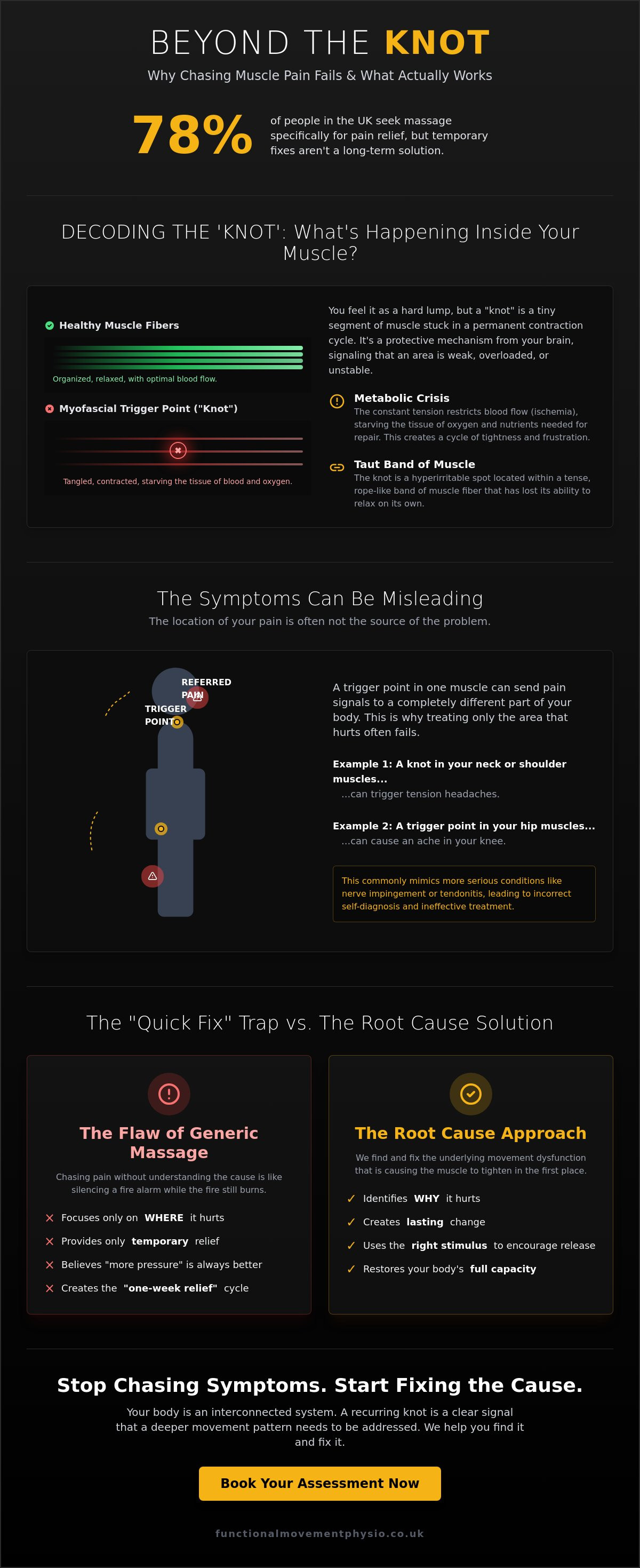
You likely know the sensation: a sharp, localized ache or a persistent throb that simply won't quit regardless of how much you stretch. These "knots" are technically known as myofascial trigger points. They are hyperirritable spots located within a taut band of muscle fiber that feel like small, hard lumps under your skin when you apply pressure. This physical manifestation is exactly what we target when providing a specialist sports massage for muscle knots Liverpool, but understanding the underlying biology is the first step toward reclaiming your movement.
The discomfort you feel isn't just a random occurrence. These spots cause genuine pain because they physically restrict blood flow and oxygen to the local tissue. When a muscle remains in a state of constant tension, it creates a localized metabolic crisis. The area becomes starved of the nutrients it needs to repair, leading to the familiar cycle of tightness and frustration that many athletes and gym-goers face daily.
The Science of a Myofascial Trigger Point
At a microscopic level, a muscle knot is essentially a tiny segment of muscle stuck in a permanent contraction cycle. It has lost the ability to relax on its own. This persistent contraction creates a state called ischemia, which is a clinical term for a lack of blood supply. To gain a deeper understanding of what are muscle knots, you have to view them through the lens of your nervous system. These knots are often a protective mechanism. Your brain creates this tension to stabilize an area it perceives as weak, overloaded, or unstable. It is a signal that your body is struggling to manage the physical demands you are placing on it.
Common Symptoms You Might Experience
The symptoms of trigger points are rarely confined to a single spot. Many active individuals in Liverpool report a deep, dull ache that significantly hinders their range of motion during gym sessions or runs. You might notice that you feel "stiff" or "heavy" even after a full night of rest. This is because the muscle fibers are physically unable to lengthen properly.
One of the most complex aspects of muscle knots is referred pain. This occurs when a trigger point in one muscle sends a pain signal to a completely different part of the body. For example, a knot in your hip might cause an ache in your knee, while tension in your neck can trigger a headache. Because of this, knots often mimic more serious injuries like nerve impingement or tendonitis. We often see patients who believe they have a structural injury when they actually have a series of highly active trigger points that require a specialist sports massage for muscle knots Liverpool to resolve.
The Problem: Why Quick Fixes and Generic Massages Fail
Many people book a session expecting a single hour of intense pressure to erase weeks of accumulated tension. It's a common misconception that a "deep tissue" treatment is a one-off cure for chronic discomfort. While a generic massage might provide a brief window of relaxation, it often fails because it focuses solely on where it hurts rather than why it hurts. Chasing the pain without understanding the cause creates a cycle of temporary relief followed by the inevitable return of tightness.
Rubbing a knot without addressing the underlying movement dysfunction is like silencing a fire alarm while the fire still burns. You might stop the noise for a moment, but the structural threat remains. This is why many gym-goers and runners find themselves stuck in a loop of recurring clinic visits. If you are searching for a sports massage for muscle knots Liverpool, you must look for an approach that prioritizes long-term resolution over a fleeting sense of ease.
The Sensation vs. Solution Trap
There is a persistent myth in the fitness community that "more pressure" always equals a more effective treatment. In reality, aggressive pressure can sometimes backfire. When you use excessive force or spend hours on a foam roller, you may actually irritate the tissue further. Your nervous system often responds to this perceived "attack" by tightening the muscle even more as a protective measure. This leads to the "one week relief" cycle, where you feel great for a few days before the familiar ache returns. A clinical partnership focuses on the right amount of stimulus to encourage release, not just seeing how much pain you can tolerate.
Why Symptom-Based Treatment Does Not Last
Your body is a master of compensation. When a specific muscle is restricted by a trigger point, your brain automatically shifts the workload to other areas. This is how the kinetic chain operates. The knot in your shoulder might actually be a "victim" of poor ribcage mobility or a lack of stability in your lower back. Standard medical treatment for myofascial pain often requires a deeper look at these physical habits to prevent recurrence.
Bridging the gap between feeling better and actually moving better is the only way to achieve sustainable results. If you don't address the reason your body created the knot in the first place, your nervous system will simply rebuild it as soon as you return to your normal training routine. If you are tired of temporary fixes, it might be time to schedule a specialist assessment to identify your specific movement triggers.
Effective sports massage for muscle knots Liverpool should serve as a catalyst for better movement. It is a tool used to "open the window" of opportunity, allowing you to retrain your muscles and build the resilience needed to stay pain-free in the long term.
The Root Cause Approach to Trigger Points
We don't just see a muscle knot as a target for pressure; we see it as a vital data point. When providing a sports massage for muscle knots Liverpool, our clinicians look at the specific movement patterns that forced your muscle into a protective state. If you spend eight hours at a desk and then head to the gym for a heavy lifting session, your body must compensate for hours of static posture. This often leads to repetitive strain and muscle imbalances that create a cycle of chronic tightness. We look beyond the physical lump to identify the biomechanical reason your body feels the need to guard itself.
Effective treatment requires a partnership where we analyze how you move in your daily life. Muscle knots are rarely the primary problem. Instead, they are often the "victims" of dysfunction occurring elsewhere in your kinetic chain. By assessing your biomechanics, we ensure that once the knot is released, it stays away. Our Liverpool specialists use manual therapy as a strategic tool to unlock your movement potential, not just to provide a temporary soothing sensation.
Identifying Your Unique Movement Triggers
Many active individuals struggle with "overactive" muscles. These are tissues that are working too hard because other muscles in the chain aren't contributing enough. For instance, if your glutes are underactive during a run, your lower back or hamstrings might develop painful knots to provide the missing stability. Understanding clinical trigger point diagnosis and management allows us to see these compensations clearly. This is where Expert Physiotherapy Liverpool becomes essential. We analyze your lifting technique, your running gait, and even your seated posture to find exactly where the movement breakdown occurs.
Integrating Sports Massage with Functional Rehabilitation
Manual therapy is a powerful intervention, but it is most effective when it is paired with purposeful movement. We use soft tissue work to create what we call a "window of opportunity." This is a specific period where your pain is reduced and your range of motion is temporarily increased. Instead of simply ending the session there, we use this window to implement corrective exercises that retrain your nervous system.
By using sports massage for muscle knots Liverpool to relax the overactive tissue, we can then effectively strengthen the areas that have been neglected. This dual approach ensures that your recovery is sustainable. We don't want you to be reliant on frequent clinic visits. Our goal is to give you the tools and the physical capacity to return to peak performance in your chosen sport. We focus on the resumption of your meaningful personal activities, ensuring you can train, run, and move with quiet confidence and resilience.
How to Manage and Prevent Muscle Knots at Home
Prevention is not a one-off event. It is a series of sustainable, daily choices that build physical resilience. While a professional sports massage for muscle knots Liverpool provides a vital reset, the work you do between sessions determines how long that relief lasts. Many people make the mistake of choosing total rest when they feel a knot forming, but this often leads to further stagnation. Active recovery is far more effective for keeping your tissues supple and functional.
One of the most effective ways to prevent postural stagnation is by implementing "movement snacks" throughout your day. These are short, 2-minute bursts of activity that break up long periods of sitting or repetitive motion. Simple movements like shoulder rolls, neck retractions, or deep lunges signal to your nervous system that it doesn't need to "lock down" a muscle for stability. While hydration and nutrition are secondary to movement, they remain vital. Dehydrated muscles are less elastic and more prone to the microscopic stuck cycles that lead to trigger points.
A Sustainable Daily Routine for Mobility
You don't need hours of stretching to see results. In fact, over-stretching a muscle that is already in a protective "knot" state can often make the problem worse. Instead, follow this three-step process for home management:
- Identify: Gently feel for areas of tension without using excessive force.
- Mobilise: Use gentle, rhythmic movements like cat-cow stretches or arm circles to encourage blood flow.
- Functional Loading: Perform light resistance exercises to teach the muscle how to work through its full range of motion.
If you use a tennis ball or a trigger point tool, remember that the goal is not to "crush" the knot. Apply moderate pressure for 30 to 90 seconds while breathing deeply. This encourages the nervous system to relax the tension rather than fighting against the pain. If you find yourself constantly reaching for a foam roller without lasting change, it's a sign that your home routine needs professional refinement.
Modifying Your Environment and Training
For those working in Liverpool city centre offices, small ergonomic tweaks can prevent recurring tension. Ensure your screen is at eye level and your feet are flat on the floor to reduce the strain on your upper traps and lower back. In your training, avoid "overuse" by varying your intensity. Repetitive strain is a primary driver of muscle knots, so cross-training is essential for long-term health.
Don't wait until you are in debilitating pain to seek help. Taking a proactive approach with a Sports Massage Treatment can catch small imbalances before they become chronic issues. By combining home care with periodic sports massage for muscle knots Liverpool, you create a robust system for long-term health. If you are ready to move beyond temporary fixes, book an initial consultation to develop your personalized recovery plan.
Specialist Sports Massage for Muscle Knots in Liverpool
Choosing a sports massage for muscle knots Liverpool at our clinic means entering into a professional partnership focused on your long-term physical resilience. We don't view massage as a luxury or a temporary escape from discomfort. Instead, it is a clinical intervention designed to help you master your movement. We offer both 30 minute and 60 minute sessions, allowing us to tailor the treatment time to the complexity of your specific issues and your personal training schedule. Our approach is a sophisticated blend of manual therapy and evidence-based rehabilitation, moving you away from symptom management toward peak performance.
You deserve a recovery plan that respects your goals and understands the demands you place on your body. By integrating our technical expertise with your commitment to health, we create a clear path forward. This isn't just about feeling better for a day; it's about optimizing your physical capacity so you can train harder and move with more confidence. We focus on the transition from physical limitation to the restoration of full, purposeful movement in your daily life.
What to Expect During Your Session
Every session begins with a focused assessment where we work together to find your "why." We don't just press on the spots that hurt. We investigate the underlying movement patterns that caused the tension to accumulate in the first place. This clinical reasoning allows us to choose the most effective techniques for your unique situation. Our therapists utilize a variety of methods beyond standard massage, including targeted trigger point release and myofascial work, to ensure the tissue responds positively.
We prioritize your comfort throughout the process. While we may use firm pressure to address deep-seated tension, the treatment is always tailored to your tolerance and your specific recovery objectives. You will leave the session not only feeling a physical release but also possessing a deeper understanding of how to manage your body effectively. This educational aspect is what sets our sports massage for muscle knots Liverpool apart from generic high-street services.
Your Path to Peak Performance
Our goal is the resumption of your meaningful personal activities. We want to see you back on the track, in the gym, or simply navigating your day without the constant distraction of a dull ache. When you visit us, you join a community of high-performing clients in Liverpool who value proactive health management over reactive fixes. We provide the expert guidance you need to unlock your potential and build a body that is resistant to future injury.
Stop settling for temporary relief that fades within forty-eight hours. It is time to address the root cause of your discomfort and invest in sustainable movement health. Take the first step toward a pain-free future and Book your appointment today to begin your recovery journey with our specialist team.
Take Control of Your Physical Resilience
You now understand that muscle knots are not just random points of pain. They are physical signals that your movement patterns require clinical attention. By moving beyond temporary fixes and addressing the underlying imbalances in your kinetic chain, you can break the cycle of recurring tightness. Sustainable relief comes from a combination of active recovery, consistent daily habits, and professional intervention that prioritizes your long-term physical capacity.
Our specialist clinic in Liverpool is dedicated to expert sports injury rehabilitation. We don't just treat symptoms; we partner with you to identify the root cause of your discomfort. If you are ready to stop managing pain and start mastering your movement, a sports massage for muscle knots Liverpool at our clinic provides the clinical reset you need to return to the activities you love.
Don't let persistent tension hold you back from your peak performance. Book your Sports Massage in Liverpool today and begin your journey toward lasting, functional relief. We are here to support your transition from physical limitation to purposeful movement with confidence and strength.
Frequently Asked Questions
What exactly is a muscle knot?
A muscle knot is a localized area of muscle fibers stuck in a permanent contraction cycle, technically known as a myofascial trigger point. These spots feel like hard lumps and occur when a muscle is chronically overloaded or fatigued. This state of persistent tension restricts local blood flow and oxygen, which is why the area feels tender or produces a dull ache during your training sessions.
Can sports massage actually break up knots?
Mechanical pressure from a sports massage for muscle knots Liverpool works by signaling your nervous system to relax the stuck contraction. It doesn't literally "break" the knot like a solid object. Instead, the manual stimulus encourages the muscle fibers to lengthen and allows fresh, oxygenated blood to return to the tissue, effectively resetting the muscle's resting tone.
How many sessions will I need to feel better?
Most individuals experience a notable improvement in movement and a reduction in pain within one to three sessions. The total number of visits depends on the chronicity of your issue and your specific activity levels. We focus on creating a sustainable plan that moves you toward independence and peak performance rather than encouraging a cycle of indefinite treatment.
Why do my muscle knots keep coming back in the same place?
Knots recur when the original movement trigger or postural habit remains unaddressed. If your desk setup or lifting technique continues to overload a specific muscle, your brain will rebuild the knot as a protective response. Lasting relief requires identifying these root causes through a professional assessment of your biomechanics to ensure the tension doesn't return.
Is sports massage for knots supposed to be painful?
You should feel a sensation of "productive" pressure, but it should never be agonizing. If the treatment is too painful, your nervous system will respond by tightening the muscle further to protect it, which is counterproductive. Our clinicians work within your tolerance to ensure the pressure is effective enough to encourage a release without causing unnecessary guarding.
What is the difference between sports massage and dry needling for knots?
Sports massage uses manual pressure to manipulate the tissue, while medical acupuncture uses fine needles to stimulate a local twitch response within the trigger point. Both methods aim to reset the muscle's neurological state and restore blood flow. We often integrate these techniques based on your specific clinical needs and how your body responds to different stimuli.
How should I prepare for my sports massage in Liverpool?
When preparing for your sports massage for muscle knots Liverpool, wear loose, comfortable clothing and ensure you are well-hydrated. Be ready to discuss your injury history, training schedule, and specific movement frustrations during the initial assessment. This information is vital for us to tailor the session to your functional goals and clinical requirements.
Can I exercise immediately after a sports massage for knots?
Light, functional movement is encouraged after a session to help your nervous system adapt to your new range of motion. However, you should avoid maximal weightlifting or high-intensity interval training for at least 24 hours. Giving your tissues this window to settle ensures you achieve the best possible results from the manual therapy and rehabilitation work.