Pain in Big Toe? A Liverpool Physio Guide to Finding the Root Cause

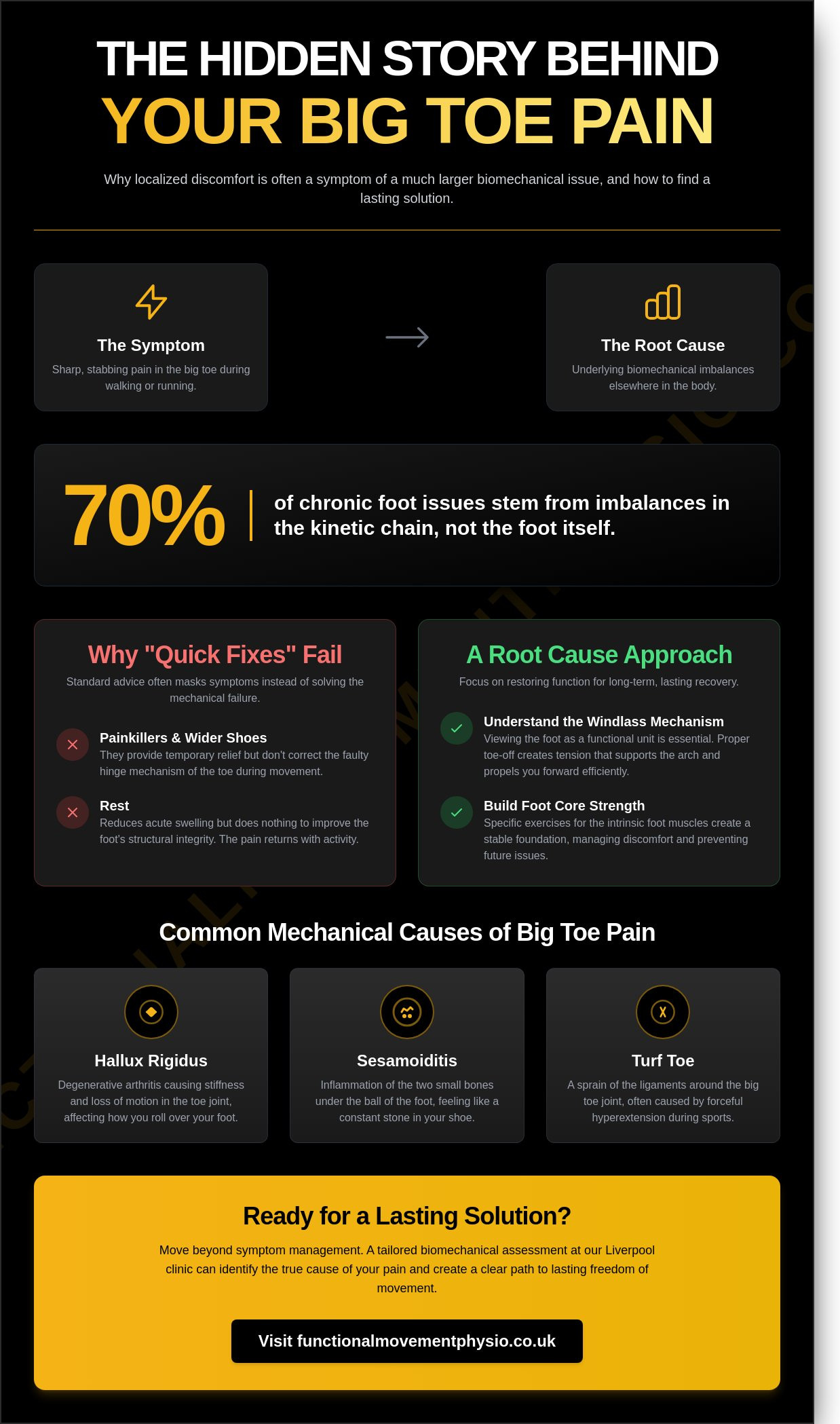
What if the sharp, stabbing pain in your big toe has less to do with your footwear and everything to do with how your body moves as a whole? It is a common mistake to assume localized discomfort requires a localized fix, yet clinical observations suggest that up to 70% of chronic foot issues actually stem from underlying biomechanical imbalances elsewhere in the kinetic chain.
You are likely tired of the conflicting advice found on general health sites and the looming fear that surgery is your only path forward. It is exhausting to feel like every step during a walk through Sefton Park or a morning run along the Liverpool waterfront is a gamble with your mobility. You deserve a recovery plan that treats you like a partner in your own health, not just a set of symptoms to be managed with ice and rest.
This guide will show you exactly why your discomfort persists and how our specialist biomechanical approach in Liverpool provides a long-term solution. We will explore the functional causes of your limitations and outline a clear, evidence-based path to help you master your own movement and return to the activities you love, completely pain-free.
Key Takeaways
- Understand why common conditions like hallux rigidus cause persistent pain in big toe and how your biomechanics impact your daily walks or runs.
- Learn why quick fixes like ibuprofen or wider shoes fail to address the underlying mechanical dysfunction that keeps you sidelined.
- Discover the role of the windlass mechanism and why viewing your foot as a functional unit is essential for long-term recovery.
- Implement specific foot core exercises to build intrinsic strength and manage discomfort without having to stop all activity.
- Explore how a tailored biomechanical assessment at our Liverpool clinic can help you move beyond symptom management toward lasting freedom of movement.
What Causes Pain in the Big Toe for Active People in Liverpool?
For many runners and walkers across Liverpool, experiencing a persistent pain in big toe joints is often the first sign that their training volume has exceeded their structural capacity. Whether you're navigating the coastal paths of Crosby or sprinting at a local track, your big toe is the anchor of your gait. It bears up to 90% of your body weight during the push-off phase of a stride. When this joint is compromised, your entire movement profile shifts to compensate.
Clinical causes for this discomfort vary significantly. While mechanical issues like hallux rigidus or sesamoiditis are common among the active population, other conditions present differently. For instance, Gout typically manifests as sudden, intense swelling and heat, often waking you up at night with a sharp, throbbing sensation. Bunions, conversely, are a progressive structural shift that changes the angle of the joint over years. Identifying whether your pain is inflammatory, structural, or mechanical is vital for effective rehabilitation.
In our Liverpool clinic, we frequently observe athletes who ignore early symptoms. You might push through a small niggle during your weekend long run, but this often leads to chronic dysfunction. By the time most people seek professional help, the underlying biomechanical issue has often been present for several months. Ignoring these signs doesn't just delay recovery; it often forces the body to create movement patterns that lead to secondary injuries.
Common Injuries: From Turf Toe to Sesamoiditis
Sesamoiditis is a frequent culprit for those who spend a lot of time on their feet. It involves inflammation of the two tiny bones tucked under the ball of the foot. You'll likely feel a dull, throbbing ache that intensifies when you wear thin-soled shoes or walk on hard surfaces like the Liverpool city centre pavements. It feels like walking on a small stone that you just can't shake out of your shoe.
Turf toe is another common issue, especially for those playing football, rugby, or engaging in combat sports on artificial surfaces. For athletes in these disciplines, ensuring your gear meets professional standards is vital; online specialists like The Fight Club provide guidance on selecting authentic equipment designed to protect your joints during training. This condition is essentially a sprain of the ligaments surrounding the big toe joint, usually caused by forceful hyperextension. The repetitive loading experienced during events like the Liverpool Half Marathon can also trigger an acute flare-up of pain in big toe areas if your footwear doesn't provide adequate support for your specific foot type. When you load the joint thousands of times over 13.1 miles, even a minor alignment issue becomes a major problem.
Degenerative Changes: Hallux Rigidus and Arthritis
Hallux rigidus refers to a loss of motion in the metatarsophalangeal joint. It's a form of degenerative arthritis that causes the joint to become stiff and painful. Over time, this wear and tear affects how you roll over your foot. You might find yourself walking on the outside of your sole to avoid bending the toe, which creates a ripple effect of pain through your shins and knees.
It's important to differentiate between an acute injury, which happens suddenly, and chronic arthritic changes. While an acute sprain might resolve with targeted movement therapy, degenerative changes require a long-term strategy focused on joint preservation and functional optimisation. We focus on how your foot interacts with the ground to ensure you can continue moving without further damaging the joint surfaces. Our goal is to move you from limitation to a state where your movement is fluid and pain-free.
The Problem: Why Quick Fixes for Toe Pain Frequently Fail
When you first notice pain in big toe, the instinct is often to reach for a packet of ibuprofen or swap your trainers for a wider fit. While these steps might offer a few days of quiet, they rarely address why the joint became inflamed in the first place. Standard advice usually centres on masking the sensation rather than investigating the mechanical failure. If your big toe cannot hinge correctly during a walking or running gait, simply providing more room in the toe box won't fix the underlying dysfunction.
Rest is another common prescription that frequently falls short. While a week off the gym might reduce acute swelling, it does nothing to improve the structural integrity of the foot. Once you resume your normal activity levels, the same faulty movement patterns will trigger the same inflammatory response. It is also vital to distinguish between mechanical issues and systemic conditions. For instance, some individuals may be dealing with Pain in your big toe - gout, which requires a different medical approach than a biomechanical strain. Without a specific diagnosis, you are simply guessing at the solution.
In cases where a medical approach is required for conditions like gout, a registered service like SW Pharma can provide safe and convenient access to necessary prescription medications alongside your physical rehabilitation.
The Trap of Temporary Relief
Ice and anti-inflammatories are useful tools for the first 72 hours of an injury, but they are not a long-term strategy. Relying on them allows you to continue training on a joint that isn't functioning correctly. This creates a dangerous cycle where you mask the pain to complete a session, only to suffer a flare-up hours later. Similarly, off-the-shelf orthotics can sometimes act as a crutch. They might shift the pressure temporarily, but they often lead to muscle atrophy in the foot because the arch is no longer working for itself. Many runners find their pain returns the moment they increase their mileage beyond a specific 5k or 10k threshold because the root cause remains unaddressed.
Compensatory Movement Patterns
Your body is an expert at avoiding discomfort. If your big toe cannot handle the load during the "toe-off" phase of your stride, your brain will subconsciously shift your weight to the outer edge of your foot. This compensation, while helpful in the short term, places immense strain on other structures. We frequently see patients who ignore a pain in big toe only to develop a stubborn calf strain or lateral knee pain three weeks later.
This "path of least resistance" alters your entire kinetic chain. When the foot doesn't ground itself properly, the hip and lower back often have to overwork to stabilise your gait. Ignoring the initial issue leads to a much longer recovery road as we eventually have to treat three areas instead of one. If you are tired of the cycle of rest and relapse, it is time to look at the mechanics of your movement through a professional lens.
A Root Cause Approach to Big Toe Biomechanics
Your foot isn't just a collection of bones; it's a complex functional unit where every part depends on the others. When you feel pain in big toe joints, it's rarely a localized problem. One of the most critical functions in human movement is the windlass mechanism. This process occurs when your big toe lifts, causing the plantar fascia to tighten and arch the foot. This creates a rigid lever for a powerful push-off. If this mechanism is disrupted, your foot loses its structural integrity, forcing smaller structures to handle loads they weren't designed for.
Often, the big toe is forced to compensate for limitations elsewhere in the kinetic chain. If your ankle is stiff, your body will find the path of least resistance to keep you moving forward. This usually involves "cheating" the movement by rolling off the side of the toe or jamming the joint. A professional assessment at our Liverpool clinic identifies these mechanical failures. We look at why the joint is under stress rather than just acknowledging that it hurts.
The Link Between Calf Tightness and Toe Load
Restricted calf muscles are a primary driver of forefoot dysfunction. When your calves are tight, they prevent the necessary upward movement of the ankle during your stride. This limitation stops your heel from lifting efficiently at the right moment. Consequently, your body shifts the entire weight of your stride onto the front of the foot prematurely. This places excessive pressure on the big toe joint with every step you take. Stretching the toe itself is useless if the calf remains tight; you are simply treating the symptom while the root cause continues to overload the joint.
Gait Analysis: Seeing the Big Picture
Your walking style reveals everything about your internal mechanics. A stroll through Sefton Park might feel relaxing, but your gait provides a wealth of data on how your body handles load. We utilize comprehensive gait analysis in Liverpool to see beyond the foot. We examine how your hips rotate and how your pelvis stabilizes during movement.
If your glutes are weak, your foot often collapses inward to find stability, which significantly increases the pain in big toe structures over time. Our clinic evaluates your whole body movement because a foot issue is frequently a hip or ankle issue in disguise. We focus on long-term solutions that restore your natural movement patterns, ensuring you can return to your training or daily walks without the fear of a setback.
Actionable Advice: How to Manage and Prevent Big Toe Pain
Managing pain in big toe doesn't mean you have to stop moving entirely. In fact, complete rest often leads to deconditioning, which makes the eventual return to activity more difficult. The goal is to find your current threshold for movement and build from there. This approach, known as relative rest, allows you to maintain your fitness while giving the joint the environment it needs to settle.
Effective rehabilitation relies on the principle of gradual loading. Research from the British Journal of Sports Medicine suggests that incremental increases in load, typically around 10 percent per week, help tissues adapt without triggering a flare-up. If you try to jump back into a 5k run after two weeks of total rest, you're likely to irritate the joint again. Success comes from consistent, small steps rather than sudden bursts of activity.
Mobility and Strength Drills
To restore function, you must address both the flexibility of the joint and the strength of the muscles supporting it. Start with the big toe extension stretch. While seated, pull your big toe back toward your shin until you feel a firm stretch along the bottom of the foot. Hold this for 30 seconds to improve the range of motion required for a natural walking gait.
Next, integrate "short foot" exercises. This involves drawing the ball of your foot toward your heel without curling your toes. It strengthens the intrinsic muscles that support your medial arch, reducing the mechanical stress placed on the big toe joint. Finally, perform three sets of 12 slow, controlled calf raises. Building resilience in the calf complex ensures your lower leg can handle the force of each step, preventing the foot from collapsing and overworking the toe.
Sustainable Movement Strategies
Your environment plays a significant role in how your foot behaves. Liverpool city centre is famous for its hard, unforgiving surfaces like the Yorkstone pavements of Castle Street or the cobbles around the Albert Dock. These surfaces offer zero shock absorption, meaning your footwear must do the work. Look for trainers with a wide toe box and a slightly firmer sole. This prevents the big toe from being compressed and limits excessive bending during the "toe-off" phase of your stride.
To complement your physical therapy, check out Ortopedia Suiza for a range of specialized orthopedic products that can help stabilize the joint and improve comfort during daily activities.
If you're a runner, consider shortening your stride slightly. Increasing your cadence by just 5 percent can significantly reduce the peak pressure exerted on the forefoot. This small biomechanical adjustment often provides immediate relief from pain in big toe during exercise. It's about working with your body's current capacity while we address the underlying dysfunction.
Self-management is an excellent first step, but it has its limits. If your pain hasn't improved after 14 days of consistent exercise, or if you notice swelling that doesn't subside with rest, it's time for a professional assessment. We don't just look at the toe; we analyse your entire movement chain to see why that specific joint is being overloaded.
Ready to move beyond temporary fixes and address the root cause of your discomfort? Book an appointment with our Liverpool team to start your personalised recovery programme today.
Specialist Foot and Ankle Physiotherapy at Our Liverpool Clinic
Persistent pain in big toe can feel like a constant anchor, holding you back from the gym, your morning run, or even a simple walk through Liverpool city centre. At Functional Movement Physio, we don't settle for surface-level relief. Our team uses a rigorous 3-step biomechanical assessment to identify exactly why your foot is struggling. We look beyond the toe itself, examining your ankle mobility, gait cycle, and hip stability to find the structural root cause of your discomfort.
Our treatment philosophy combines targeted manual therapy with evidence-based loading protocols. Manual therapy helps desensitise the area and restore joint gliding, providing an immediate window of relief. However, long-term success comes from our tailored exercise plans. We don't just give you a generic sheet of stretches. We design movements that build resilience in your foot's intrinsic muscles, ensuring you can return to the activities you love without the fear of a relapse. Since we began treating patients in 2018, we've found that addressing these movement compensations leads to more sustainable outcomes than rest or ice alone.
Personalised Recovery Plans
A one-size-fits-all approach fails because your pain in big toe is unique to your anatomy and your lifestyle. A marathon runner requires a different rehabilitation stimulus than someone who spends eight hours a day on their feet in a retail environment, or even a guest preparing to dance the night away to The Hitmen Trio. We integrate expert physiotherapy in Liverpool with your specific performance goals to create a clear, actionable roadmap.
Your recovery journey starts with a comprehensive 60 minute initial consultation. From there, we move through three distinct phases:
- The Symptom Management Phase: Reducing inflammation and restoring basic range of motion.
- The Load Tolerance Phase: Strengthening the foot and ankle complex to handle daily stress.
- The Functional Mastery Phase: Returning to high-impact activities with 100% confidence in your movement.
Book Your Assessment in Liverpool
Stop guessing about your injury and stop waiting for the pain to disappear on its own. Most chronic foot issues only become more complex the longer they are left unaddressed. Our clinic is conveniently located for Liverpool residents, providing a professional environment where you can focus entirely on your recovery. We provide the clinical authority and the supportive coaching you need to master your own body and regain your freedom of movement.
You deserve a solution that lasts. Take the first step toward a pain-free life and Book your initial consultation today. Let's fix the root cause and get you back to peak performance.
Take Control of Your Recovery and Return to Peak Performance
Persistent pain in big toe isn't just an inconvenience; it's a signal that your body's mechanics are out of alignment. For those looking for expert insights into how systemic health and weight management affect joint pressure, specialists like ד"ר אסנת רזיאל offer valuable guidance on long-term wellness strategies. By shifting your focus toward a root-cause approach, you can move beyond mere symptom relief and start building a foundation for sustainable movement.
At our expert clinic based in the heart of Liverpool, we specialise in identifying these hidden imbalances. Through specialist biomechanical gait analysis, we pinpoint exactly how your foot interacts with the ground to ensure your recovery is based on evidence rather than guesswork. Our focus on long-term functional movement ensures you don't just stop the pain, but you actually improve how your body performs during the activities you love.
Don't let foot dysfunction dictate your training schedule or limit your daily life. Book your big toe pain assessment in Liverpool today and start your journey back to full, unrestricted activity. We're here to help you master your movement and reach your true potential.
Frequently Asked Questions
Is pain in the big toe a sign of gout?
Pain in the big toe can be a sign of gout, as this condition affects the first metatarsophalangeal joint in 50% of initial cases. It usually presents as sudden, intense swelling and redness that peaks within 12 hours. If your discomfort is gradual or linked to specific activities, it's more likely a mechanical issue. We focus on identifying whether your symptoms stem from systemic inflammation or biomechanical overload.
Can tight shoes cause permanent big toe damage?
Yes, prolonged use of narrow footwear can lead to permanent structural changes like Hallux Valgus. Research indicates that 33% of adults in the UK develop bunions, often exacerbated by shoes that cramp the toes. This pressure alters joint alignment and weakens the stabilizing muscles. Our approach involves restoring functional toe splay and strengthening the foot to prevent further structural decline and manage existing damage.
Why does my big toe hurt more when I run uphill?
Running uphill requires your big toe joint to achieve 65 degrees of extension to push off effectively. When the incline increases, the mechanical demand on the MTP joint and sesamoid bones rises significantly. If you lack the necessary range of motion, the joint becomes overloaded and painful. We assess your running biomechanics to ensure your foot can handle these vertical loads without causing persistent pain in big toe.
How long does it take for sesamoiditis to heal?
Most cases of sesamoiditis resolve within 4 to 8 weeks when managed with a structured rehabilitation plan. These two tiny bones bear up to 3 times your body weight during high-impact movement, so they require careful loading. We don't just wait for the inflammation to subside; we rebuild the capacity of your foot. This ensures you return to the gym or the track with a resilient foundation.
Do I need an X-ray for my big toe pain?
You rarely need an X-ray unless there's a suspected fracture or severe joint degeneration that isn't responding to conservative care. Clinical guidelines show that 80% of foot issues are accurately diagnosed through a physical assessment. An X-ray provides a static image of bone, but it fails to show the functional movement patterns causing your pain. We prioritise movement-based diagnostics to find the root cause of your limitation.
Can physiotherapy fix a bunion without surgery?
Physiotherapy cannot reverse the physical bone protrusion of a bunion, but it can successfully manage pain and stop the condition from worsening. By strengthening the 4 primary muscles that support the big toe, we improve your foot's alignment during movement. This functional approach helps 75% of patients avoid surgery by reducing joint stress and improving overall gait efficiency through targeted exercise and manual therapy.
What are the best exercises for big toe arthritis?
The most effective exercises focus on maintaining joint mobility and building "short foot" strength. We recommend resisted big toe isometrics and "toe yoga" to improve the control of the intrinsic muscles. These movements prevent the 20% loss of range of motion often seen in arthritic joints. By keeping the joint active and strong, you can maintain a high level of performance and delay the progression of stiffness.
Why does my big toe joint feel stiff in the morning?
Morning stiffness is a common symptom of Hallux Rigidus or osteoarthritis, where joint fluid thickens during periods of inactivity. This stiffness typically lasts for 30 minutes until movement helps lubricate the joint surfaces. If you notice this daily, it suggests the joint is struggling with current loading levels. We help you manage this by improving your foot mechanics and selecting footwear that reduces morning inflammation and discomfort.