Physio Near Me: Finding the Best Specialist Care in Liverpool 2026

That generic exercise sheet you were handed six months ago isn't just uninspiring; it's likely the primary reason your hip pain resurfaces every time you squat or run. You don't need another temporary fix that masks the symptoms for a week or two. When you search for physio near me in Liverpool, you're likely looking for more than just a massage or a list of basic stretches. You're looking for a way to reclaim your performance without the constant fear of another setback.
It's frustrating to feel like your progress is stalled by recurring injuries that keep you away from the sports you love. We agree that a one size fits all approach to musculoskeletal health is outdated and ineffective for high performance individuals. You deserve a clear, evidence based explanation for why your pain started and a structured pathway to resolve it permanently.
In this article, you'll discover how to choose a specialist who prioritises a deep biomechanical assessment over quick fixes. We'll explore the essential criteria for finding expert care in 2026, ensuring you move from mere symptom management to long term functional freedom and peak physical health.
Key Takeaways
- Understand why choosing a specialist based on clinical expertise rather than just searching for the closest "physio near me" is essential for your recovery.
- Discover why traditional symptom-based treatments often fail and how identifying the biomechanical root cause prevents recurring injuries.
- Learn how a functional movement approach treats your body as an integrated system to restore long-term performance and resilience.
- Access a practical checklist to help you evaluate Liverpool clinics and ensure you receive high-quality, personalised care.
- Move beyond temporary relief to achieve sustainable recovery that allows you to return to the activities you love with total confidence.
Searching for a Physio Near Me in Liverpool: Prioritising Quality Over Proximity
Searching for a physio near me often starts at a point of peak frustration. You might be three weeks into a training block for the Liverpool Half Marathon when a nagging Achilles pain halts your progress. Perhaps you have spent months dealing with a recurring lower back issue that flares up every time you try to lift heavy at the gym. When pain limits your life, the instinct is to find the quickest solution possible. However, a specialist physiotherapist should provide more than just a local postcode. They must offer a collaborative partnership focused on your specific recovery goals.
Choosing the closest clinic can be a gamble when dealing with complex musculoskeletal issues or sports injuries. While proximity is helpful for a one-off assessment, it shouldn't be the primary factor in your decision. In a city like Liverpool, the options for care stretch from the busy city centre to the quiet suburbs of Woolton or West Derby, but the quality of intervention varies significantly. To understand the full scope of professional standards, you can explore What is Physiotherapy? to see how clinical expertise differs across the board. For a deeper look at our philosophy, read our guide on Finding the Best Physiotherapist in Liverpool: A Root Cause Approach to Recovery.
Why convenience is often a trap for recovery
Selecting a physio near me based solely on a five-minute drive often leads to a cycle of short-term fixes. You might receive 20 minutes of massage or heat therapy that feels good in the moment, but the underlying biomechanical issue remains unaddressed. This "cheap and close" approach often costs more in the long run. If you require six sessions of passive treatment without seeing progress, you have wasted both money and time. A 15-minute commute to a specialist who understands your movement patterns is a better investment for your long-term health. Consider the value of your time; getting back to your favourite activities without the fear of re-injury is worth the extra travel.
Defining the specialist physiotherapy landscape in Liverpool
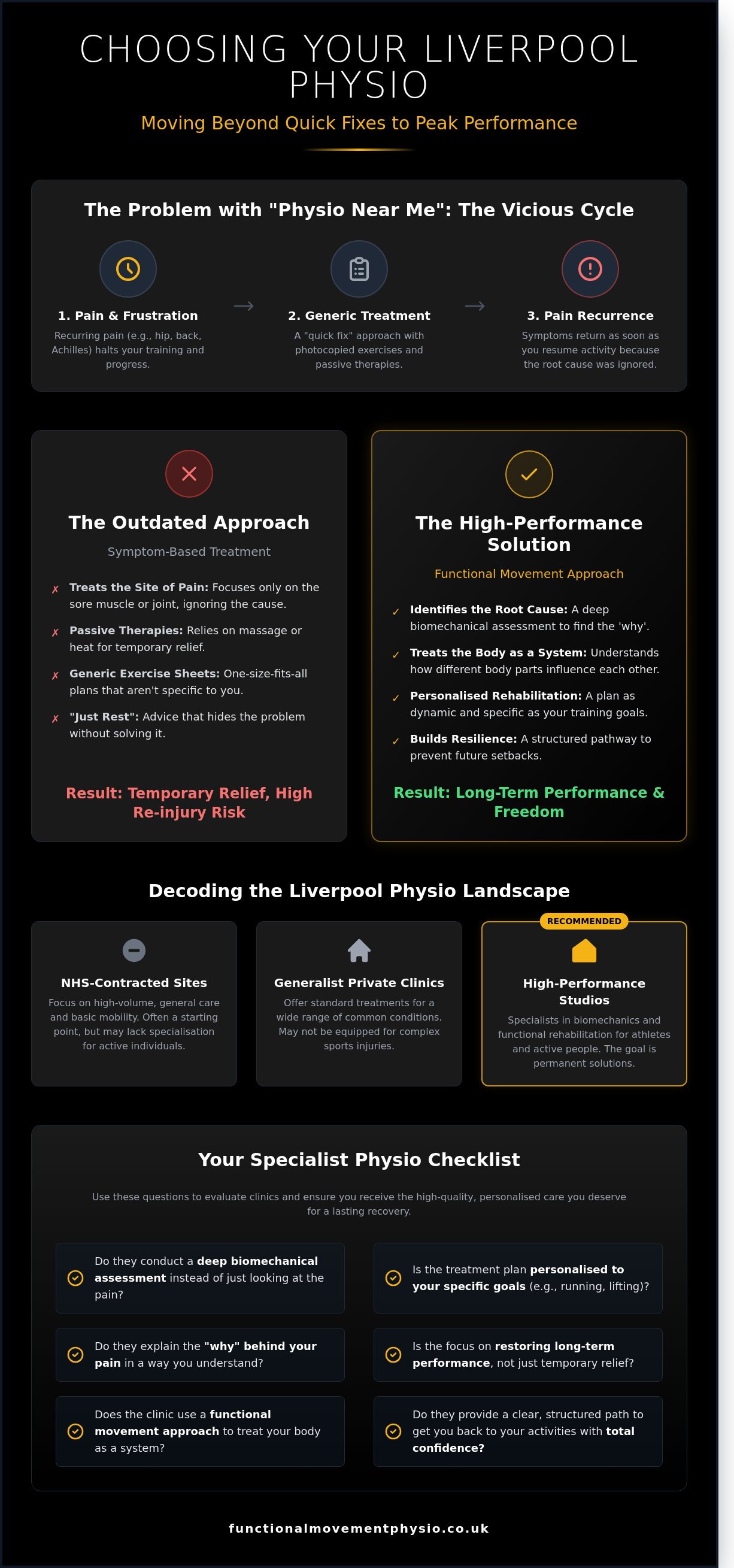
The physiotherapy landscape in Merseyside is diverse. You will find several types of facilities across the city:
- NHS-contracted sites: These often focus on high-volume general care and basic mobility.
- Generalist private clinics: These typically offer standard treatments for a wide range of age-related conditions.
- High-performance movement studios: These specialise in biomechanics and functional rehabilitation for active individuals.
Generalist care often follows a standard protocol that might not align with an active lifestyle. If you are a weekend warrior or a competitive athlete, you need a movement-focused specialist. These practitioners look at how you run, jump, and lift, ensuring your rehabilitation programme is as dynamic as your training. Choosing a clinic that aligns with your specific lifestyle is the first step toward a permanent solution rather than a temporary patch.
The Problem with Quick Fixes: Why Symptom-Based Treatment Fails the Active Individual
Many people searching for a physio near me in Liverpool have already been through the standard treatment loop. You might have received a 20 minute sports massage or a photocopied exercise sheet that looks the same as everyone else's. These methods often provide a fleeting sense of relief for 24 to 48 hours, but the underlying issue remains untouched. Treating the site of pain is a surface-level strategy that fails to address why the tissue became overloaded in the first place.
Pain is frequently a messenger, not the actual source of the problem. If you only treat the symptom, you're essentially silencing a fire alarm without putting out the fire. This logic applies to any complex system; for instance, just as Parallel Plumbing and Heating focuses on finding the root cause of a leak rather than just managing the water damage, a specialist physio must identify the mechanical driver of your pain. You're often told to "just rest," but rest usually just hides the problem until you move again, at which point the dysfunction reappears because the root cause was never corrected.
The cycle of recurring injury and frustration
Being stuck in a recovery plateau is mentally exhausting. You feel better for a week, return to your training programme, and the pain immediately returns during your first set of squats or your second mile. This "boom-bust" cycle creates a deep-seated fear of making the injury worse. This anxiety is a natural response to conflicting advice and failed treatments.
Your brain is highly efficient at creating compensatory patterns to avoid pain. For example, a stiff ankle from an old sprain might be the secret driver behind your persistent knee pain. Your body shifts the load elsewhere, leading to a secondary injury that seems unrelated. Breaking this cycle requires a practitioner who looks at the whole picture rather than just the area that hurts. You can start your recovery journey today by identifying these hidden patterns.
Why generic exercise sheets do not work
High-volume clinics often rely on a "one size fits all" model to save time. Without a comprehensive biomechanical assessment, these generic exercises are essentially guesswork. To actually change tissue health and movement patterns, you need specific loading and progression tailored to your unique anatomy. The Chartered Society of Physiotherapy maintains high standards for professional conduct, emphasizing that effective rehabilitation must be evidence-based and patient-centric.
- Lack of Specificity: Generic sheets don't account for your specific limb length, muscle imbalances, or training history.
- Poor Loading: Exercises must be heavy or complex enough to trigger a physiological change in the body.
- No Progression: Doing the same three movements for six weeks won't prepare you for the demands of high-performance sport.
You deserve a bespoke plan that bridges the gap between basic rehabilitation and your peak performance goals. Movement is the foundation of your health, and your treatment should reflect that by focusing on long-term functional capacity rather than temporary patches.
The Root Cause Approach: How Functional Movement Restores Long-Term Performance
When you search for a physio near me, you are likely looking for immediate relief from a specific pain. However, true recovery requires us to look beyond the site of your discomfort. We focus on identifying exactly why your tissue failed in the first place. Your body operates as a single, integrated system rather than a series of isolated components. If your knee hurts, the problem often originates in your hip or ankle. By assessing your whole kinetic chain, we ensure that your recovery is a permanent resolution rather than a temporary patch. This comprehensive outlook is why our approach is the gold standard for athletes and active individuals in Liverpool who want to return to high-level activity. You can read more about our specific philosophy in our guide on Expert Physiotherapy Liverpool: Mastering Movement and Resolving Root Causes.
Understanding biomechanics and movement patterns
Biomechanics is the science of how your muscles, bones, and joints interact to produce movement. A specialist physio in Liverpool uses this science to spot "weak links" in your movement patterns that lead to tissue overload. If you understand how your body moves, you gain the power to prevent future injuries yourself. This knowledge supports your longevity and helps you maintain peak performance in your sport. It's about moving better to live better. According to NHS guidance on physiotherapy, this type of physical approach is vital for restoring movement and function after injury or illness.
The role of specialist assessments in diagnosis
Effective diagnosis happens when we see you move. We don't just assess you while you are lying on a treatment plinth; we watch how you squat, lunge, or run. This functional testing reveals the true nature of your dysfunction in real-world scenarios. We use manual therapy as a precise tool to reduce pain and facilitate better movement, but it isn't the final destination. Our process involves a clear transition from hands-on work to active rehabilitation. This ensures you build the strength and stability needed for a successful, permanent recovery. Finding a physio near me who prioritises this level of detail is the difference between managing a recurring niggle and achieving lasting freedom from pain.
- Mobility: Ensuring your joints have the necessary range of motion.
- Stability: Controlling that range of motion under load.
- Strength: Building the capacity to perform at your best without breakdown.
This systematic approach provides you with a clear roadmap. You won't be left guessing about your progress or wondering if the pain will return. We provide the tools and the evidence-based strategy to help you master your own body.
The Buyers Checklist: How to Compare Liverpool Physiotherapy Clinics Effectively
When you search for a physio near me, the results page can feel overwhelming. A polished website doesn't always translate to clinical excellence. You need to look for specific indicators that a clinic prioritises long term recovery over temporary relief. Finding a specialist physio near me shouldn't be a game of chance; it's a calculated decision based on clinical markers and proven results. High quality care is built on a foundation of evidence based practice and advanced diagnostic tools that go beyond simple massage or heat packs.
Verifying credentials and clinical experience
Your safety is non-negotiable. Every practitioner you consider must be registered with the Health and Care Professions Council (HCPC) and should hold membership with the Chartered Society of Physiotherapy (CSP). These certifications ensure the clinician adheres to strict professional standards and remains updated on the latest medical research. Don't be afraid to ask about their specific experience with your injury type.
Look for experience that matches your lifestyle goals. If you're recovering from a complex sports injury or post-operative rehab, a generalist approach often falls short. When reading reviews, ignore generic praise about friendly receptionists. Instead, look for stories of tangible outcomes. You want to see testimonials from patients who returned to the 2026 Liverpool Half Marathon or regained the ability to train in the gym without pain. A reputable clinic is always transparent about their team’s specialisms and clinical history.
Assessing technology and treatment modalities
Modern physiotherapy has moved far beyond the treatment couch. A clinic committed to your progress will invest in technology that provides objective data. This includes tools like shockwave therapy for chronic tendon issues or video gait analysis for biomechanical assessment. For runners, a comprehensive gait analysis in Liverpool is essential to identify the root cause of recurring injuries rather than just treating the site of pain.
A holistic approach is also vital. A clinic offering a diverse range of modalities, such as medical acupuncture or clinical pilates, demonstrates a commitment to treating the whole person. Check if the facility includes a dedicated rehab space or gym area. Functional testing requires room to move; if a clinic only has small treatment rooms, they can't effectively assess how your body performs under load. The presence of advanced technology shows a commitment to modern, evidence based practice that focuses on your long term performance.
The first step in your recovery journey is a thorough assessment that looks at how you move. You can Book your Initial Physiotherapy Consultation in Liverpool to begin identifying the true cause of your limitations.
Taking the Next Step: Your Path to Professional Recovery in Liverpool
You have likely spent weeks or months searching for a physio near me while dealing with the persistent frustration of an injury that just won't quit. It's an exhausting cycle of temporary relief followed by a return to the same old limitations. Our goal is to break that cycle. At Functional Movement Physiotherapy, we don't just aim to stop your pain. We want you to move with more confidence and efficiency than you did before your injury occurred. This is about total physical empowerment, not just a quick fix.
Preparing for your initial consultation
Your first visit is a comprehensive evaluation designed to uncover why your body is struggling. To get the most out of this session, please wear appropriate clothing such as shorts or a vest top. This allows us to observe your biomechanics and joint alignment accurately. If you have any previous medical reports or scan results from the last 12 months, bring those along too. They provide valuable context for your clinical history.
Think about your specific objectives before you arrive. Are you training for the Liverpool Marathon, or do you simply want to pick up your grandchildren without a sharp twinge in your lower back? Your goals define our strategy. Expect to move during this session. We won't just sit and talk; we will test your functional capacity through various movements. You will leave the clinic with a clear diagnosis and a structured recovery roadmap that explains exactly how we will get you back to peak performance.
Committing to a sustainable movement plan
True recovery is a partnership between you and your specialist. We provide the expertise and the manual therapy, but the most significant results come from your consistency with the bespoke plan we create. A root cause approach requires more patience than a simple rub-down or a heat pack, but it delivers results that actually last. When we address the underlying dysfunction, we stop the injury from recurring. This is the difference between managing a symptom and mastering your body.
Investing in your long-term physical health means moving away from the "patch-up" mentality. It's about building a body that is resilient and capable of meeting the demands of your lifestyle. There is a profound sense of freedom that comes with a body that moves well. Stop settling for a life dictated by physical limitations. It is time to take control of your recovery and build a stronger foundation for the years ahead. Finding a specialist physio near me is the first step toward that freedom.
Just as you seek professional help to navigate injury recovery, other life-changing milestones like moving to the UK to be with a partner require expert guidance; for those in this situation, it is wise to explore Spouse Visa Application Service to ensure a smooth transition alongside your physical rehabilitation.
Don't let another week pass in discomfort. Book your appointment at our Liverpool clinic today and start your journey toward lasting movement health.
Take Control of Your Recovery and Performance
You deserve a recovery plan that looks far beyond the surface. Finding a physio near me in Liverpool shouldn't just be about the shortest commute; it's about finding a clinical partner who understands the intricate biomechanics of your movement. By choosing HCPC Registered Specialists who prioritise root cause focused treatment over temporary symptom relief, you ensure your body is built for longevity rather than just a quick fix.
Whether you require a Specialist Runner Gait Analysis to refine your stride or a comprehensive functional assessment to resolve chronic discomfort, the goal remains the restoration of full, meaningful activity. Don't let the frustration of recurring injuries or the fear of worsening your condition keep you on the sidelines. Moving from limitation to peak performance requires a structured, evidence-based approach that values your long-term health and resilience.
You now have the criteria to compare clinics effectively and select a specialist who treats you as an individual rather than a set of symptoms. It's time to stop managing your pain and start mastering your movement.
Book Your Initial Consultation in Liverpool
We look forward to helping you get back to doing what you love with absolute confidence.
Frequently Asked Questions
How do I find the best physio near me in Liverpool?
To find the best physio near me in Liverpool, you should prioritise clinics that focus on root cause diagnosis rather than temporary symptom relief. Ensure the practitioner is one of the 24,000 physiotherapists registered with the Health and Care Professions Council (HCPC) in the UK. Look for reviews from patients with similar goals, such as returning to the gym, to ensure their expertise aligns with your specific movement needs.
Do I need a GP referral for private physiotherapy in Liverpool?
You don't need a GP referral to access private physiotherapy in Liverpool. Most private clinics allow you to book an initial assessment directly, which can save you the 4 to 6 week wait often associated with NHS primary care pathways. This immediate access means you can start your recovery journey sooner, preventing minor musculoskeletal issues from developing into chronic compensations that limit your daily performance.
What should I wear to my first physio appointment?
You should wear comfortable, loose-fitting clothing that allows your specialist to clearly observe the affected area. If you're seeking help for a lower limb or back issue, please bring a pair of shorts. For neck or shoulder assessments, a vest top is most effective. This ensures your therapist can perform a detailed biomechanical analysis of your movement patterns without any physical obstructions from heavy fabric.
How many physio sessions will I need to see results?
Most patients experience a measurable improvement in their functional capacity within 3 to 6 sessions. While every injury is unique, your specialist will provide a structured recovery timeline following your 45 minute initial assessment. We focus on long term resilience rather than quick fixes, ensuring you have the tools to maintain your progress and prevent the recurrence of pain during high intensity activities or daily tasks.
Can a physio help with chronic pain that has lasted for years?
Yes, physiotherapy can effectively resolve chronic pain by identifying the deep-seated compensatory patterns that keep your pain cycle active. Even if you've struggled for over 2 years, a root cause approach looks beyond the site of pain to find the underlying movement dysfunction. By addressing these biomechanical triggers, we help you break free from frustration and return to the activities you've been avoiding.
What is the difference between a physio and a sports therapist?
Physiotherapists are university-trained, regulated healthcare professionals with a broader clinical scope than sports therapists. While a sports therapist focuses specifically on athletic injuries, a physiotherapist manages complex musculoskeletal conditions, post-surgical rehabilitation, and neurological issues. This deeper medical training allows for a more comprehensive assessment of your overall health, ensuring every factor influencing your recovery is professionally managed.
How much does a private physio session cost in Liverpool?
Private physiotherapy costs in Liverpool vary depending on the clinic's location and the specialist's expertise. You'll typically find that an initial consultation, which includes a full diagnostic assessment, is priced differently than subsequent follow up treatments. It's best to check the clinic's website for transparent pricing. This ensures you can plan your rehabilitation budget effectively while investing in high quality care that targets the source of your discomfort.