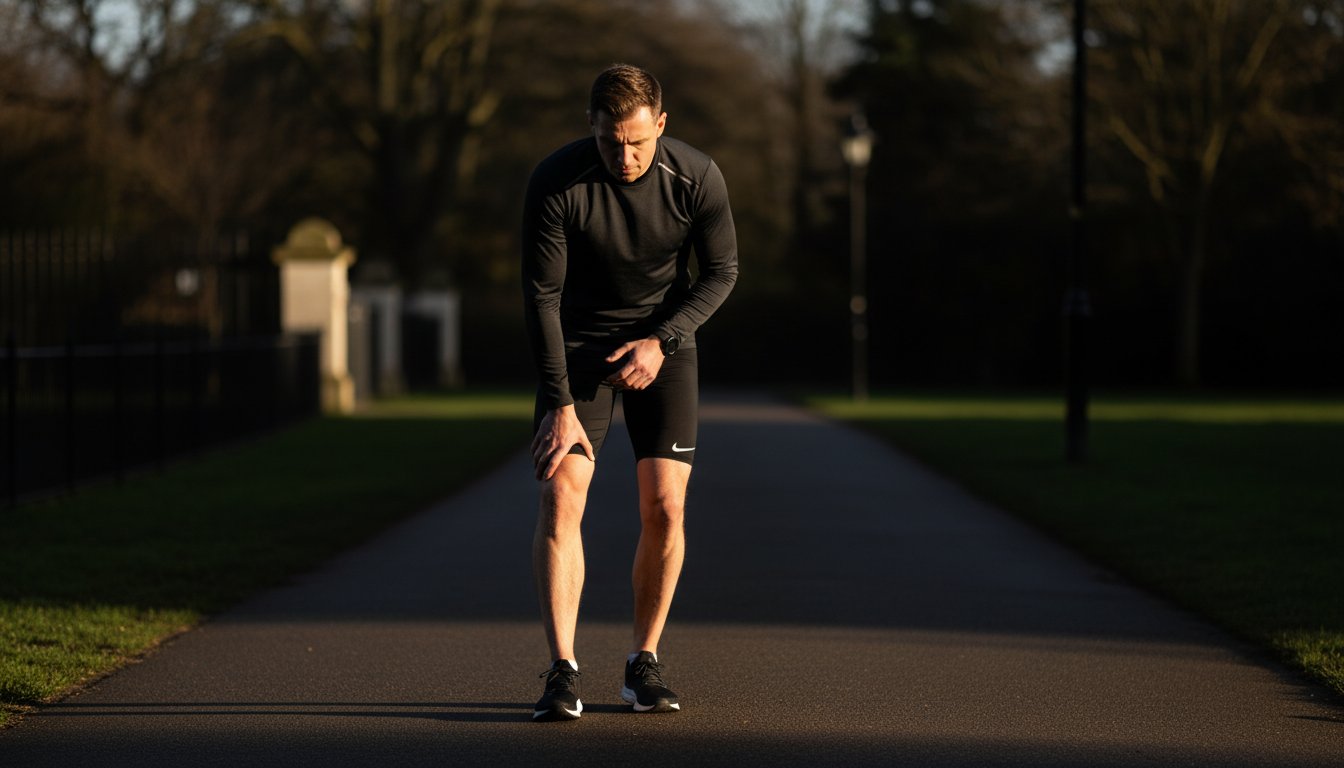
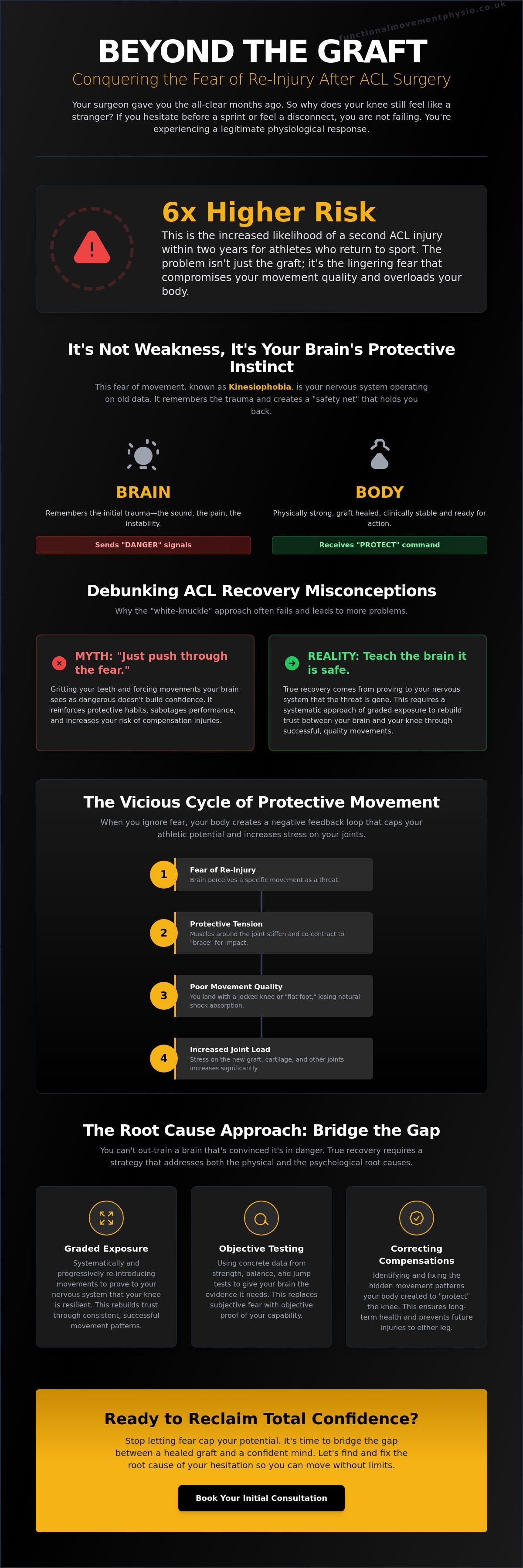
Why does your knee still feel like a stranger even though your surgeon gave you the all-clear months ago? It is a heavy burden to carry, especially when you know that athletes who have undergone reconstruction face a nearly six times higher risk of a second injury within their first two years of returning to sport. If you find yourself hesitating before a sprint or feeling a disconnect between your brain and your joint, you aren't failing your rehab. This fear of re-injury after ACL surgery is a legitimate physiological response where your nervous system prioritizes protection over performance.
We believe that true recovery requires more than just a strong graft; it requires a brain that trusts the body. You will discover how psychological apprehension manifests as physical tension and learn how a root cause approach to movement can help you reclaim total confidence. We will break down the steps to transition from physical limitation to peak performance, ensuring you understand exactly why you feel this way and how to finally move without hesitation.
Key Takeaways
- Understand why your brain uses hesitation as a biological protective mechanism rather than a sign of physical weakness.
- Discover how the fear of re-injury after ACL surgery creates subconscious physical tension that can compromise your movement quality.
- Challenge common myths about graft strength and learn why simply pushing through the pain often creates more problems than it solves.
- Explore how graded exposure and objective testing provide the concrete evidence your nervous system needs to trust your knee again.
- Learn how a root cause approach to recovery helps you bridge the gap between clinical stability and high-performance movement.
Understanding the Fear of Re-injury After ACL Surgery
You have spent months in the gym. Your quads are back, the swelling is gone, and your surgeon is happy. Yet, when you think about returning to the pitch or hitting a heavy squat, your body says no. This is not a lack of willpower. It is often kinesiophobia, a clinical term for an excessive fear of movement. It is incredibly common in the recovery journey, affecting a significant portion of the athletic population. Statistics show that while many athletes technically recover, about 8% never return to their sport at all because the mental hurdle is simply too high.
Feeling hesitant is a normal biological protective mechanism. Your brain is a master at pattern recognition. It remembers the exact moment of the tear, the sound, and the initial pain. Even after a successful Anterior cruciate ligament reconstruction, your nervous system might still be operating on old data. It treats your knee like a fragile glass structure rather than the resilient joint it has become. This disconnect is why addressing the fear of re-injury after ACL surgery is just as vital as the physical exercises themselves.
One of the biggest frustrations for runners and gym-goers is that physical strength does not automatically resolve psychological fear. You can have the strongest hamstrings in the world, but if your brain doesn't feel safe, it won't let you use them. We must bridge the gap between clinical stability and your confidence to move at full speed. This is where professional mental health support, such as that provided by Klinik Psikolog Bahattin Bakır, becomes a vital component of a comprehensive recovery plan.
The difference between fear and anxiety
Fear is a response to a specific, immediate threat. You feel it when you are asked to land a jump or pivot on a damp surface. Anxiety is a broader, more persistent worry about your future performance or the long-term health of your knee. In a clinical physiotherapy setting, we treat these differently. Fear requires graded exposure to specific movements, while anxiety often requires objective data and education to prove to your mind that you are truly capable of returning to your previous levels.
Why your brain is overprotecting your knee
Your brain creates a "safety net" by subconsciously increasing muscle tension around the joint. This can feel like physical stiffness or a sense that the knee is "stuck," but it is actually your nervous system limiting your range of motion to keep you safe. This protection often persists long after the graft has fully integrated and healed. It is a lingering memory of trauma. To move forward, we have to teach your brain that the threat has passed through consistent, successful movement patterns.
The Problem: Why Pushing Through Fear Often Fails
Many athletes believe the only way to beat the fear of re-injury after ACL surgery is to grit their teeth and ignore it. They think that if they just do enough repetitions, the hesitation will eventually vanish. This "white-knuckling" approach is a mistake. When you force a movement that your brain perceives as dangerous, you don't actually build confidence. Instead, you reinforce protective habits that sabotage your performance and increase your risk of long-term issues.
Ignoring fear leads to a direct decline in movement quality. Your body is incredibly smart; if it doesn't trust the knee, it will find another way to complete the task. Often, this means shifting the load to your hips, your back, or the opposite leg. This compensation is a major reason why athletes who have had one reconstruction face a nearly six times higher rate of suffering another ACL injury within two years. You aren't just protecting the surgical knee; you are overloading the "healthy" one.
A symptom-based approach fails because it treats the hesitation as a character flaw rather than a physiological signal. If you only focus on the physical symptoms of weakness, you miss the psychological root cause. You cannot out-train a brain that is convinced it is in danger. If you feel stuck in this cycle, an Initial Physiotherapy Consultation can help identify these hidden movement compensations before they become permanent habits.
The hidden impact of protective movement patterns
When you are scared, you naturally stiffen. This manifests as landing with a "flat foot" or a locked knee during running or jumping. By reducing the natural bend in your joint, you lose your body's ability to absorb shock. This increases the vertical loading on your cartilage and the new graft. This fear also leads to muscle co-contraction, where your hamstrings and quads fire simultaneously to "brace" the joint. This constant bracing makes your movements clunky and slow, effectively capping your athletic potential and making you feel like your knee is no longer part of your body.
Why traditional gym work is not enough
Standard rehabilitation often relies heavily on machines like the leg press or leg extension. While these are excellent for building raw muscle mass, they are predictable and safe. Your brain knows exactly where the weight is going. Confidence on the pitch requires more than just quad strength. You need to react to unpredictable environments. Strength built in a controlled gym setting rarely translates to the split-second decisions required during a game. To truly retrain the nervous system, you must move beyond the machines and into drills that challenge your brain's ability to trust your body in real-time.
Myth vs Reality: Debunking ACL Recovery Misconceptions
When you are recovering from a major injury, the advice you receive can be a confusing mix of outdated beliefs and clinical jargon. Many runners and gym-goers assume that if they still feel a fear of re-injury after ACL surgery, it must mean the surgical graft is weak or the operation wasn't entirely successful. This is rarely the case. To reclaim your performance, we must separate the biological facts from the psychological myths that keep you stuck in a cycle of hesitation.
One of the most persistent myths is that wearing a brace is the only way to feel safe. While a brace provides a physical sensation of support, it often acts as a psychological crutch. It tells your brain that the knee cannot support itself, which actually prevents you from building internal trust. Similarly, there is a dangerous assumption that being "cleared for sport" by a surgeon is the same as being "ready for sport." Clinical clearance usually means the graft has healed biologically, but it doesn't account for whether you have the reactive speed or the mental confidence to handle a game-day environment.
You might also hear people say you will never feel 100 per cent again. We challenge this. With a root cause approach that addresses both the physical and the neurological aspects of movement, it is entirely possible to return to pre-injury performance levels. The goal isn't just to get back to where you were; it's to become a more resilient and self-aware athlete than you were before the injury.
Myth: If the knee is strong the fear will go
Strength is essential, but it isn't a cure for kinesiophobia. Clinical evidence shows that athletes can achieve high strength scores on a leg press or extension machine while still experiencing a significant fear of re-injury after ACL surgery. Strength in a controlled environment does not automatically translate to psychological readiness. Confidence is a skill that must be practiced just like a squat or a sprint. It requires specific, intentional exposure to the movements that scare you in a safe, clinical setting.
Myth: Avoiding scary movements keeps you safe
It feels logical to avoid pivoting, jumping, or sudden stops if those movements cause anxiety. However, avoidance is the primary driver of persistent fear. Every time you skip a challenging drill, you reinforce your brain’s belief that the movement is dangerous. This "safety seeking" behaviour keeps your nervous system in a state of high alert. True safety doesn't come from avoiding the pitch; it comes from the mastery of movement. Gradual, progressive exposure is the only evidence-based way to break the fear cycle and teach your brain that your knee is capable of handling high-intensity loads.
Practical Strategies to Rebuild Confidence in Your Knee
Rebuilding trust in your body after a major injury is not about "being brave" or ignoring your instincts. It is a systematic process of providing your brain with undeniable evidence that your knee is safe. When you experience a persistent fear of re-injury after ACL surgery, your nervous system is essentially stuck in a high-alert state. To lower this alarm, we use specific, evidence-based strategies that transition you from cautious movement to instinctive, high-performance activity.
One of the most effective tools we use is an external focus of attention. Instead of focusing on what your knee is doing during a jump, you focus on a target on the floor or the sound of your landing. Research shows that focusing on the joint itself often increases stiffness and hesitation. By shifting your focus to the outcome of the movement, you allow your body to self-organize and move more fluidly. This helps break the cycle of "over-thinking" every step you take on the pitch or in the gym.
Graded exposure and movement mastery
Graded exposure is the backbone of psychological recovery. We start with low-threat movements that you feel comfortable with and slowly increase the complexity as your confidence grows. If you are afraid of pivoting, we don't start with a full-speed game simulation. We might start with slow-motion weight shifts, then progress to controlled turns, and finally move into reactive drills. Using video feedback is a powerful part of this process; seeing with your own eyes that your knee is stable and aligned during a landing provides the "visual proof" your brain needs to let go of its protective bracing. For a clearer understanding of how this fits into your timeline, you can view our guide on Post-Operative Rehabilitation.
Neuromuscular retraining and gait analysis
Confidence is often undermined by subtle movement compensations that you might not even realize you're making. We use comprehensive gait analysis to identify exactly where your brain is still trying to protect the joint. For example, many athletes subconsciously use their hamstrings, specifically the biceps femoris, as a "brake" during landings. This creates a stiff-legged landing that actually increases joint stress. Neuromuscular retraining helps you "re-wire" the firing sequence of your muscles, ensuring your quads and glutes are doing the heavy lifting. This restores your natural shock absorption and makes your movement feel like "yours" again.
If you feel like your physical recovery is ahead of your mental readiness, it's time for a more targeted approach. You can book a Runner's Assessment to get objective data on your movement patterns and start rebuilding your confidence with a clear, data-driven plan.
The Root Cause Approach to ACL Rehabilitation in Liverpool
Recovering in Liverpool means you have access to more than just a standard rehab protocol. At Functional Movement Physio, we recognize that the gap between being "clinically healed" and feeling "performance ready" is where most athletes struggle. If you are still battling the fear of re-injury after ACL surgery, it is because your current rehabilitation hasn't yet addressed the neurological root cause of your hesitation. We don't just treat the joint; we treat the person behind the movement.
Our approach is built on the philosophy that you cannot guess your way back to peak performance. We use objective, functional data to silence the doubts in your mind. When you can see on a screen that your limb symmetry is within a safe margin or that your landing mechanics are consistent on both sides, the fear begins to lift. This data-driven reassurance is the foundation of a successful return to sport, providing the certainty that your brain needs to stop overprotecting the knee.
We prioritize long term resilience over temporary fixes. This means looking beyond the surgery site to assess your hips, ankles, and core stability. By fixing the underlying movement errors that may have contributed to your initial injury, we ensure that you don't just return to your sport, but you do so with more power and efficiency than before. This is the difference between surviving your recovery and mastering your physical capabilities.
How we bridge the gap between physio and performance
We don't just look at the knee; we look at the athlete. Our Liverpool clinic specializes in Post-Operative Rehabilitation that transitions you from the treatment table to the gym floor. We use rigorous functional testing to validate your readiness at every stage. This isn't about hitting a specific date on the calendar. It is about meeting specific performance markers that prove you are ready for the next level of intensity. By moving from physical limitation to peak performance, we help you reclaim the instinctive movement that made you love your sport in the first place.
Your roadmap to full purposeful movement
A clear, structured plan is the best antidote to the anxiety of the unknown. When you know exactly what the next stage of your recovery looks like, the fear of re-injury after ACL surgery becomes a manageable hurdle rather than an invisible wall. We provide a sustainable roadmap focused on realistic progress and long term joint health. Your journey back to the pitch, the gym, or the running trail starts with a thorough understanding of your current capacity and a direct path toward optimization.
It's time to stop letting hesitation dictate your activity levels. You can book your Initial Physiotherapy Consultation today to start your recovery with a team that values your performance as much as your health. Let’s work together to restore your confidence and get you moving with purpose again.
Reclaim Your Confidence and Return to Peak Performance
You have learned that hesitation is a biological protective mechanism rather than a sign of a failing graft. By moving away from "white-knuckling" through exercises and embracing a strategy of graded exposure, you can retrain your nervous system to trust your body again. True recovery is about more than just strength; it is about bridging the gap between clinical stability and the instinctive movement required for the sports you love.
Addressing the fear of re-injury after ACL surgery is a vital step in your journey toward long-term resilience. Our expert Liverpool-based clinical team uses a root cause diagnostic approach to identify hidden compensations and build a roadmap tailored to your specific goals. We focus on sustainable results that go beyond simple symptom management, helping you master your own physical capabilities through specialist Post-Operative Rehabilitation.
You don't have to stay stuck in a cycle of frustration and doubt. Whether you are a runner looking to hit the pavement or a gym-goer ready to squat heavy again, the right support makes all the difference. Book your expert ACL recovery assessment in Liverpool today and take the first step toward full, purposeful movement. We are ready to help you unlock your potential and move with quiet confidence once more.
Frequently Asked Questions
Is it normal to be scared of jumping after ACL surgery?
Yes, it is completely normal because jumping requires the highest level of joint loading and reactive speed. Your brain perceives this as a high-risk activity and triggers a protective hesitation. This response is a biological safety mechanism designed to prevent further trauma while your nervous system is still integrating the reality of your new graft. It usually indicates that you need more graded exposure to landing mechanics in a safe environment.
How do I know if my ACL fear is psychological or physical?
You can distinguish between the two by looking at your performance in different environments. If you can move perfectly in a controlled gym setting but feel "stuck" or weak when you step onto a pitch, the root cause is likely psychological. Physical weakness is consistent regardless of the setting, whereas fear of re-injury after ACL surgery often manifests as a sudden loss of coordination or power only during unpredictable or high-stakes movements.
Can fear of re-injury cause actual pain in the knee?
Yes, fear can lead to real physical discomfort through a process called muscle co-contraction. When you are anxious, your brain signals the muscles around the knee to stiffen and "brace" for impact. This constant tension increases the pressure within the joint and can lead to a sensation of dull aching or sharp pinching. This isn't necessarily a sign of damage, but rather a result of your body's overprotective posture.
What is the best exercise to overcome fear after ACL reconstruction?
There isn't a single "best" exercise, but reactive drills are the most effective for building confidence. Exercises that require you to respond to a visual or auditory cue, such as a coach pointing in a direction for a lateral shuffle, force your brain to focus on the task rather than the knee. This external focus helps bypass the conscious hesitation and allows your body to move instinctively, which is essential for reclaiming your pre-injury performance.
How long does it take to get over the fear of re-injury?
The timeline varies for every individual, but psychological readiness often lags behind biological healing by several months. While a graft may be biologically stable at nine months, it often takes a full year of consistent exposure to high-intensity drills before the brain fully trusts the joint. Using objective movement data can significantly speed up this process by providing the mental proof required to silence your nervous system's alarm bells.
Just as data and education are key to overcoming ACL-related anxieties, those exploring other elective procedures can benefit from detailed medical resources, such as those provided by the Hair Transplant Malaysia Centre regarding recovery and potential side effects.
Should I wear a knee brace if I am scared of re-injury?
You should generally avoid using a brace as a long-term solution for fear. While it might provide temporary comfort, a brace can act as a psychological crutch that prevents your brain from learning that the knee is stable on its own. Relying on external support often reinforces the belief that the joint is fragile. True confidence comes from mastering movement mechanics and building internal strength rather than depending on a piece of equipment.
Can a physiotherapist help with the mental side of ACL recovery?
Absolutely, a physiotherapist plays a crucial role in bridging the gap between physical health and mental confidence. By using graded exposure and neuromuscular retraining, we help you confront and overcome the fear of re-injury after ACL surgery. We provide the objective testing and expert guidance needed to show your brain that your body is capable of handling the demands of your sport, ensuring a safe and successful return.