
What if the most influential factor in your long term success isn't the surgeon's precision, but the specific way you reintroduce movement in the days following your procedure? It is a frustrating reality that while the operation fixes the structural issue, the path to speeding up recovery after surgery often feels like a confusing maze of conflicting advice and the constant fear of re-injury. You want to get back to your training schedule, yet you feel stuck behind a wall of generic caution that doesn't seem to account for your specific athletic goals.
We understand that 'rest' often feels more like stagnation than progress. You deserve a clear roadmap that addresses the root cause of your physical limitations rather than just managing post-operative swelling. This article reveals the professional framework for restoring full mobility and preventing the secondary injuries that occur when movement patterns aren't properly corrected. We will provide you with the confidence to transition from physical limitation back to peak performance and the sports you love.
Key Takeaways
- Shift your mindset from passive waiting to an active process of restoring physical capacity and movement quality.
- Understand why relying on pain medication alone often masks symptoms and how speeding up recovery after surgery requires addressing the body's natural compensations.
- Learn the importance of a biomechanical analysis to identify muscle imbalances and movement restrictions caused by surgical trauma.
- Access a structured recovery checklist that provides a clear roadmap from your initial operation back to peak athletic performance.
- Discover how focusing on the root cause of your pain ensures you return to sport without the risk of secondary injuries.
Speeding Up Recovery After Surgery: More Than Just Waiting to Heal
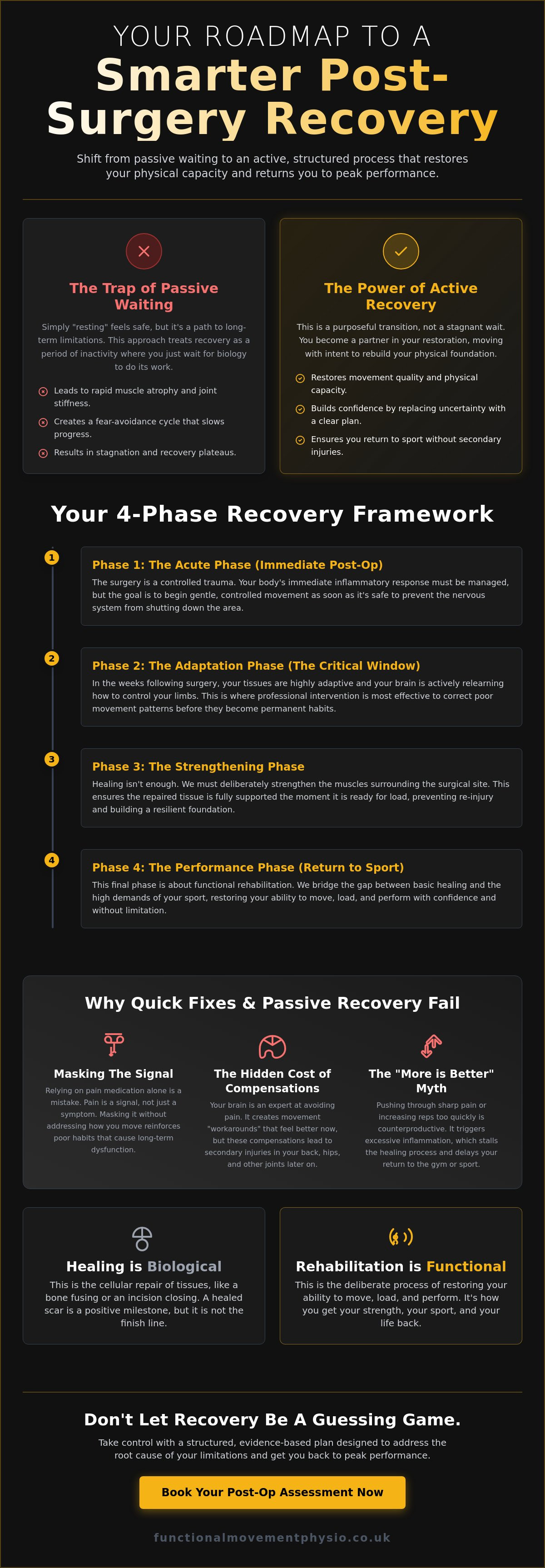
Recovery is often misunderstood as a period of total inactivity where you simply wait for the body to fix itself. In reality, speeding up recovery after surgery is an active, structured process of restoring your physical capacity and movement quality. While your surgeon has successfully addressed the structural issue, the procedure itself is a form of controlled trauma. This trauma triggers an immediate inflammatory response and can lead to rapid muscle inhibition. If you don't respond with a proactive plan, your nervous system begins to shut down movement to protect the area, which quickly leads to muscle atrophy and stiffness.
There is a critical window following your operation where professional intervention is most effective. During this phase, your tissues are highly adaptive and your brain is actively relearning how to control your limbs. Relying solely on passive recovery might feel safe, but it often leads to long term limitations that are difficult to correct months down the line. Convalescence should be viewed as a purposeful transition rather than a stagnant wait. While rest is a necessary component of the initial healing phase, it is only one tool in your toolbox. To return to running or high level sport, you must move beyond basic rest and begin the work of rebuilding your physical foundation.
The Difference Between Healing and Rehabilitation
It is vital to distinguish between biological healing and functional rehabilitation. Healing refers to the cellular repair of tissues, such as a bone fusing or a surgical incision closing. Rehabilitation is the deliberate process of restoring your ability to move, load, and perform. A healed scar is a positive milestone, but it doesn't mean your muscles are ready to absorb the impact of a sprint or a heavy squat. Biological timelines for ligament and tendon repair dictate the absolute ceiling of your recovery speed. You cannot force cells to knit faster, but you can ensure that your surrounding musculature is strong enough to support the new repair the moment it is ready for load.
Why Your Mindset Matters for Post-Operative Success
The psychological aspect of recovery is just as impactful as the physical. It's completely natural to feel a sense of anxiety when first moving a joint that has been operated on. However, this fear-avoidance often creates a cycle of tension that slows down your physical progress. We focus on replacing that uncertainty with a sense of quiet confidence by providing a structured, evidence-based plan. You aren't just a recipient of medical care; you are a partner in your own restoration. When you understand the clinical reasoning behind each exercise, you move with purpose. This shift from "protecting" to "preparing" is what allows you to master your physical capabilities and reach peak performance faster.
The Problem: Why Quick Fixes and Passive Recovery Often Fail
Many individuals fall into the trap of believing that pain management is synonymous with recovery. While medication serves a purpose in the initial days for comfort, relying on it as your primary strategy is a mistake. Pain is a signal, not just a symptom. When you mask that signal without addressing how you are moving, you risk reinforcing poor habits that lead to long term dysfunction. Speeding up recovery after surgery requires a focus on movement quality rather than just numbing the sensation of the procedure.
A common frustration for athletes and active individuals is the recovery plateau. You might experience a surge of progress in the first few weeks as the initial swelling subsides, only to find yourself stuck a month later. Truly speeding up recovery after surgery involves identifying these subtle shifts before they become ingrained. There is also a pervasive myth that 'more is always better' in early rehab. Pushing through sharp pain or doubling your repetitions too early often triggers excessive inflammation, which actually stalls the healing process and delays your return to the gym.
The Hidden Cost of Movement Compensations
Your brain is exceptionally skilled at avoiding pain. If you have had knee surgery, your body will instinctively shift your weight to the opposite side or alter your gait to protect the joint. While this is helpful for the first 48 hours, these compensations can quickly become permanent habits. We often see patients who come to us with lower back pain or hip issues months after a successful knee operation. Treating the back pain in isolation is a failed approach because the root cause is actually the altered gait from the original surgery. The body is a single, interconnected system; a restriction in one area will always manifest as a problem elsewhere.
Why Generic Exercise Sheets Aren't Enough
The standard exercise handouts provided upon hospital discharge are designed for the average person to achieve basic daily function. They are rarely sufficient for a runner who wants to return to the trail or a lifter aiming for a new personal best. These generic protocols lack the personalisation needed to address your specific muscle imbalances and athletic goals. Completing fifty repetitions with poor form is significantly less effective than performing five repetitions with perfect biomechanical alignment. To break through these limitations, you need a private physiotherapy assessment Liverpool to identify exactly where your movement patterns are failing. If you feel like your progress has stalled, a tailored Post-Operative Rehabilitation plan can help bridge the gap between basic healing and peak performance.
The Root Cause Approach: Restoring Functional Movement Patterns
While the previous section highlighted the dangers of movement compensation, we solve this through a dedicated root cause approach. Speeding up recovery after surgery isn't about forcing flexibility through aggressive stretching. It is about understanding why your body has restricted that movement in the first place. Often, a joint feels stiff because the surrounding muscles are no longer providing the stability your brain requires to feel safe. If we simply stretch a joint that the brain is trying to protect, we often see a cycle of increased tension and pain.
Our process begins with a comprehensive biomechanical analysis to map out the muscle imbalances created by your operation. This isn't a generic checkup. We examine how your hip interacts with your ankle, or how your shoulder stability affects your thoracic spine. We use specific functional tests to provide objective data on your movement quality. This data ensures we only progress your load when your body is truly ready, rather than following an arbitrary calendar date. We treat you as an individual with specific goals, whether that means returning to competitive running or simply being able to enjoy gardening without discomfort.
Re-educating the Neuromuscular System
Surgery acts as a mute button for certain muscle groups. Your brain effectively loses the ability to recruit the glutes or quads efficiently because of the trauma, swelling, and period of inactivity. We use targeted activation drills to switch these dormant muscles back on and restore the communication between your nervous system and your limbs. Incorporating Clinical Pilates Liverpool is a highly effective way to restore core and pelvic stability during this phase. It provides a controlled environment to master your physical capabilities before you return to the unpredictable demands of high impact sport.
Graded Loading: The Science of Progress
Progress should be measurable and evidence-based. We use the principle of graded loading to safely increase the stress on your tissues, allowing them to adapt and grow stronger without being overwhelmed. The most reliable metric for speeding up recovery after surgery is how your joint reacts 24 hours after an activity. If there is no increase in pain or swelling the following day, we know the load was appropriate and we can continue to build. This clinical precision prevents the common boom and bust cycle where you feel great one day, overdo it, and spend the next three days regressing. Professional guidance ensures your trajectory remains consistent and sustainable.
Your Essential Recovery Checklist: Actionable Steps for Long-Term Progress
To achieve a high performance outcome, you need more than a list of exercises; you need a strategic plan that addresses every variable within your control. Speeding up recovery after surgery is as much about what you do in the weeks leading up to the procedure as it is about the work you do in the clinic afterward. This checklist provides the practical anchors required to bridge the gap between hospital discharge and your return to peak physical capacity. You are not just waiting for time to pass. You are building a foundation for sustainable movement.
The Pre-Operative and Immediate Post-Op Phase
- Engage in pre-habilitation: Building strength and range of motion before your operation creates a physical buffer. Optimising your health before surgery significantly reduces hospital stays and postoperative complications by ensuring your muscles are prepared for the coming challenge.
- Prioritise protein and hydration: Your body requires a surplus of building blocks for tissue synthesis. Aim for high quality protein sources at every meal to mitigate the muscle atrophy that naturally follows a period of reduced activity.
- Manage swelling strategically: Use prescribed icing and elevation protocols to control the inflammatory response. The goal is to reduce pain and pressure enough to allow for early, pain free movement, rather than using ice to completely numb the area and remain sedentary.
The Active Rehabilitation and Movement Phase
- Schedule a professional assessment: Do not guess your way through recovery. Book an initial consultation to establish a clear Post-Operative Rehabilitation roadmap that identifies your specific biomechanical needs and long term athletic goals.
- Focus on adjacent joints: Perform daily mobility drills for the joints above and below the surgical site. If you have had knee surgery, maintaining hip and ankle mobility is essential to prevent the compensations that lead to secondary injuries.
- Track functional milestones: Stop counting the days since your operation and start measuring what you can actually do. Can you balance on one leg? Can you perform a bodyweight squat with equal weight distribution? These are the metrics that matter for speeding up recovery after surgery.
- Integrate stability work: Use low impact conditioning like Clinical Pilates to maintain core and pelvic stability. This ensures your entire system is prepared to support your primary joint as you return to higher impact loads and sports.
If you are ready to move beyond generic recovery advice and start your journey back to full movement, book your Post-Operative Rehabilitation assessment today to ensure you are addressing the root cause of your limitations.
Specialist Post-Operative Rehabilitation in Liverpool: Your Path to Full Capacity
Speeding up recovery after surgery is not a passive event that happens to you; it is a proactive journey that you lead with the right professional support. Choosing a specialist, root cause approach is the fastest way to return to the activities that define your lifestyle. You don't have to accept a recovery that feels incomplete or a body that feels permanently altered. By moving beyond basic symptom management and focusing on movement optimization, you ensure that your return to sport is sustainable and free from the risk of secondary injuries.
Our Liverpool team provides the clinical authority and empathetic encouragement you need to push through the uncertainty of the post-operative phase. We act as your high performance mentors, providing the expert guidance required to navigate each milestone with quiet confidence. This transition from physical limitation to peak performance is a structured process. We help you understand the clinical reasoning behind every intervention, ensuring you feel professionally guided at every touchpoint of your recovery. Speeding up recovery after surgery requires this level of clinical precision to ensure no movement pattern is left to chance.
Personalised Care at Functional Movement Physio
We pride ourselves on delivering one to one sessions that focus entirely on your specific biomechanical needs. Our expertise lies in working with runners, gym-goers, and active individuals in the Liverpool area who demand more than generic advice. We identify the muscle imbalances and compensatory patterns mentioned earlier in this guide, providing a clear path to bridge the gap between clinical discharge and the resumption of meaningful personal activities. Whether you are aiming for a marathon or simply want to walk the dog without pain, our approach is designed to restore full, purposeful movement.
Taking the Next Step in Your Recovery
The best time to start your professional rehabilitation is as soon as your surgeon allows. Early intervention prevents the development of the permanent compensations that often lead to chronic issues down the line. If you feel that your progress has stalled or if the advice you've received feels conflicting and vague, it is time for a more precise, evidence based strategy. We help you master your own physical capabilities so you can move forward without the fear of making your condition worse.
You have the power to influence how well you heal and how quickly you return to your best. Take the first step toward reclaiming your mobility and confidence today. Book your appointment online to begin your personalised recovery journey and ensure you are addressing the root cause of your physical limitations.
Take Control of Your Return to Peak Performance
Surgery is the beginning of your journey, not the end. To truly master your physical capabilities, you must transition from a mindset of protection to one of preparation. As we have explored, speeding up recovery after surgery is achieved by addressing the root cause of movement restrictions rather than simply managing post-operative symptoms. By following a structured checklist and focusing on neuromuscular re-education, you ensure that your return to sport is both safe and sustainable.
The team at Functional Movement Physio is dedicated to providing the clinical authority and personalised care needed to help you reach full capacity. Our Liverpool based clinic specialises in helping athletes and active individuals overcome the plateaus that often follow major procedures. We don't just treat the injury; we help you rebuild a foundation for purposeful movement and long term resilience.
Similarly, for patients seeking expert guidance in the Milton Keynes, Northampton, and Towcester regions, RED Physiotherapy offers specialized rehabilitation services designed to bridge the gap between surgery and a return to full physical activity.
Additionally, if you are based in Perth, Western Australia, Bio Health Prosperity Wellness offers mobile allied health services to help you manage your recovery in the comfort of your own environment.
Book your post-operative assessment at Functional Movement Physio to start your personalised recovery journey today. You have the resilience to return to the activities you love; we provide the roadmap to get you there.
Frequently Asked Questions
How soon can I start physiotherapy after my surgery?
You can often begin your rehabilitation within days of your procedure, provided your surgeon has given the initial clearance. Early intervention is key to speeding up recovery after surgery as it prevents muscle inhibition and the buildup of excessive scar tissue. We focus on gentle mobility and activation drills in these early stages to maintain the communication between your brain and muscles while protecting the surgical site.
Is it normal to feel pain during my recovery exercises?
Mild discomfort or a stretching sensation is common, but you should never experience sharp, stabbing pain during your sessions. We use a 24 hour rule to monitor your progress; if your pain or swelling increases the day after exercise, the load was likely too high. Learning to distinguish between productive rehabilitation work and actual tissue irritation is a vital part of mastering your physical capabilities and ensuring long term safety.
Can I speed up my recovery by doing more exercises than prescribed?
Doing more than the prescribed amount of exercise rarely leads to faster results and often triggers a boom and bust cycle. Excessive repetitions can cause inflammation that stalls tissue repair and forces you to take several days off to recover. Speeding up recovery after surgery is about the quality of your movement and the consistency of your effort rather than sheer volume. Following the specific dosage provided ensures your tissues adapt without being overwhelmed.
What is the most important factor in a fast surgical recovery?
The most critical factor is the restoration of functional movement patterns rather than just waiting for the incision to heal. While tissue repair follows a biological timeline, how you load those tissues determines your long term physical capacity. A proactive approach that identifies and corrects compensatory habits ensures you return to full activity without developing secondary issues in other joints like your lower back or hips.
How do I know if my recovery is on track or if I am plateauing?
You are likely plateauing if you haven't seen an improvement in your functional milestones, such as range of motion or balance, for over two weeks. This often happens when the initial phase of healing ends and the body requires a more specific stimulus to progress. If you feel stuck, a biomechanical analysis can identify the specific muscle imbalances or dormant muscle groups that are preventing you from reaching the next level.
What happens if I don't do my post-operative rehabilitation?
Skipping professional rehabilitation often leads to permanent movement compensations, such as a subtle limp or a shift in weight distribution. These habits eventually cause secondary pain because your body is working inefficiently and overloading other structures. Without a structured plan, you may find that you never quite return to your pre-surgery level of strength, leaving you vulnerable to recurring injuries when you try to return to sport.
Will I be able to return to running after my operation?
Most patients can return to running if they follow a structured, graded loading programme that builds the necessary impact tolerance in the joint. We use specific assessments to ensure your mechanics are sound and your strength is symmetrical before you increase your mileage. The goal is to return to the trail or road with better movement quality and more resilience than you had before your operation.
How does nutrition actually affect my surgical healing speed?
Nutrition provides the essential building blocks, specifically high quality proteins and micronutrients, required for tissue synthesis and repair. Inadequate protein intake can lead to increased muscle wasting during your period of reduced activity, which significantly delays your physical progress. Proper hydration and a balanced diet create the optimal internal environment for your cells to knit and grow stronger, supporting the work you do in the clinic.