How to Build Core Strength to Prevent Back Pain: A Root Cause Guide

What if the very exercises you're doing to protect your spine are actually contributing to your recurring discomfort? Building core strength to prevent back pain is often misunderstood as a quest for visible abdominal muscles, but for many runners and gym-goers, traditional sit-ups only lead to more frustration and that familiar back tweak. It's exhausting to follow standard fitness advice only to remain fearful that one wrong move will set your progress back by weeks.
We understand how discouraging it is to feel stuck in a cycle of injury and "safe" movements. You likely recognize that a strong foundation is essential, yet the conflicting advice found online leaves you unsure of which muscles actually matter. True spinal protection doesn't come from brute force; it comes from the reflexive timing and coordination of your deep stabilizers. When these muscles function correctly, they act as a natural internal brace for your spine.
This guide will teach you how to move beyond generic core work toward a functional approach that addresses the root cause of your pain. You'll learn which muscle groups provide the most stability and how to follow a sustainable progression that leads to a pain-free return to lifting and running. Our goal is to help you transition from physical limitation to peak performance by mastering your own physical capabilities.
Key Takeaways
- Understand how your core functions as a 360-degree cylinder of support rather than just a set of visible abdominal muscles.
- Learn why traditional high-repetition crunches can increase spinal stress and how building core strength to prevent back pain requires a more strategic, evidence-based approach.
- Discover the importance of the diaphragm as the "lid" of your core to create functional stability during lifting, running, and daily tasks.
- Follow a clear three-step progression from basic muscle activation to static stability exercises that protect your spine under load.
- Gain practical strategies for integrating core support into daily life and using Clinical Pilates to achieve sustainable, long-term movement.
Why Core Strength Is Your Best Defence Against Recurring Back Pain
Most people associate the core with the visible "six-pack" muscles. In reality, your core is a complex network of muscles that extends far beyond the surface. It includes everything from your diaphragm at the top to your pelvic floor at the bottom, wrapping around your midsection like a high-performance corset. Understanding this distinction is the first step toward building core strength to prevent back pain effectively.
Your core functions as your body's primary suspension system. When you lift a heavy weight or sprint for a bus, your core distributes the mechanical load across your entire trunk. This prevents any single vertebra or disc from absorbing too much force. Think of a strong core as a natural, internal back brace. It provides the necessary stiffness to keep your spine in a neutral, safe position while your limbs perform the heavy lifting. Without this support, your lower back is forced to compensate for every movement, leading to the "tweaks" and strains that keep you sidelined.
In our clinic, we often see core dysfunction as the underlying factor in common Liverpool sports injuries. Whether you are training at a local gym or running along the Mersey, a lack of deep stability often manifests as recurring lower back stiffness. By focusing on core stability, you aren't just working on your physique; you are installing a protective shield for your spine.
The Difference Between Global Movers and Local Stabilisers
Your body uses two distinct types of muscles to manage movement. Global movers, like your rectus abdominis, are designed to create large, powerful motions. However, these "outer" muscles cannot compensate for a weakness in your "inner" core. True protection comes from local stabilisers like the transversus abdominis. This deep muscle layer provides specific lumbar support by increasing intra-abdominal pressure and tensioning the fascia around your spine. Local stabilisers are the spine's primary protectors.
Static vs Dynamic Stability
There is a significant difference between holding a static plank and protecting your back during a dynamic activity like running. While static exercises have their place, building core strength to prevent back pain requires reflexive engagement. This means your muscles must fire automatically in response to movement. If your core doesn't engage the moment your foot hits the pavement, your spine absorbs the impact. This lack of reflexive control is a primary root cause of many disc issues, as it allows for uncontrolled micro-movements that gradually wear down spinal tissues. We focus on training your body to activate these muscles naturally, ensuring you stay protected during every daily activity.
The Problem: Why Traditional Ab Workouts Often Fail to Protect Your Back
Many people believe that doing hundreds of crunches is the key to building core strength to prevent back pain. However, this high-repetition flexing can actually increase spinal shear forces. Every time you crunch, you compress the discs in your lower back. While your spine is designed to move, repetitive loaded flexion without proper stabilization creates unnecessary wear and tear. This is why you might feel "strong" in the gym but still experience a sharp tweak when performing a simple task like reaching for a low shelf.
Another common mistake is "bracing" too hard by holding your breath. If you create massive internal pressure without proper ribcage alignment, you aren't training stability; you're creating a rigid, brittle system. This often leads to overactive hip flexors. These muscles connect your legs directly to your lumbar spine. When they take over during leg raises or sit-ups, they pull your pelvis into an anterior tilt, increasing the arch in your lower back and stressing the facet joints. Instead of protecting your spine, you end up reinforcing the very patterns that cause discomfort.
It's incredibly frustrating to have "gym strength" that doesn't translate to pain-free living. This gap exists because traditional workouts often focus on the wrong muscles. For those looking for a safer foundation, the Mayo Clinic provides examples of safe core exercises that prioritize spinal neutrality over excessive movement. True resilience comes from muscles that can adapt to changing loads, not just those that can perform a repetitive motion against a floor.
The Myth of the Six-Pack
Visible abdominal muscles are often a result of low body fat rather than functional strength. While achieving a healthy weight with the help of the Houston Medical Wellness Clinic can reduce the mechanical load on your spine, you can still have a defined "six-pack" and suffer from significant core weakness. Aesthetic-focused training creates "blind spots" in your spinal stability by neglecting the deep, stabilizing layers like the multifidus and transversus abdominis. These deep muscles are responsible for micro-adjustments during movement. When they are weak, the larger "global" muscles try to compensate, leading to fatigue and injury. We must move past the idea that "stronger" always means "better" if the underlying form is compromised.
Why Quick Fixes and Generic Programs Stagnate
Generic YouTube workouts often ignore your unique biomechanical root causes. A program that works for a professional athlete might aggravate your specific disc issue or hip impingement. Relying on a one-size-fits-all approach to building core strength to prevent back pain often leads to a plateau where the pain never truly disappears. Symptom-based routines fail because they don't address why your back is vulnerable in the first place.
This vulnerability often ties back to how you carry yourself throughout the day. You can learn more about how your alignment impacts your recovery in our How to Fix Bad Posture Guide. If you feel stuck in a cycle of temporary relief followed by recurring pain, a professional assessment can help identify exactly where your movement patterns are breaking down.
The Root Cause Approach: Understanding Your Core as a Functional Cylinder
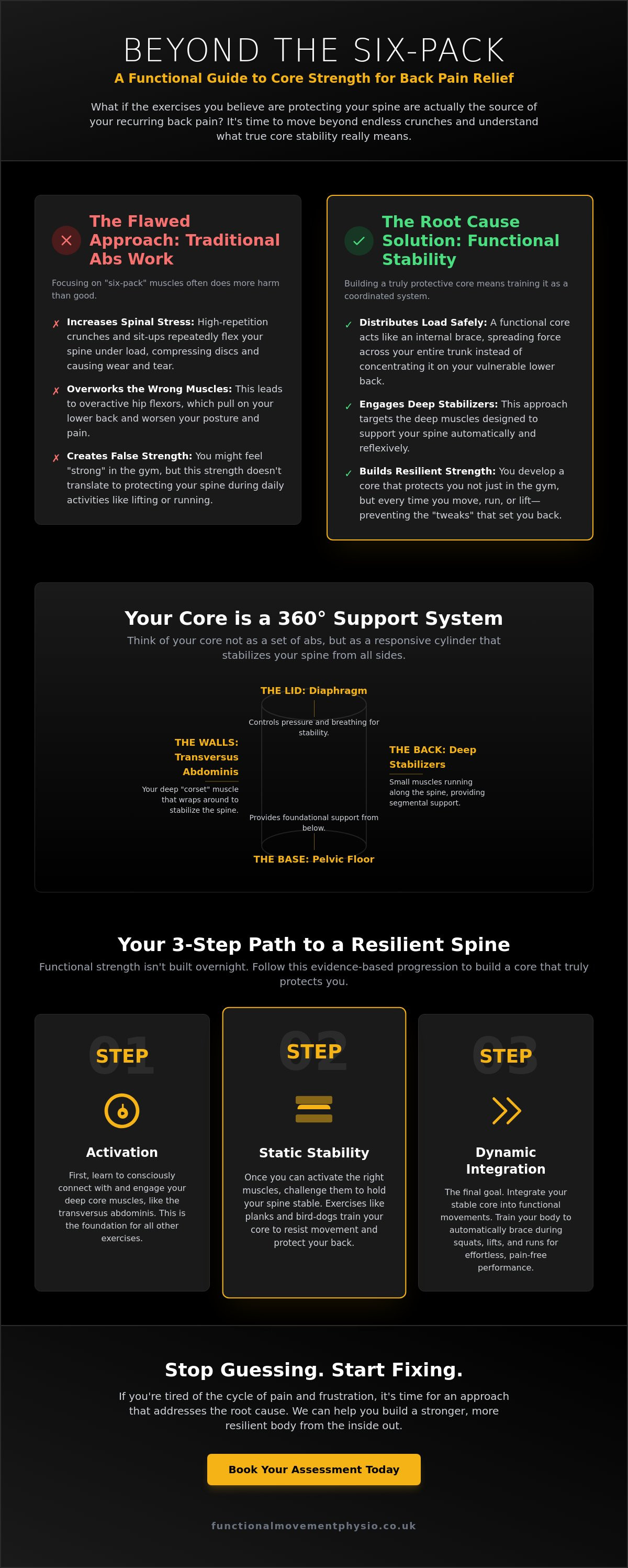
To move beyond temporary relief, you must stop viewing your core as a flat group of muscles on the front of your stomach. Effective building core strength to prevent back pain requires visualising your midsection as a 360-degree functional cylinder. This three-dimensional model ensures that every angle of your spine is supported, whether you are sitting at a desk or lifting a heavy barbell.
This cylinder consists of four essential components: the diaphragm at the top, the pelvic floor at the base, the transversus abdominis wrapping around the sides, and the multifidus supporting the back. When these muscles work in harmony, they create a stable environment for your vertebrae. If even one part of this system is weak or poorly timed, the entire structure becomes vulnerable to injury. This is why "six-pack" training often fails; it only addresses one side of the cylinder.
Intra-Abdominal Pressure: The Secret to Spinal Support
True stability is created through Intra-Abdominal Pressure. When you breathe correctly using your diaphragm, you create a sense of "internal buoyancy" that offloads the pressure on your spinal discs. Many people mistakenly "suck their stomach in" to look thinner or feel more stable, but this actually collapses the cylinder and weakens your functional core. Pressure management is the foundation of core stability.
Relying on this internal pressure system is far safer than traditional methods. Research into the dangers of traditional ab exercises shows that moves like sit-ups can actually force the spine into compromised positions. By mastering your breath and pressure, you protect your back from the inside out, ensuring your spine remains supported during both rest and high-intensity activity.
The Multifidus: Your Spine's Individual Muscle Guards
While the larger muscles move your body, the multifidus muscles act as individual guards for each segment of your spine. These tiny, deep muscles control the micro-movements of your vertebrae. Interestingly, these muscles often "switch off" or become dormant after just one episode of back pain. This leaves your spine unprotected even after the initial pain has faded, which is a common reason why back issues tend to recur.
Waking up these dormant stabilisers is crucial for long-term recovery. This isn't about high-intensity training; it's about subtle, targeted activation. If you feel like your back is constantly "giving out" or feels "tired" after light activity, it's likely your multifidus isn't firing correctly. Identifying these specific weaknesses is a key part of an initial physiotherapy consultation, where we can help you re-establish these vital connections and restore your body's natural protective mechanisms.
How to Build Functional Core Strength: A Progressive Three-Step Guide
Success in building core strength to prevent back pain isn't about the total number of repetitions you can grind out. It's about how effectively you can control your spine under varying degrees of challenge. We use a progressive three-step framework to ensure you master the foundations before moving to complex movements. This prevents the common mistake of adding "strength on top of dysfunction," which is a primary cause of recurring injury.
Mastering the basics is non-negotiable. If you cannot stabilize your spine while lying on the floor, you certainly won't be able to protect it while squatting or running. This systematic approach ensures your progress is sustainable and your spine remains resilient under load.
Step 1: Finding Your Deep Core Activation
Before you can stabilize your spine during a heavy lift, you must learn to activate your deep stabilizers in a controlled environment. The Deadbug is the gold standard for neutral spine awareness. Lie on your back with your arms reaching toward the ceiling and your knees bent at 90 degrees. As you slowly lower one arm and the opposite leg, your primary goal is to keep your lower back glued to the floor. Use a slow, controlled exhale to initiate the movement. This breath-first approach engages the diaphragm and pelvic floor, creating the internal tension necessary for true stability.
Step 2: Building Endurance without Spinal Stress
Once you can control your spine while lying down, you need to maintain that stability against gravity. The Bird-Dog exercise is excellent for engaging the multifidus and glutes simultaneously. From an all-fours position, extend one arm and the opposite leg while keeping your torso perfectly still. A common mistake in planks and similar holds is allowing the lower back to arch, which shifts the load from your muscles to your spinal joints. Focus on a "long spine" cue, imagining a straight line from the crown of your head to your tailbone. This phase is about building the stamina your muscles need to support you throughout the day.
Step 3: Moving from the Floor to Real Life
The final phase of building core strength to prevent back pain involves standing up. This is essential for Liverpool runners and gym-goers who need their core to function during dynamic movement. Anti-rotational work, such as the Pallof Press, teaches your body to resist unwanted motion. Hold a resistance band at chest height and press it away from you, resisting the band's pull to turn your torso. This skill translates directly to functional movements like squats or lunges. Standing core work is the bridge between rehabilitation and peak performance.
If you're unsure if you're activating the right muscles during these movements, a professional assessment can provide the clarity you need to progress safely and effectively.
Beyond Exercises: Integrating Core Stability into Your Daily Movement
True resilience isn't built in thirty minutes at the gym; it's established in the thousands of movements you perform every day. Building core strength to prevent back pain only works if you can transfer those skills to the real world. Whether you are lifting heavy groceries from the car or picking up your children, your core must act as a reflexive shield. This means your muscles should engage automatically before you even begin the movement.
Applying "core bracing" in daily life doesn't mean holding your breath or walking around like a statue. It involves a subtle engagement of your deep stabilizers to maintain a neutral spine under load. By practicing this during mundane tasks, you turn every movement into a mini-rehab session. This transition from conscious exercise to subconscious habit is what ultimately stops the cycle of recurring tweaks and injuries. We want to move you from a state of physical limitation to one of peak performance.
A professional gait or movement assessment can often identify hidden weaknesses that you might miss on your own. These assessments reveal how your body compensates during activity, allowing for a more targeted approach to your recovery. By identifying these root causes, you can stop guessing and start moving with confidence again.
For those outside of Liverpool seeking similar expert support, clinics like Fit & Healthy Chiropractic provide comprehensive wellness and spinal health services that align with these principles of functional recovery.
Clinical Pilates for Long-Term Resilience
For many, moving from basic activation to high-performance activity requires expert guidance. Clinical Pilates in Liverpool offers a bridge between rehabilitation and peak physical performance. Unlike a standard gym class, these sessions focus on identifying the specific root cause of your movement dysfunction. One-to-one supervision ensures your form is perfect, preventing the compensation patterns that often lead to back pain.
This specialized training builds the reflexive core strength needed for sports and complex daily activities. It refines your movement patterns so your body knows exactly how to distribute weight and manage pressure. By mastering these connections, you don't just fix a symptom; you optimize your entire physical capacity for long-term health and achieves sustainable results.
When to Seek a Professional Physiotherapy Consultation
While self-management is powerful, certain situations require a deeper clinical look. If you experience "red flags" such as radiating leg pain, numbness, or weakness that doesn't improve with rest, a professional diagnosis is essential. An Initial Physiotherapy Consultation provides the clarity needed to stop the cycle of recurring pain. We use detailed evaluations to uncover hidden weaknesses that generic programs often miss.
Your journey shouldn't end when the pain stops. We help you create a bespoke roadmap that moves you beyond recovery toward sustainable, pain-free movement. Building core strength to prevent back pain is a long-term investment in your freedom. By addressing the root cause today, you ensure that your spine remains protected for every run, lift, and daily challenge ahead. If you're ready to take the next step, you can book an appointment at book appointment.
Master Your Movement for a Pain-Free Future
You now understand that true spinal protection comes from a functional cylinder of support rather than just visible abdominal muscles. By mastering reflexive activation and following a structured progression, you can move away from the fear of injury and toward lasting physical freedom. Building core strength to prevent back pain is about more than just gym sessions; it's about reclaiming your ability to move with confidence in every aspect of your life.
We specialize in an expert Root Cause Approach to back pain, ensuring you don't just treat symptoms but fix the underlying movement patterns that cause them. From our clinic in the heart of Liverpool, we offer specialist Clinical Pilates 1:1 sessions to help you refine your form and build long-term resilience. You don't have to stay stuck in a cycle of recurring tweaks and frustration.
Take the first step toward peak performance and purposeful movement today. Book your Initial Physiotherapy Consultation in Liverpool today and let's work together to restore your full physical capabilities. You have the potential to live a life without limitation.
Frequently Asked Questions
Is core strength the same as having six-pack abs?
No, they are entirely different. Six-pack abs refer to the rectus abdominis, which is a superficial muscle designed for movement. True core strength involves the deep stabilizing layers, such as the transversus abdominis and multifidus, which wrap around your spine to provide support. You can have a visible six-pack and still possess a weak functional core that leaves your back vulnerable to injury.
Can I build core strength if I currently have active back pain?
Yes, you can and often should start gentle activation even during a pain episode. The key is to work within a pain-free range of motion to re-engage muscles that may have "switched off" due to injury. We focus on subtle movements that stabilize the spine without aggravating your symptoms, ensuring a safe transition back to full activity.
How often should I perform core exercises to see results?
Consistency is more important than intensity when building core strength to prevent back pain. Research suggests that 3 to 4 sessions per week for 30 to 45 minutes is highly effective for lasting relief. However, performing just five to ten minutes of daily activation can significantly improve your muscle timing and reflexive stability during everyday tasks.
Why does my back hurt more after doing sit-ups or crunches?
Sit-ups and crunches place significant compression and shear force on your spinal discs. If your deep stabilizers aren't firing correctly, your lower back joints absorb the load instead of your muscles. This repetitive flexing can aggravate existing sensitivities and reinforce poor movement patterns rather than protecting your spine.
Is a plank the best exercise for preventing back pain?
Planks are excellent for static endurance, but they aren't a universal solution. If your form breaks down and your back arches, the exercise becomes counterproductive by stressing your facet joints. Functional stability requires moving beyond static holds toward dynamic movements that mimic how you actually move during gym sessions or daily life.
How do I know if my deep core muscles are actually working?
Deep core activation feels like a subtle tightening or "hollowing" deep in your midsection rather than a superficial burn. You should be able to maintain this engagement while breathing naturally and moving your limbs. If you find yourself holding your breath or your stomach "domes" outward, you are likely over-relying on your outer abdominal muscles.
Can Clinical Pilates help me if I am an athlete?
Clinical Pilates 1:1 is a powerful tool for high-performance athletes. It identifies specific biomechanical weaknesses that can limit your power output or lead to recurring injuries. By refining the timing of your stabilizers, you improve your efficiency in movements like sprinting, jumping, and heavy lifting, allowing you to reach your peak physical capacity.
What is the most common mistake people make when building core strength?
The most frequent error is choosing "brute force" over coordination. Many people brace so hard that they hold their breath, which actually bypasses the deep pressure system your spine needs for support. Building core strength to prevent back pain requires mastering the subtle art of pressure management and reflexive control before adding heavy resistance or high-intensity repetitions.