Foot Strike Analysis for Running: Beyond the Shoe Fitting

What if the way your foot hits the pavement is actually a symptom of a deeper biomechanical issue rather than the primary cause of your pain? You've likely spent hours researching the latest trainers or been told that a professional foot strike analysis for running is only for choosing shoes. It's incredibly frustrating to feel stuck in a cycle of rest and new gear only to find that your recurring shin splints or knee pain returns the moment you pick up the pace.
I understand that conflicting advice makes it difficult to know who to trust. You want to run without the constant fear of worsening an injury. Identifying the genuine root cause of your limitations is the only way to achieve sustainable results. By looking at your movement as a whole, we can unlock your true performance potential and ensure you stay on the road for the long term.
This guide will explain why traditional gait analysis often misses the bigger picture and how a technical assessment provides a clear roadmap for technique improvement. You will discover how to transition from managing symptoms to mastering your own physical capabilities for a more efficient, pain-free run.
Key Takeaways
- Learn how your ground contact patterns influence impact forces and joint loading throughout your entire gait cycle.
- Discover how a professional foot strike analysis for running reveals if your technique is actually a symptom of hip or core limitations.
- Identify why forced changes to your foot strike often fail and how to implement sustainable neuromuscular retraining instead.
- Understand the technical differences between heel, midfoot, and forefoot striking to find the most efficient movement profile for your body.
- See how a specialized Runner's Assessment provides the data needed to move beyond temporary fixes and achieve long term, pain free performance.
Understanding Foot Strike Analysis for Running
You have likely been told that the right pair of trainers is the ultimate secret to pain free miles. While footwear plays a role, it's only one piece of a much larger biomechanical puzzle. A professional foot strike analysis for running is a systematic, clinical observation of how your entire body interacts with the ground during the gait cycle. It moves beyond simple pronation to examine the complex relationship between impact forces and joint loading.
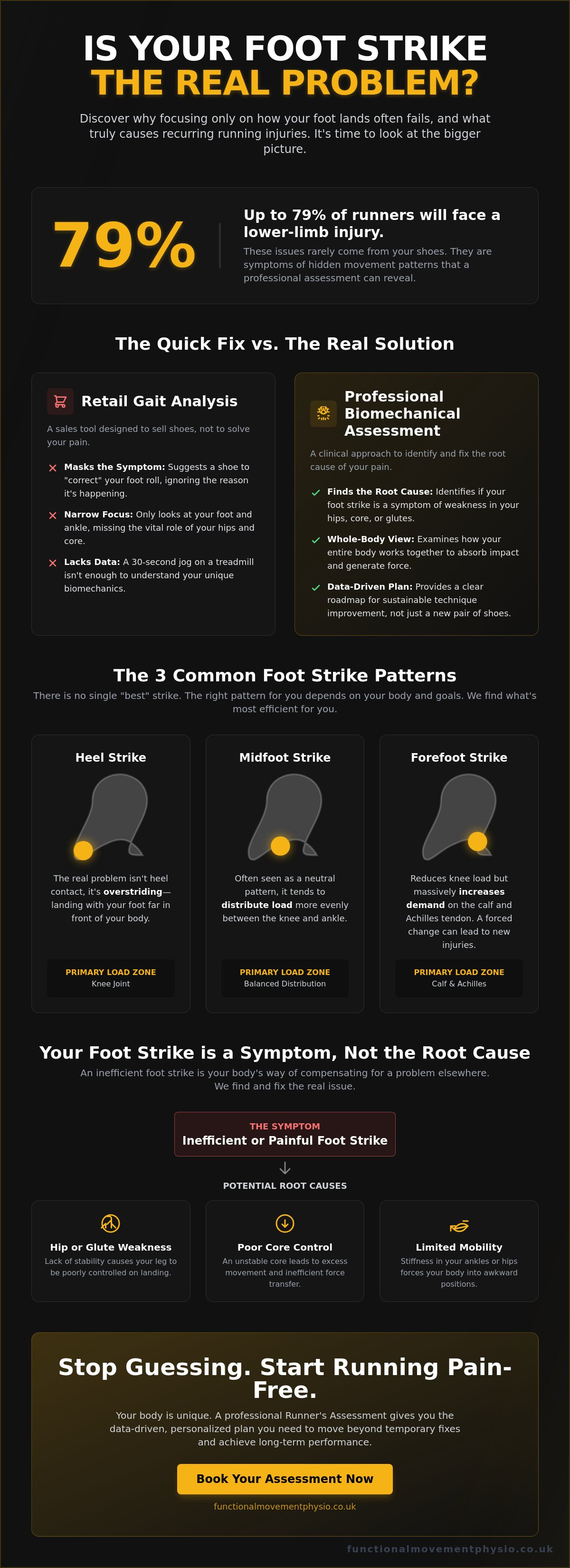
Most runners focus on cushioning or arch support, yet the way you move is the primary driver of your injury risk. Research suggests that up to 79% of runners will experience a lower limb injury at some point. These issues rarely stem from the shoe alone. Instead, they are often the result of movement patterns that your naked eye or a standard retail treadmill test simply cannot detect. A professional assessment identifies these hidden patterns, providing the data needed to protect your joints and improve your performance. For those seeking specialized clinical guidance, you can visit Local Foot Doc to see how podiatry experts analyze foot health to prevent recurring injuries.
The Problem with Retail Gait Analysis
A 30 second jog in a shoe shop is not a clinical assessment. Retail gait analysis is designed to sell shoes, which means the focus is almost exclusively on the ankle and foot. This narrow view ignores the vital role of your hips, knees, and core in stabilizing your stride. When a retail fix involves a specific shoe to stop your foot from rolling, it often just masks a symptom. It doesn't address the underlying weakness or restriction that caused the movement, leaving the root cause of your pain untouched.
Why Biomechanics Matter More Than Your Trainers
Your biomechanics determine how your body manages Ground Reaction Force. This is the force the ground exerts back on your body every time you land. If your mechanics are inefficient, this force isn't absorbed correctly by your muscles; it's transferred directly into your joints. Understanding Foot Strike requires looking at how these impact forces load your knees, hips, and lower back.
There's a significant difference between a natural, efficient strike and a forced technique change. Many runners try to fix their form by consciously landing on their toes, but without addressing hip mobility or core stability, this often leads to new injuries like Achilles tendonitis. True efficiency comes from optimizing your unique movement profile rather than fighting against it. By utilizing a professional foot strike analysis for running to identify how you land, we can create a sustainable path toward peak performance and long term health.
The Biomechanics of Heel, Midfoot, and Forefoot Striking
Understanding the way your foot meets the ground requires more than a simple label. While popular running culture often debates which strike is "best", clinical research on running biomechanics and foot strike shows that each pattern shifts loads to different structures. There is no universal "perfect" strike. Your ideal pattern depends on your unique anatomy, injury history, and the speed at which you run. A comprehensive foot strike analysis for running helps identify which pattern you currently use and whether it's serving your goals or contributing to your pain.
Most runners fall into one of three categories. Heel striking, or rearfoot striking, is the most common among recreational athletes. It involves the heel making initial contact, often associated with a longer stride. Midfoot striking is frequently viewed as a neutral goal because it balances the load between the calf and the knee. Forefoot striking, common in sprinters and those using minimalist footwear, places a much higher demand on the Achilles and calf complex. Each has distinct trade-offs that influence your efficiency and injury risk profile.
Heel Striking and the Overstriding Myth
You may have heard that heel striking is inherently bad for your joints. This is a common misconception. The real issue isn't the heel contact itself, but rather overstriding. This happens when your foot lands too far in front of your center of mass. This position creates a significant "braking" effect, sending a shockwave through your leg and increasing stress on the knee joint. If you feel a jarring sensation with every step, your strike is likely acting as a brake rather than a propeller. Identifying this braking effect is a key part of any professional foot strike analysis for running.
Forefoot Striking: Efficiency vs. Injury Risk
Transitioning to a forefoot strike is often presented as a quick fix to improve speed and reduce knee pain. While it can reduce load on the knee, it significantly increases the work required by your lower leg muscles. We often see runners who have switched to a forefoot strike overnight, only to develop stress fractures or chronic Achilles issues. Your body needs months, not days, to adapt to these new demands. Forcing a change without the necessary strength often leads to a different set of injuries.
Mastering your movement isn't about forcing a specific landing pattern because you read about it in a magazine. It's about ensuring your body can handle the forces of your natural stride while optimizing efficiency. If you're feeling stuck or frustrated by recurring pain, a professional Runner's Assessment can provide the clarity you need to move forward with confidence and sustainable results.
The Root Cause: Why Your Foot Strike Might Be Causing Pain
Your foot strike isn't a choice you make with your brain; it's a symptom of how your body functions as a whole. A professional foot strike analysis for running often reveals that your landing pattern is dictated by limitations elsewhere, such as tight hips or a weak core. If your glutes aren't providing enough stability, your body might adopt a heavy heel strike simply because it's the path of least resistance at that moment.
Quick fixes like forcing yourself to run on your toes usually fail. They don't address the underlying restrictions that caused the pattern in the first place. Instead, they shift the stress to your Achilles or calves, leading to a new cycle of pain. We look at the entire kinetic chain to understand why your body moves the way it does. Fixing the root cause is the only way to achieve sustainable, long term relief from running pain. External variables play a role too, and research into how shoe weight influences foot strike shows that even your gear can subtly alter your mechanics.
When Foot Strike Leads to Runners Knee and Shin Splints
A heavy heel strike significantly increases the load on your patellofemoral joint, which is a primary driver of runner's knee. Similarly, rapid pronation of the foot is closely linked to medial tibial stress syndrome, or shin splints. You might find that strengthening your glutes is actually the key to fixing your foot strike. By improving hip stability, you reduce the rotational forces that cause your foot to collapse inward upon impact.
The Role of Cadence in Foot Strike Mechanics
Cadence is simply the number of steps you take per minute, and it's often the secret weapon for runners. By increasing your step rate, you naturally move your foot strike closer to your centre of mass. This reduces the jarring braking force that occurs when you overstride. To ensure your body adapts without injury, you should only increase your cadence by a maximum of 10 percent at any one time. If you feel stuck despite trying these changes yourself, booking an Initial Physiotherapy Consultation can help you identify the exact mechanical changes you need.
How to Improve Your Running Efficiency and Reduce Impact
Improving your running form is a gradual process of neuromuscular retraining. It is not about an overnight overhaul of your technique. Instead, you should focus on small, sustainable changes that allow your tissues to adapt without triggering new injuries. A professional foot strike analysis for running provides the data you need to identify your starting point, but the implementation happens during your daily miles through consistent biofeedback and awareness.
You can't simply think your way into a better stride. You must feel it. Biofeedback techniques help you become more aware of how your feet hit the pavement. By focusing on the sounds and sensations of your gait, you create a stronger brain to muscle connection. This allows you to refine your movement patterns until they become second nature, ensuring your new form is both efficient and resilient.
Practical Drills for a Better Foot Strike
Specific drills help bridge the gap between clinical data and actual running. Try incorporating these into your warm up or during short segments of your run:
- Quiet Running: Focus on making as little noise as possible when your feet hit the ground. This naturally encourages you to reduce vertical oscillation and land with less jarring force.
- Hill Intervals: Running up a moderate incline forces a shorter stride and a more efficient midfoot landing. It is almost impossible to overstride while running uphill.
- Marching and Skipping: These classic drills reinforce proper foot placement directly under your hips. They help eliminate the braking effect discussed in previous sections.
Monitoring Your Progress Safely
You can track your form changes using wearable tech or simple smartphone video. However, you must listen to your body's signals. Unusual calf soreness or Achilles tightness are common signs that you are pushing the transition too fast. If you feel these sensations, reduce your volume and revisit your foundational work.
True progress requires more than just better technique; it requires a body capable of supporting that technique. This is why we emphasize a strength and conditioning for runners Liverpool programme as part of your recovery. Strengthening your glutes and calves provides the physical capacity needed to maintain your improved foot strike over longer distances. If you are ready to stop guessing and start moving with purpose, booking a Runner's Assessment is the most direct path to sustainable, pain free performance.
Professional Runner’s Assessment in Liverpool: Mastering Your Movement
If you are tired of the cycle of injury and frustration, it is time to move beyond the guesswork of retail shoe fittings. Our Specialist Runner’s Assessment in Liverpool provides a comprehensive deep dive into your unique biomechanics. We don't just look at your feet; we analyze the person moving on top of them. By understanding how your body operates as a single, connected unit, we can identify why your current patterns might be holding you back or causing you pain.
A professional foot strike analysis for running is the cornerstone of this process. Using high speed video analysis, we break down every phase of your gait to see exactly what the naked eye misses. This data allows us to stop guessing with gear and start moving with clinical confidence. You will leave with a personalized plan that addresses your specific needs across strength, mobility, and technique.
What Happens During a Clinical Gait Analysis?
Your assessment begins with a thorough review of your injury history and specific running goals. We need to understand where you have been to determine where you are going. This is followed by a functional movement screening. This screening is vital because it reveals the root cause of technique issues, such as hip instability or core weakness, that often dictate your foot strike.
The core of the session involves detailed video analysis. We record your running from multiple angles to evaluate your foot strike and whole body mechanics in real time. This allows us to spot the subtle braking forces or overstriding patterns that lead to long term tissue overload. It is a collaborative process where we show you exactly what is happening in your stride and explain the technical reasons behind it.
Your Roadmap to Pain-Free Running
We believe that a diagnosis is only useful if it leads to a solution. That is why we combine our technical analysis with specialist physiotherapy Liverpool services to resolve your pain at the source. This integrated approach ensures that we aren't just giving you drills; we are treating the underlying physical limitations that prevent you from running efficiently.
The goal is a smooth transition from clinical treatment to peak performance. You deserve to run without the constant anxiety of a recurring injury. By mastering your movement, you regain control over your physical health and unlock your true potential on the road or trail. Take the first step toward better, more resilient running and book your assessment today. Let's work together to build a sustainable roadmap for your long term progress.
Reclaiming Your Run with Clinical Precision
You now understand that your landing pattern is more than just a preference; it is a direct reflection of your body's current biomechanical capabilities. By moving beyond retail shoe advice and focusing on the root cause of your pain, you can finally break the cycle of recurring injuries. A professional foot strike analysis for running identifies the subtle imbalances in your kinetic chain that lead to joint overload and inefficiency.
Our assessment process utilizes specialist biomechanical video analysis to provide a clear, data-driven picture of your stride. We combine this with a root cause clinical approach and tailored strength and conditioning plans to ensure your recovery is both sustainable and effective. You deserve a roadmap that prioritizes your long term health and physical capacity rather than temporary fixes.
Book your Specialist Runner’s Assessment in Liverpool today to stop the guesswork and start moving with purpose. You don't have to stay stuck in a cycle of frustration and rest. Your best, most efficient miles are still ahead of you.
Frequently Asked Questions
Is heel striking always bad for runners?
No, heel striking is not inherently damaging. It is the most common landing pattern among recreational and elite long distance runners alike. The problem arises when heel striking is combined with overstriding, which occurs when your foot lands too far in front of your body. This creates a jarring braking force that increases stress on your joints. If your heel makes contact closer to your center of mass, it is often a perfectly safe and efficient way to run.
Can I change my foot strike to avoid injuries like runners knee?
Yes, modifying how you land can reduce the specific loads that contribute to patellofemoral pain, or runners knee. Shifting away from a heavy heel strike can decrease the stress on the kneecap. However, this must be a gradual process of neuromuscular retraining. Simply forcing a change without addressing the root cause, such as hip weakness, often just moves the injury risk to your calves or Achilles tendon.
How long does it take to change your foot strike pattern?
It typically takes several months to safely transition your landing pattern. Your muscles, tendons, and bones need time to adapt to new loading forces. A sudden change can lead to overuse injuries like stress fractures. We recommend making small, incremental adjustments to your form and volume over a period of 12 to 16 weeks to ensure your body remains resilient throughout the process.
Do I need different shoes for a midfoot or forefoot strike?
You don't strictly need new shoes, but the design of your trainers can influence your mechanics. Shoes with a high "heel to toe drop" can make it physically harder to land on your midfoot. While minimalist or lower drop shoes can facilitate a more forward strike, the technique itself is far more important than the gear. A professional foot strike analysis for running can help determine if your current footwear is supporting or hindering your movement goals.
What is the best foot strike for long distance running?
There is no single "perfect" strike for every distance runner. Most successful marathoners utilize a heel strike because it is often more energy efficient over long periods. The best strike for you is the one that allows you to run pain free and maintain a consistent pace. Efficiency is driven more by where your foot lands relative to your hips than by which part of the foot touches the ground first.
How does running cadence affect my foot strike?
Increasing your cadence, or step rate, is one of the most effective ways to improve your landing. When you take more steps per minute, your stride naturally shortens. This brings your foot strike closer to your center of mass and reduces the impact forces associated with overstriding. It is often the simplest way to shift a heavy, jarring strike into a smoother, more efficient movement pattern.
Is a professional foot strike analysis worth it for beginners?
Yes, an early assessment is highly beneficial for preventing the development of chronic issues. Starting your running journey with an understanding of your unique biomechanics helps you build a foundation of efficient movement. A foot strike analysis for running identifies potential risks before they turn into painful setbacks, giving you a clear roadmap for long term progress and enjoyment of the sport.
Can foot strike analysis help with chronic Achilles tendonitis?
It is a vital tool for managing Achilles issues because it reveals how much load you are placing on the lower leg. For example, an aggressive forefoot strike can significantly overwork the Achilles tendon. By analyzing your gait, we can identify if your strike pattern is contributing to the irritation. We then provide a plan to offload the tendon while you build the necessary strength to return to full activity.