How to Fix Bad Posture: A Specialist Liverpool Physio Guide

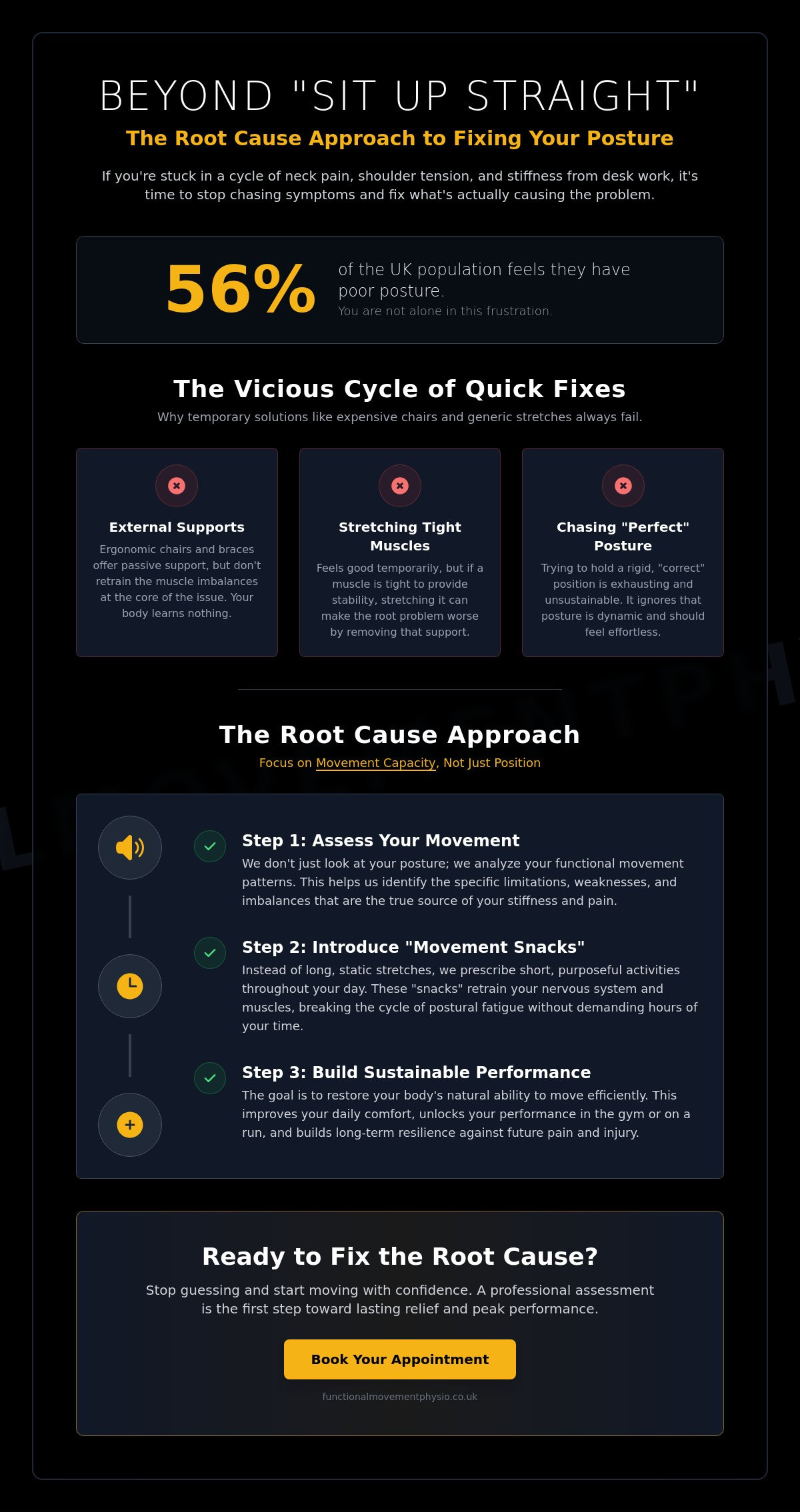
Did you know that 56% of the UK population feels they have poor posture according to the Office for National Statistics? If you spend your evenings rubbing a tight neck or feeling "stuck" and stiff after a long day at the desk, you are far from alone. It's incredibly frustrating to deal with recurring shoulder tension only to find that "sitting up straight" feels exhausting and unsustainable. This guide explores how to fix bad posture physio Liverpool experts recommend to ensure you move beyond temporary fixes and achieve lasting relief.
We understand that you want to resolve the root cause of your discomfort rather than just masking symptoms with heat packs or generic exercises. You deserve to move with confidence and ease without the constant distraction of physical limitation. We will move beyond conflicting online advice to provide a clear, evidence-based path that restores your physical capacity and helps you return to peak performance.
By viewing posture as a dynamic reflection of your functional movement, you can implement sustainable strategies that work for your specific lifestyle. We will explore the underlying causes of your stiffness and outline a professional framework for returning to the purposeful, pain-free activities you love.
Key Takeaways
- Understand why chasing a "perfect" static position often fails and why your ergonomic chair isn't solving the underlying issue.
- Learn how to fix bad posture physio Liverpool specialists recommend by identifying the dynamic root cause of your specific stiffness.
- Discover the power of "movement snacks" and how short, purposeful activity is more effective than long periods of static stretching.
- Gain a clear sequence to assess your own movement patterns at home to identify where your functional capacity is limited.
- Shift your focus from temporary symptom relief to sustainable, pain-free performance in your daily life and training.
Understanding the Frustration of Bad Posture in Liverpool
Posture is often misunderstood as a rigid, static position you must force your body into. In reality, it is a dynamic state of musculoskeletal balance that allows you to move efficiently through your daily life. When you search for how to fix bad posture physio Liverpool, you are likely looking for more than just a list of stretches. You want to understand why your body feels heavy and why your shoulders seem permanently pinned to your ears after a shift in the city center or a long day at the desk.
Common signs of postural strain include rounded shoulders, a forward head position, and persistent tension through the base of the neck. These aren't just aesthetic concerns. Feeling "stuck" or stiff is your body's way of signaling a movement limitation. It's a protective mechanism that occurs when your muscles are overworked and under-stimulated. Maintaining good posture involves more than just sitting upright; it requires your nervous system and muscles to coordinate effectively to manage the constant pull of gravity.
Why Your Body Feels Stiff After a Day in the City
Your daily environment in Liverpool significantly shapes your physical capacity. Whether you are commuting from the Wirral, navigating the M62, or walking from Lime Street to the business district, your body is constantly adapting to repetitive patterns. Long periods of sitting lead to what we call postural fatigue. This isn't a sign of weakness. It's a natural response to holding a single position for too long without adequate movement variety.
Postural fatigue occurs when your postural muscles become tired and stop providing the support you need. This leads to that familiar aching sensation in your mid-back or the sharp pinch in your neck. Validating this experience is the first step toward recovery. Your stiffness is a logical result of your environment, not a permanent flaw in your anatomy.
The Link Between Posture and Performance
If you are a regular at a Liverpool gym or a weekend runner, you've likely noticed how daily stiffness translates to your training. Poor alignment doesn't just cause aches; it restricts your ribcage. This impacts your breathing capacity and reduces your overall energy levels during high-intensity activity. When your foundation is restricted, your body has to work twice as hard to achieve the same results.
Traditional advice often focuses on "perfect" sitting positions or expensive chairs. However, these solutions rarely address why your body feels limited in the first place. Understanding how to fix bad posture physio Liverpool experts recommend means looking at how your alignment affects your power, speed, and recovery. By focusing on movement capacity rather than just a static pose, you can unlock your full physical potential and return to the activities you love without the constant shadow of discomfort.
The Problem: Why Quick Fixes for Posture Usually Fail
You might have already tried buying an expensive ergonomic chair or a wearable brace to improve your posture, only to find the tension returns within hours. These external tools offer a temporary sense of support, but they fail to address the internal muscle imbalances that are actually causing the problem. When you look for how to fix bad posture physio Liverpool experts often highlight that your brain is incredibly efficient at adapting to your environment. If you spend years in a slouched position, your nervous system accepts this as your "new normal."
An external brace cannot retrain your brain; it simply creates a new set of compensations. Ignoring the underlying cause of your pain is risky. In the UK, back, neck, and muscle pain account for an estimated 31 million lost working days every year. Relying on quick fixes keeps you in a cycle of temporary relief followed by recurring frustration. To break this cycle, you must address why your body is choosing to move this way in the first place.
The Trap of Symptom Management
Stretching tight muscles feels good in the moment, but it's often just symptom management. If a muscle is tight because it's trying to stabilize a weak joint, stretching it actually removes that stability. Your body then creates compensatory movements where other muscles have to work even harder to keep you upright. This is why "forcing" a specific position often leads to new areas of tension you didn't have before.
Chronic pain often stems from these layers of compensation. You might feel a pinch in your shoulder, but the root cause could be a lack of mobility in your mid-back. Identifying these specific imbalances is the only way to achieve a sustainable result. A thorough initial physiotherapy consultation can help you map out these patterns before they become more restrictive.
Why "Sitting Up Straight" Is Not the Answer
The classic advice to "just sit up straight" is often the least helpful thing you can do for your body. It requires immense muscular effort to hold a rigid, unnatural position for hours on end. This creates a fatigue cycle where you eventually collapse back into your old habits, feeling more frustrated and exhausted than before. Your muscles simply aren't designed to hold one static pose indefinitely.
Rigid posture actually restricts your functional movement. It limits your ability to breathe deeply and prevents your spine from moving through its full, healthy range. True postural health isn't about being a statue; it's about having the capacity to move freely and return to a balanced state effortlessly. Trying to fix your posture through sheer willpower alone is a losing battle that ignores the way your musculoskeletal system actually functions.
The Root Cause Approach: Why Movement Matters More Than Position
Instead of forcing a rigid pose, our functional movement philosophy focuses on your body's ability to adapt and respond. When considering how to fix bad posture physio Liverpool clients often discover that the source of their discomfort isn't actually where they feel the pain. Your body operates as a complex kinetic chain. This means a restriction in your ankle can force your pelvis into a tilt, which then pulls your shoulders forward to compensate. By the time you feel neck tension, the root cause might be several joints away.
Seeking expert physiotherapy ensures that you aren't just treating the symptom, but addressing the mechanical foundation. At our clinic, expert physiotherapy Liverpool is about building long term resilience. We want you to have the physical capacity to handle your daily life without needing to constantly think about your position. True recovery comes from restoring the natural flow of movement across your entire body.
Identifying Your Unique Movement Patterns
Every recovery journey begins with a comprehensive functional assessment. We don't just look at the curve of your spine; we analyze how you squat, reach, and walk. You might find that your rounded shoulders are actually caused by poor hip mobility. If your hips are tight, your lower back overcompensates, which creates a ripple effect up to your neck. We also evaluate your core stability to see if your deep supporting muscles are engaging correctly to maintain natural alignment.
This level of specificity is what separates a professional intervention from generic advice. Understanding how to fix bad posture physio Liverpool specialists provide means looking at the unique way your body has adapted to your lifestyle. By identifying these specific patterns, we can create a targeted plan that addresses your limitations directly. You can book an appointment to start this assessment process and uncover the real reason you feel stuck.
Clinical Pilates for Postural Resilience
Once we identify the root cause, we use tools like clinical pilates Liverpool to retrain your movement. This isn't just about exercise; it's about neurological retraining. Controlled, precise movements help your brain and nervous system rediscover how to support your joints efficiently. It moves you away from the "willpower" method of posture and toward a state where your body naturally holds itself in a balanced position.
Our 1:1 Clinical Pilates sessions focus on core rehabilitation and functional strength. This process bridges the gap between clinical treatment and your daily activities. You won't just feel better on the treatment table; you'll notice the difference when you're running, lifting at the gym, or sitting through a long meeting. The goal is to make balanced, purposeful movement your body's default setting, providing a sustainable path to peak performance.
Actionable Steps to Improve Your Posture and Performance
Taking control of your physical health starts with small, deliberate changes to your daily habits. Learning how to fix bad posture physio Liverpool experts advocate requires a shift from passive relief to active engagement. Instead of waiting for pain to trigger a stretch, you should focus on "movement snacks." These are brief, two minute bursts of activity performed throughout the day to keep your nervous system alert and your joints mobile. Consistency in these small movements is far more effective for long term change than an intense hour of stretching once a week.
Before starting a new routine, perform a simple self-assessment. Stand with your back against a flat wall, attempting to keep your heels, sacrum, shoulders, and the back of your head in contact with the surface. If you find yourself arching your lower back excessively or tilting your chin up to make contact, you've identified a functional limitation in your thoracic spine or hips. This baseline helps you track your progress as you move toward more fluid, purposeful movement.
The 3-Step Morning Mobility Routine
Start your day by addressing the areas most affected by a sedentary lifestyle. This routine shouldn't take more than five minutes, but it sets a foundation for better biomechanics. Focus on these three movements:
- Thoracic Rotations: From all fours, reach one arm under your body and then rotate it toward the ceiling. This opens the mid-back and chest, reversing the "slumped" position of desk work.
- 90/90 Hip Switches: Sit on the floor with your knees bent at 90 degree angles. Rotate your knees from side to side to unlock hip internal and external rotation. This reduces the pull on your lower back.
- Dead Bugs: Lie on your back and slowly lower opposite limbs while keeping your spine pressed into the floor. This activates your deep core, providing the stability needed to support your natural alignment.
Optimising Your Liverpool Office Setup
If you work in the Liverpool business district or commute via the Merseyrail, your environment often dictates your position. However, you don't need the most expensive ergonomic chair to find relief. The best position is always your next position. Practice "active sitting" by frequently shifting your weight and changing how your legs are crossed. This prevents any single muscle group from becoming overloaded and fatigued. Enhancing your visual surroundings is another way to improve your desk experience, and you can explore Ready-to-Hang Framed Art from First4Frames Gallery to help design a workspace that encourages you to look away from your screen and maintain better posture.
You can use your environment to trigger better movement. Place your bin on the other side of the room or set a reminder to stand up every time you take a phone call. These small environmental cues force you to break the cycle of static loading. If you're finding it difficult to implement these changes or your stiffness persists, you can book an initial physiotherapy consultation to receive a personalised strategy tailored to your specific work environment and physical goals.
Expert Physiotherapy in Liverpool: Restoring Your Functional Movement
Resolving your postural issues is about more than just standing taller. It's about reclaiming the ability to move through your life without the constant drain of physical tension. Throughout this guide, we've explored why generic advice and external braces fail to provide lasting relief. By choosing a professional approach focused on how to fix bad posture physio Liverpool residents can trust, you are making a commitment to understanding your body's unique mechanics. We don't just treat your symptoms; we work alongside you to identify and resolve the underlying imbalances that limit your potential.
Your initial physiotherapy consultation is the first step in this process. During this session, we conduct a thorough functional assessment to map your movement patterns and identify specific restrictions. We look at your body as a whole, ensuring that every joint and muscle group is contributing to a balanced, resilient foundation. You'll leave with a clear, evidence-based plan designed to restore your physical capacity and provide a sustainable path to pain-free activity. This structured approach ensures you feel understood and professionally guided at every touchpoint.
Your Path to Peak Performance
Achieving lasting results requires a partnership between the expert and the individual. We provide the clinical guidance and technical methodology, while you provide the consistency needed to retrain your movement. This collaborative approach ensures that your progress is both realistic and sustainable. We move beyond simple symptom management to focus on physical optimization and long term wellness.
Whether you are aiming to improve your gym performance, return to running after an injury, or simply move through your workday with ease, resolving your postural issues unlocks your true physical potential. We focus on helping you master your own capabilities rather than relying on temporary fixes. This transition from physical limitation to peak performance is the ultimate goal of our professional services. By restoring your functional movement, we help you achieve a state of resilience that carries over into every aspect of your daily life.
Book Your Assessment Today
You don't have to stay stuck in a cycle of stiffness and frustration. Our clinic is conveniently located in Liverpool city centre, providing a professional and supportive environment for your recovery. We understand the unique challenges of city life and the physical toll it can take on your body, from long commutes to sedentary desk work. Taking the first step is often the most important part of the journey toward physical freedom.
We invite you to book an appointment today to begin your comprehensive assessment. Let's work together to restore your functional movement and help you return to the purposeful, active life you deserve. Our team is ready to provide the expert guidance and empathetic encouragement you need to achieve sustainable, long-term results.
Reclaiming Your Physical Potential
Your journey toward pain-free movement doesn't have to be a constant battle against your own anatomy. True postural health comes from understanding that your body is designed for dynamic activity, not static rigidity. By shifting your focus from temporary external braces to functional movement capacity, you build a foundation for long-term resilience. We've explored how small, consistent changes to your biomechanics can transform how you feel during your workday and your training sessions.
Our specialist clinic combines root cause focused clinical expertise with a deep understanding of sports rehab to help you achieve sustainable results. If you're tired of conflicting advice, learning how to fix bad posture physio Liverpool experts provide is the most effective way to restore your performance. We create personalised plans that empower you to master your own physical capabilities and return to the meaningful activities you love without hesitation.
Don't let physical limitations dictate your lifestyle. Book your initial physiotherapy assessment in Liverpool today and start your transition to peak performance. We're here to provide the expert guidance and support you need to move with purpose once again.
Frequently Asked Questions
Can physiotherapy really fix years of bad posture?
Yes, physiotherapy is highly effective at reversing long-term postural habits by addressing the underlying muscle imbalances and joint restrictions. Years of slumping can be undone through a combination of manual therapy and targeted neurological retraining. We don't just focus on the position of your spine; we work to restore your body's natural ability to support itself. This process requires patience but leads to sustainable, pain-free movement.
How long does it take to see results from postural physio?
You can often feel an immediate reduction in muscle tension after your initial session, but lasting structural change typically takes six to twelve weeks. This timeframe allows your muscles to strengthen and your nervous system to adopt new movement patterns. When searching for how to fix bad posture physio Liverpool residents should focus on this window for sustainable progress. Consistency with your prescribed movement snacks is the key to accelerating these results.
Is bad posture the cause of my recurring tension headaches?
Recurring tension headaches are frequently linked to forward head posture and rounded shoulders. This position places excessive strain on the small muscles at the base of your skull, known as the suboccipital muscles. When these muscles become overworked, they can refer pain into your forehead and behind your eyes. Identifying this root cause allows us to resolve the headaches by improving your upper body biomechanics and neck stability.
Do I need a GP referral to see a physio in Liverpool for posture?
You do not need a GP referral to access private physiotherapy services in Liverpool. We operate on a direct-access basis, meaning you can book your initial consultation whenever you feel ready to address your discomfort. This allows you to bypass long waiting lists and begin your recovery process immediately. If you have private medical insurance, it is always best to check their specific requirements, but for self-funding patients, no referral is necessary.
Will I have to do exercises every day to see an improvement?
Consistency is far more important than the total volume of exercise you perform. You don't need to spend an hour every day on a complex routine to see improvements in your alignment. Instead, we focus on integrating short, purposeful movement snacks into your existing daily schedule. These brief interventions keep your muscles engaged and prevent the build-up of postural fatigue, making the process much more realistic and sustainable for a busy lifestyle.
Can clinical pilates help with my rounded shoulders?
Clinical Pilates is an exceptional tool for addressing rounded shoulders because it focuses on posterior chain strength and thoracic mobility. By strengthening the muscles between your shoulder blades and opening up the chest, we can naturally pull your shoulders back into a balanced position. This isn't about forcing a pose; it's about building the internal support system required to hold that position effortlessly during your daily activities and gym sessions.
What is the difference between posture management and sports physiotherapy?
Posture management is often a core component of sports physiotherapy, as efficient alignment is the foundation of high-performance movement. While general posture management might focus on sitting, sports physio looks at how your alignment impacts dynamic loads like running or lifting. When looking for how to fix bad posture physio Liverpool specialists use sports-based principles to ensure your body is resilient enough to handle both the demands of the desk and the gym.
Is my workstation setup the main reason for my back pain?
Your workstation setup is a contributing factor, but the primary cause of back pain is usually a lack of movement variety. Even the most expensive ergonomic chair cannot protect you from the effects of staying in one position for too long. We focus on teaching you how to vary your posture throughout the day rather than just relying on furniture. Improving your body's internal capacity to manage load is always more effective than external gear.