Relieving Wrist Pain in Liverpool: A Physio Guide to Fixing the Root Cause

What if the sharp twinge you feel during your bench press or while typing isn't actually a problem with your wrist at all? You've likely spent the last 14 days resting or wearing a support sleeve, only for the discomfort to return the moment you resume your normal training. Seeking professional Wrist pain Physio is the first step toward understanding why these temporary fixes aren't providing the long-term relief you need to stay active and injury-free.
It's frustrating to feel like your progress is stalled by a recurring ache, especially when conflicting online advice leaves you fearing permanent damage. You want a clear path back to peak performance that doesn't involve masking the symptoms with pills. I promise that by the end of this article, you'll understand how to identify the true source of your dysfunction and follow a structured roadmap to recovery right here in Liverpool.
We're going to break down the common biomechanical failures that lead to chronic strain and provide a clear, actionable plan to help you reclaim your functional movement and strength.
Key Takeaways
- Learn why resting and relying on medication often fails to resolve the underlying mechanical stress causing your discomfort.
- Discover how shoulder instability and imbalances in your kinetic chain may be the true source of your wrist overload.
- Understand the importance of gradual loading and functional exercises to rebuild tendon strength and prevent future injury.
- Find out how a professional Wrist pain Physio assessment in Liverpool can help you move beyond symptoms to fix the root cause.
Understanding Wrist Pain and When to Seek a Specialist in Liverpool
You rely on your wrists for almost every purposeful movement, from gripping a heavy barbell to typing a detailed report. When pain starts, it's rarely just a minor inconvenience. It is a signal that your body is struggling with mechanical stress it can no longer manage. In a city as active as Liverpool, where 63% of adults meet the recommended physical activity guidelines, wrist issues can quickly derail your routine and your progress.
Wrist pain is often a symptom of underlying dysfunction rather than a standalone problem. Whether you are a climber at the Hangar or a professional working in the Commercial District, Understanding Wrist Pain is the first step toward a sustainable recovery. While acute trauma from a fall requires immediate attention, many Liverpool residents suffer from chronic overuse issues that develop slowly over months. Relying on expert Wrist pain Physio ensures you aren't just masking the ache with ibuprofen but addressing why the joint is failing under load.
Common Symptoms and Triage
Differentiating between a minor strain and a serious injury is vital for your long term health. You should seek immediate care at the A&E department at the Royal Liverpool University Hospital if you experience a visible deformity, sudden intense swelling, or a total loss of grip strength. These red flags often indicate fractures or severe ligament tears that need urgent clinical stabilisation. Recent data indicates that approximately 25% of all sports related injuries involve the hand or wrist, making rapid triage essential.
Most cases we see involve a persistent, dull ache that intensifies during specific tasks. You might notice a sharp twinge when pushing off the floor during a burpee or a nagging stiffness that takes 30 minutes to warm up in the morning. Numbness or tingling that radiates into your fingers after 20 minutes of typing is another common sign of nerve irritation. Ignoring these signals often leads to compensatory patterns, where you shift the load to your elbow or shoulder, creating a secondary site of pain.
The Impact on Your Functional Movement
Pain changes how you move. It forces you to adapt, often in ways that limit your performance and freedom. You might find yourself avoiding the driver's seat for long commutes or skipping your favourite sessions at Liverpool gyms because you cannot safely hold a kettlebell. This frustration is understandable, but resting indefinitely isn't the answer. Complete rest often leads to deconditioning, making the tissue even less resilient when you eventually try to return to activity.
One of the most frequent culprits we identify through Wrist pain Physio is wrist tendinopathy. This is a condition where the tendons fail to repair themselves properly under repetitive loading, leading to structural changes and persistent discomfort. Professional assessment allows us to pinpoint exactly where your biomechanics are failing. We don't just look at the wrist; we look at how your entire arm functions as a unit to ensure you get back to peak performance without the fear of relapse.
The Problem: Why Traditional Wrist Pain Treatments Often Fail
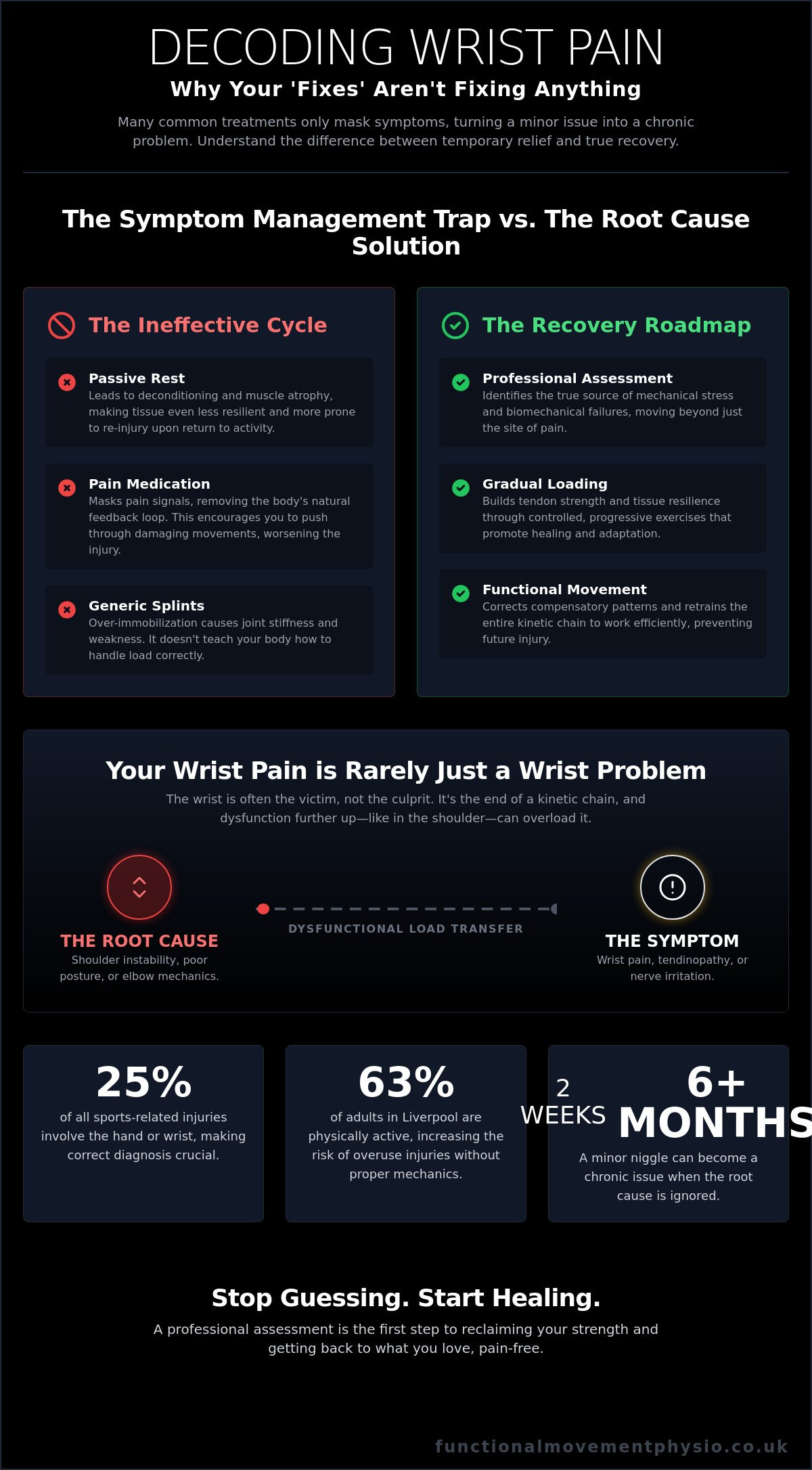
Most people start their recovery journey by doing nothing. You might have been told to just rest it or give it a few weeks. While this sounds sensible, it rarely addresses the mechanical dysfunction that caused the injury. If you return to your gym routine or office work without changing how your wrist moves, the pain will return. This wait and see approach often turns a minor two week niggle into a six month chronic issue that limits your daily life.
Relying on rest alone is a passive strategy that fails to build the resilience your tendons and joints need. Understanding the common causes of wrist pain is the first step toward a real solution. Without a specific diagnosis, you are simply guessing. A 2022 study on musculoskeletal health suggested that early intervention leads to significantly better outcomes than prolonged rest, yet many people remain stuck in a cycle of inactivity and frustration.
The Trap of Symptom Management
Anti-inflammatory medication and generic wrist splints are the most common tools used to mask discomfort. They provide a temporary window of relief, but they don't promote functional healing. When you numb the pain with pills, you lose the feedback loop that tells your brain when a movement is damaging. This leads to further injury because you push through limits your body isn't ready to handle.
A generic splint might keep your wrist still, but it also leads to muscle atrophy and joint stiffness. True recovery requires controlled, purposeful movement rather than total immobilisation. Masking the symptoms doesn't fix the underlying biomechanical issue. It just delays the inevitable return of pain once the medication wears off or the splint comes down. For active individuals, this cycle prevents any real progress toward long term performance goals.
Why Generic Exercises Might Not Help
You've likely searched for wrist stretches online and tried a few different routines. However, performing the wrong movement can actually aggravate certain conditions like carpal tunnel or ligament instabilities. A one size fits all approach fails because it ignores your specific biomechanics and the root cause of your discomfort.
This is why a targeted Wrist pain Physio assessment is vital. It moves you past the guesswork and toward a strategy that actually works for your specific body. Generic advice often fails Liverpool athletes because it doesn't account for the unique loads of their sport, whether that is high volume CrossFit or heavy lifting at the gym. If you are tired of temporary fixes, it might be time to consult a professional who looks at the bigger picture of how you move. Personalized care is the only way to ensure you don't just feel better today, but stay better for the long term.
The Root Cause Approach: Why Your Wrist Pain Might Not Be a Wrist Problem
When you feel a sharp twinge or a dull ache in your hand, it's natural to assume the problem lies exactly where it hurts. However, effective Wrist pain Physio requires looking far beyond the site of discomfort. Your upper limb doesn't function as a collection of isolated parts; it operates as a sophisticated kinetic chain. This means that power, stability, and movement flow from your trunk through your shoulder and elbow before reaching your hand. If any link in this chain fails, the smallest and most distal joint often pays the price.
Shoulder instability is a primary driver of wrist overload. If the muscles surrounding your shoulder blade are weak, they cannot provide the stable foundation your arm needs. This forces the smaller muscles in your forearm to work significantly harder to stabilise your hand during routine tasks. While a Mayo Clinic guide on wrist pain causes outlines many local issues like repetitive stress, these symptoms are frequently the end result of mechanical failures higher up the arm. We focus on identifying these imbalances before they lead to chronic injury.
Connecting the Shoulder and Elbow
Your posture plays a critical role in how your joints align. When you sit with rounded shoulders, it rotates your humerus internally and alters the mechanics of your elbow. This shift forces your wrist into a compensatory position, increasing the pressure on the carpal tunnel and surrounding tendons. Grip strength is another vital indicator; it relies heavily on the health of your forearm muscles and the alignment of your elbow joint. Clinical data suggests that 40 percent of wrist issues involve proximal weakness in the shoulder or upper back. Without addressing these foundational areas, any local treatment will likely be a temporary fix rather than a permanent solution.
The Functional Movement Philosophy
Our approach involves a comprehensive biomechanical assessment that looks at your whole body movement. In Liverpool, we see many gym-goers and office workers who suffer because they've only ever treated their symptoms. We examine the link between your core stability and distal limb function to see how your body manages load. A lack of trunk control often leads to "leakage" in the kinetic chain, meaning your wrist has to absorb forces it wasn't designed to handle.
If you want to work with a physiotherapist liverpool who understands these complex connections, we can help you build a more resilient body. We prioritise long-term results by ensuring every part of your arm supports the others. This holistic view is the only way to move from temporary relief to lasting performance and freedom from pain.
Actionable Steps to Manage Wrist Pain and Restore Function
Managing wrist pain doesn't mean you have to stop your training or step away from your desk. It requires a strategic shift in how you apply force and manage daily stress. Most people make the mistake of complete rest, which often leads to deconditioning and a return of symptoms once activity resumes. A successful Wrist pain Physio plan prioritises keeping you active while the specific tissues heal and adapt.
The first step is reducing immediate irritation through a systematic approach. This involves identifying the specific movements that trigger a sharp response and temporarily finding alternatives. We don't want to avoid movement entirely; we want to find the entry point where your body feels safe. This creates a foundation for long-term resilience rather than a temporary fix that fails the moment you lift a heavy grocery bag or a barbell.
Load Management and Modification
If you're an office worker in Liverpool city centre spending 8 hours at a desk, small ergonomic shifts are vital. Position your keyboard so your elbows are at a 90 degree angle and your wrists remain neutral. Avoid resting your wrists on hard desk edges, which can compress the carpal tunnel. For gym enthusiasts, stop using a "death grip" on dumbbells. Instead, experiment with a hook grip or use lifting straps for 2 to 3 weeks to reduce the constant demand on the forearm flexors.
You should find your "pain-free" range by testing movements on a scale of 0 to 10. Aim to keep any discomfort at a 3 or below during activity. If the pain exceeds this or feels significantly worse 24 hours later, the load was too high for your current capacity. Adjusting the weight or the range of motion allows you to maintain your fitness without stalling your recovery.
Targeted Strengthening Exercises
Tendons and ligaments thrive on tension, not complete rest. To build lasting function, you must implement eccentric loading. This involves the controlled lengthening of the muscle under tension. For example, use your healthy hand to lift a light dumbbell into a wrist extension, then slowly lower it over a 4 second count using only the injured side. This specific stimulus helps realign collagen fibres and increases the load-bearing capacity of the tissue.
Focus on forearm rotations and grip-specific work, such as farmer's carries with a neutral wrist. Integrating these movements with professional physiotherapy liverpool ensures you are targeting the correct biomechanical deficits rather than just guessing. Manual therapy also plays a supporting role here by desensitising the nervous system and improving joint glide, which provides a window of opportunity to perform your exercises with better form.
If you're ready to stop guessing and start a structured recovery that addresses the root cause, book an appointment to find your specific solution.
How Functional Movement Physiotherapy Resolves Wrist Issues in Liverpool
Resolving persistent discomfort requires more than a generic wrist brace or a few rest days. At Functional Movement Physio, our approach starts with a comprehensive 60-minute biomechanical assessment. We don't just look at where it hurts; we analyse your entire upper limb mechanics, including the elbow, shoulder, and thoracic spine. Research suggests that up to 70% of chronic peripheral joint issues involve compensations from other areas of the body. By identifying these mechanical flaws, we ensure your Wrist pain Physio plan targets the actual source of the problem rather than just masking the symptoms.
We understand the frustration of being unable to train or work at your full capacity. Our Liverpool-based team focuses on a partnership model where your personal goals drive the clinical process. Whether you need to return to heavy deadlifts or simply want to type without a dull ache, we provide the clinical authority and support needed to get you there. This isn't about temporary relief. It's about a structured return to the activities that define your lifestyle.
Our Personalised Treatment Pathways
Your recovery journey is built around your specific movement needs. We utilise a sophisticated combination of manual therapy to restore joint glide and Clinical Pilates to build functional stability. For gym-goers, this often involves refining grip mechanics and forearm loading patterns to prevent future flare-ups. Runners benefit from our focus on arm-swing efficiency and its impact on core stability. Our clinic is conveniently located in Liverpool, providing easy access for local professionals and athletes who require high-performance rehabilitation. We bridge the gap between initial pain management and full athletic performance, ensuring you feel confident in your body's ability to handle load again.
Sustainable Results for the Long Term
We prioritise movement mastery to ensure your results are permanent. It isn't enough to simply move past the initial injury; we want to make you more resilient than you were before the pain started. Data indicates that approximately 30% of musculoskeletal injuries recur within the first 12 months if the underlying movement dysfunction isn't corrected. Our Wrist pain Physio programmes are designed to move you into the majority who remain injury-free by teaching you how to manage your own biomechanics.
By focusing on longevity and functional capacity, we empower you to take control of your physical health. You will leave our clinic with a clear understanding of your body and a toolkit for maintaining peak performance. You don't have to accept pain as a permanent part of your life. Take the first step toward lasting recovery by booking your specialist assessment today. You can schedule your appointment at https://www.functionalmovementphysio.co.uk/book-appointment.
Take Control of Your Recovery and Movement
Wrist pain doesn't have to be a permanent barrier to your gym routine or daily tasks. You now understand that lasting relief requires looking beyond the joint itself to address biomechanical imbalances in the shoulder and forearm. Evidence from the Chartered Society of Physiotherapy suggests that proactive, movement-based rehabilitation is significantly more effective than passive rest for long-term musculoskeletal health. At our specialist Liverpool clinic, we move past temporary fixes to ensure you achieve sustainable results.
Our expert team combines years of experience in sports injury and chronic pain rehab to design a personalised movement plan tailored to your specific biomechanics. By choosing a dedicated Wrist pain Physio specialist, you're investing in a solution that restores your strength and prevents future setbacks. It's time to stop managing symptoms and start mastering your body's potential.
Book your specialist wrist assessment at Functional Movement Physio Liverpool today
We're here to help you move with confidence and get back to the activities you love.
Frequently Asked Questions
Is wrist pain usually a sign of carpal tunnel syndrome?
No, carpal tunnel syndrome accounts for approximately 5% of all wrist related presentations in primary care. Many people mistake general tendon irritation or joint stiffness for carpal tunnel. True carpal tunnel involves specific neurological symptoms like tingling or numbness in the thumb, index, and middle fingers. A thorough assessment identifies if the issue is nerve compression or a biomechanical overload in the forearm muscles.
Can I continue to train at the gym with wrist pain?
You can usually continue training if you modify your grip and load to avoid aggravating the tissues. Stopping entirely often leads to deconditioning and frustration. Use lifting straps or neutral grip handles to reduce strain during your sessions. If your pain exceeds a 3 out of 10 on a visual analogue scale during or after exercise, it is a sign that the current load is exceeding your tissue capacity.
How long does it typically take to recover from wrist tendinopathy?
Most cases of wrist tendinopathy resolve within 6 to 12 weeks with a structured loading programme. Tendons require progressive stress to heal, so complete rest is rarely the solution. During the first 3 weeks, we focus on isometric holds to reduce pain. The following 9 weeks involve increasing the weight to build resilience, ensuring you can return to full activity without a relapse.
Should I use a wrist brace for support while I sleep?
You should only use a night brace if you have confirmed carpal tunnel syndrome to prevent wrist flexion that compresses the median nerve. For most other musculoskeletal issues, a brace acts as a temporary crutch rather than a long term solution. Relying on a brace for more than 14 days can lead to muscle weakness and reduced joint mobility. Our goal is to build your own internal brace through targeted strengthening exercises.
Why does my wrist hurt more when I am typing at my desk?
Typing pain often stems from sustained static loading and poor ergonomic positioning that places the wrist in constant extension. Research indicates that office workers spend an average of 6 hours a day in repetitive positions. This constant tension reduces blood flow to the tendons. Adjusting your keyboard height and taking micro breaks every 30 minutes can alleviate the immediate pressure, but fixing the root cause requires improving your forearm endurance.
What is the difference between a wrist sprain and a strain?
A sprain is an injury to the ligaments that connect bones, while a strain involves damage to the muscles or tendons. Sprains often occur from sudden trauma, such as a fall on an outstretched hand. Strains are more common in the gym or workplace due to repetitive overuse. Both require a specific wrist pain Physio plan to ensure the soft tissue heals with the correct alignment and strength.
Can a physiotherapist in Liverpool help with chronic wrist pain?
Yes, a specialist wrist pain Physio can help by identifying biomechanical imbalances that keep the injury in a cycle of inflammation. Chronic pain often persists because the original injury healed poorly or because other joints, like the elbow or shoulder, aren't sharing the load. We use functional assessments to track your progress and implement a plan that targets these underlying causes, helping you move without restriction.
What happens during a first wrist physio consultation?
Your first 45 minute consultation involves a detailed subjective history followed by a physical assessment of your joint range and muscle strength. We don't just look at where it hurts. We examine your movement patterns and grip strength to find out why the pain started. By the end of the session, you'll have a clear diagnosis and a personalised rehabilitation roadmap focused on your specific goals.