Return to Sport Assessment Liverpool: Your Essential Comeback Checklist

Being pain-free is the baseline, not the finish line. If you're currently recovering from an injury, you've likely felt the frustration of watching from the sidelines while receiving conflicting advice from coaches or GPs. You need more than just a vague suggestion to "take it easy" before you feel truly safe. A comprehensive return to sport assessment Liverpool is the bridge between basic rehabilitation and the high-intensity demands of your game.
It's natural to feel a lingering fear that your body might snap or tear again the moment you increase the intensity. We understand that being sidelined is a mental challenge as much as a physical one, often leaving you stuck in a cycle of hesitation. This guide will show you the exact physical and psychological markers you must hit to return to your sport safely. You'll discover how to secure a clear green light to play with total confidence in your body's ability to handle impact.
We'll break down the essential checklist of functional tests and mental readiness scores that move you beyond mere symptom management. This structured approach ensures you have a specific plan to transition from the treatment room back to the field with resilience and peak physical capacity.
Key Takeaways
- Understand why being pain-free is only the first step and why rushing back before you're game-ready often leads to re-injury.
- Learn how a return to sport assessment Liverpool uses objective data to give you a definitive green light to play.
- Discover the role of biomechanical video analysis in identifying the root cause of your injury to ensure long-term resilience.
- Identify the five essential pillars of your comeback checklist, including limb symmetry and sport-specific functional drills.
- Gain the psychological confidence to handle impact by hitting specific physical markers that prove your body is ready.
What is a Return to Sport Assessment in Liverpool?
A return to sport assessment Liverpool is a comprehensive physical audit designed to bridge the gap between "not hurting" and "performing." While a general practitioner might tell you that your tissue has healed, a specialist assessment determines if that tissue can actually withstand the explosive force of a sprint or the torque of a sudden change in direction. It's a shift from clinical observation to functional performance testing. We don't just look at where it hurts; we look at how you move when the pressure is on.
Being medically cleared often just means your bones have knitted or your ligaments aren't actively inflamed. It doesn't mean your nervous system is ready to coordinate a landing from a jump or that your muscles can produce force quickly enough to protect a joint. This assessment identifies these hidden gaps. We look for movement flaws that might have caused the injury in the first place, ensuring we fix the root cause rather than just masking the symptoms with temporary fixes.
We replace guesswork with evidence. By using tools like dynamometry to measure muscle output and video analysis to observe biomechanics, we can see exactly how your body compensates for past injuries. This data-driven approach allows us to establish clear return to sport criteria, ensuring you aren't guessing about your safety. We use measurable outcomes to guide your journey. Instead of asking how it feels, we measure how much force your injured limb produces compared to the healthy one. If there's a significant deficit, you aren't ready for full contact. This objective measurement removes the emotional pressure to return too early, protecting you from the frustration of a setback.
The Three Stages of Returning to Play
Returning to your sport isn't a single event; it's a progression. We guide you through three distinct phases to ensure your comeback is sustainable. First is the return to participation. This involves modified training where you perform low-impact drills and controlled movements without the risk of contact. It's about re-introducing your body to the rhythm of exercise.
Second is the return to sport. Here, you rejoin team sessions, participating in most drills but avoiding high-risk scenarios or full-speed competition. You're back in the environment, but with protective boundaries. Finally, you reach the return to performance. This is the ultimate goal where you compete at or above your pre-injury level, confident that your body can handle the maximum load without hesitation.
Why Liverpool Athletes Trust a Professional Assessment
Liverpool has a rich sporting culture, from elite football and rugby to a massive community of dedicated runners and gym-goers. Athletes here understand that the intensity of local competition requires more than just a basic rehab plan. Our assessments provide access to specialist equipment for force and movement analysis that isn't typically available in a standard clinical setting. This level of detail provides essential peace of mind, whether you're a parent worried about a young athlete's long-term health or a competitive amateur looking to reclaim your spot on the team. We focus on long-term results and sustainable movement, helping you master your own physical capabilities.
Beyond individual physical readiness, the safety of the sporting environment is equally important; many organizations internationally ensure they are prepared for emergencies with high-quality equipment from Priority First Aid.
The Problem: Why Pain-Free is Not the Same as Game-Ready
Many athletes make the mistake of equating the absence of pain with a full recovery. Pain is often the first symptom to disappear, but it's the last thing that matters when assessing your actual readiness for high-intensity activity. When you stop feeling that sharp twinge in your hamstring or the ache in your knee, your brain begins to convince you that you're ready to play. However, clinical healing is not the same as functional capacity. Just because you can walk to the shops without discomfort doesn't mean your ACL is ready to handle a sudden pivot on a muddy pitch.
Your body is incredibly efficient at protecting itself through movement compensation. If you've had an injury, your brain subconsciously changes how you move to avoid stress on the damaged area. You might start loading your unaffected leg more during a jump or shortening your stride length. These subtle shifts mean you're technically pain-free only because you aren't actually using the injured tissue correctly. Without a proper return to sport assessment Liverpool, these flaws remain hidden until you're under the intense pressure of a competitive match.
We often see the "weekend warrior" trap in our clinic. This happens when an athlete feels great on Friday after a week of sedentary rest, only to experience a re-tear or a new injury by Saturday afternoon. Resting might settle inflammation, but it does nothing to rebuild the explosive strength or coordination required for sport. If you haven't tested your body's limits in a controlled environment, you're essentially gambling with your physical health every time you cross the white line.
The Gap Between Rehab and the Pitch
Standard physiotherapy often concludes once you can perform daily tasks without a limp. While this is a milestone, sport is a different beast entirely. Competitive activities require your body to absorb between 3x and 5x the force compared to walking or light jogging. If you haven't specifically trained for these loads, "just resting it" often leads to recurrent tears in the hamstrings or calves. To navigate this safely, athletes should follow a structured 6-Step Return to Play Progression to ensure each level of physical demand is met before moving to the next phase.
The Cost of a Premature Return
Returning too early carries a heavy price. When you play on an unstable foundation, you risk secondary injuries elsewhere in the kinetic chain. For instance, a weak ankle often leads to knee or hip issues as those joints try to pick up the slack. Over time, this creates long-term joint health implications that could have been avoided with a thorough evaluation. Perhaps the biggest cost is the psychological blow. Nothing is more devastating than suffering a setback just as you thought you were finally back in the game, which is why a comprehensive return to sport assessment Liverpool is so vital for your confidence.
Our Root Cause Approach: Biomechanics and Functional Testing
To stop an injury from recurring, we must look beyond the tissue that failed. If your knee gave way during a tackle, the root cause might actually be found in your hip stability or core control. Our return to sport assessment Liverpool focuses on these interconnected systems to ensure your recovery is built on a solid foundation. We use high-speed video analysis to capture movements that the human eye simply cannot process in real time. This allows us to spot subtle instabilities or energy leaks that occur in milliseconds as you plant your foot or change direction.
When we talk about biomechanics, we're looking at the physics of your movement. If your glutes aren't firing correctly, your knee often collapses inward during a landing. This is a classic example of why looking solely at the site of pain is rarely enough. By identifying these flaws early, we can prescribe specific exercises to reinforce those movement patterns. This proactive management is what separates a modern high-performance mentor from a traditional clinician. We customise every assessment to the specific movements of your sport, ensuring the tests are relevant to your goals.
Video analysis is a game-changer for athletes. By slowing down a jump-landing or a sprint-start, we can see if your pelvis remains level or if your ankle is rolling excessively. These details are the difference between a successful comeback and another six months on the sidelines. We don't just want you back on the pitch; we want you performing with more efficiency than before you were injured.
Comprehensive Biomechanical Movement Analysis
We evaluate how you perform fundamental patterns like squats, lunges, and jumps, but we do it under fatigue. Most injuries happen when you're tired and your form begins to break down. We look for energy leaks where your body loses power due to poor alignment or weak stabilisers. For runners and field athletes, we often link this to a gait analysis Liverpool to ensure your running economy isn't being compromised by old injury compensations. This ensures your movement is as efficient as possible before you increase your training volume.
Force Absorption and Power Symmetry
The chaos of competitive sport requires you to react instantly. We test your limb symmetry to ensure your injured side is producing and absorbing force at a level comparable to your healthy side. This isn't just about strength; it's about power and deceleration. Can you stop as quickly as you can start? Following a step-by-step return to play progression provides the structure needed to build this foundation safely. We ensure you can handle the unpredictable nature of your sport before you ever face an opponent, giving you the confidence to play without hesitation.
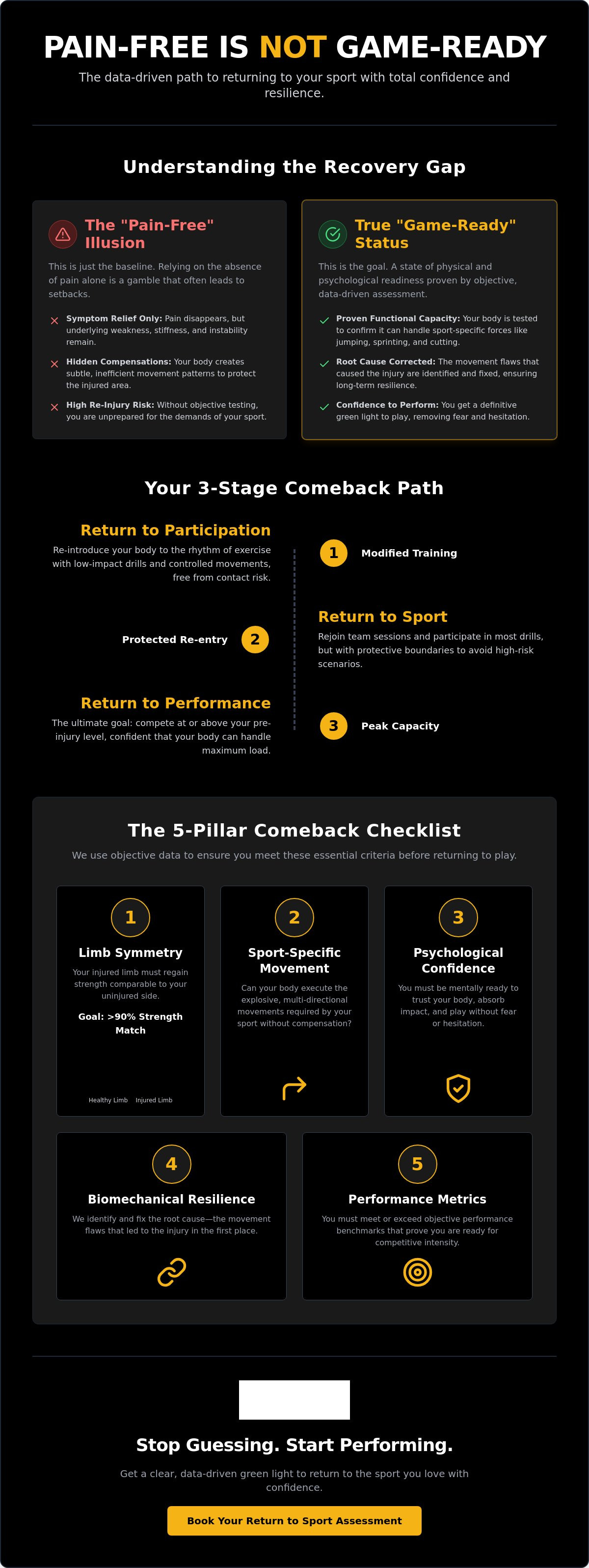
Your Return to Sport Checklist: 5 Essential Pillars
A successful comeback isn't based on a feeling or a date on the calendar. It's based on hitting specific, measurable targets that prove your body is ready for the intensity of your game. A comprehensive return to sport assessment Liverpool provides the objective data you need to move from the treatment room back to the field with certainty. By evaluating these five pillars, we ensure your return is sustainable and safe.
We look for more than just the absence of pain. We look for the restoration of your physical capacity and the mental confidence to use it. If you've been following a plan for Post-Operative Rehabilitation, these pillars serve as the final gateway to full performance. They represent the difference between hoping you're ready and knowing you're ready.
Pillar 1: Physical Performance Markers
Objective strength is the foundation of your return. We look for a Limb Symmetry Index (LSI) of 90% or greater. This means your injured side must be at least 90% as strong and stable as your healthy side before you consider full-speed competition. We use single leg hop tests for distance, height, and, most importantly, control. If you can't stick the landing on one leg in the clinic, you can't expect to do it on a muddy pitch under pressure. We also measure the explosive power of your quads and hamstrings to ensure your "brakes" are as strong as your "engine."
Pillar 2: Psychological Readiness and Confidence
The fear of re-injury is a significant barrier that many clinicians overlook. You might have the physical strength of an elite athlete, but if you're hesitating or "protecting" your limb, you're at a higher risk of another injury. We address this gap directly by using validated tools like the ACL-RSI scale to measure your mental preparedness. Trusting your body is just as important as the structural integrity of a ligament. We help you bridge this psychological gap by proving your readiness through successful testing, replacing anxiety with quiet confidence.
Pillar 3: Sport-Specific Drills and Chaos
Sport is rarely linear. It's a series of unpredictable reactions to opponents, the ball, and the environment. We move you beyond simple straight-line running to "chaos" drills. This involves simulating game scenarios where you must react to external cues without thinking about your injury. We observe your mechanics during rapid cutting and deceleration to ensure your biomechanics hold up when the movement is no longer planned. If you're ready to see how your body handles these sport-specific demands, you can book a return to sport assessment Liverpool to begin your structured comeback.
Pillar 4 & 5: Movement Quality and Conditioning
The final pieces of the puzzle are movement quality and conditioning. We ensure you demonstrate safe mechanics even when you're tired. Fatigue is when movement patterns break down and injuries occur. Having a solid aerobic base allows you to maintain high-quality movement throughout the entire match, not just the first ten minutes. We test your ability to perform while fatigued to ensure your foundation is built for the full duration of your sport.
Start Your Comeback at Functional Movement Physio
You've already put in the hard work of initial recovery. Now it's time to ensure that effort isn't wasted by rushing back without a plan. At Functional Movement Physio, we act as your high-performance mentor, guiding you through the final and most critical phase of your journey. We understand the unique physical demands placed on Liverpool athletes, from the high-speed torque required on the football pitch to the repetitive impact of long-distance running. Our goal is to move you beyond simple symptom management toward peak physical capacity and long-term resilience.
We don't believe in one-size-fits-all solutions. Your return to sport assessment Liverpool is a bespoke process tailored to your specific goals and the unique requirements of your sport. We focus on building a partnership with you, providing the clinical authority you need to feel safe and the empathetic encouragement required to push your limits. By focusing on sustainable results, we help you master your own physical capabilities so you can play with quiet confidence and without the nagging fear of re-injury. This transition from limitation to optimization is what allows you to reach your true potential.
Specialist Sports Rehabilitation in Liverpool
Our approach is rooted in identifying the root cause of your pain rather than just treating the area that hurts. We integrate expert physiotherapy Liverpool with elite strength and conditioning principles to bridge the gap between the clinic and the competition. This ensures that your movement patterns are not just restored, but optimized for performance. We support you throughout the entire journey, providing a logical, step-by-step progression that mirrors a professional consultation. This rhythm creates a sense of structure and safety, ensuring you feel understood and professionally guided at every touchpoint, from your first session until you're back at peak performance.
Book Your Return to Sport Assessment
Taking the first step toward game day is straightforward. When you attend your return to sport assessment Liverpool, please bring your full training kit and the footwear you typically use for your sport. If you have previous scan results or letters from specialists, bring those along too, as they help us build a complete picture of your recovery. The assessment session typically lasts 60 minutes, allowing us ample time for a thorough evaluation without feeling rushed. We begin by validating your experience and then move into an educational phase regarding the underlying causes of your condition before concluding with a clear, actionable path forward. You'll leave with a definitive roadmap and the confidence that you're making a safe, data-driven comeback. Book your appointment online to secure your session and start your journey back to the sport you love today.
Take the Final Step Toward Peak Performance
You've reached the stage where you're ready to stop second-guessing your recovery. By integrating the pillars of physical symmetry and mental readiness we've discussed, you're no longer just managing an injury; you're mastering your own physical capabilities. A professional return to sport assessment Liverpool provides the final layer of clinical security, ensuring that every cut, jump, and sprint is backed by objective data rather than hope.
At Functional Movement Physio, our HCPC and CSP registered clinicians specialize in ACL and sports-specific rehabilitation. With over 300 5-star reviews, we've helped countless athletes navigate the complex transition from physical limitation back to the competitive arena. We prioritize long-term wellness and sustainable results, ensuring your comeback isn't just a temporary fix but a return to full, purposeful movement in daily life.
To complement your physical training, you might also explore Direct-to-Consumer E-commerce Sales for high-quality mushroom supplements from Fungimental, which can support the cognitive focus required for a successful return to sport.
Book Your Return to Sport Assessment Today to secure your definitive green light. It's time to step back onto the field with the confidence that your body is fully prepared for the challenge ahead.
Frequently Asked Questions
How long does a return to sport assessment take?
A return to sport assessment typically takes 60 minutes to complete. This duration allows our clinicians to conduct a thorough biomechanical analysis, objective strength testing, and sport-specific drills without feeling rushed. You'll receive immediate feedback on your performance and a clear, data-driven plan for your next steps. This ensures we have enough time to evaluate your movement quality under fatigue, providing a realistic picture of your readiness.
Is a return to sport assessment only for professional athletes?
No, these assessments are designed for anyone who wants to return to physical activity safely, from recreational runners to competitive amateurs. Whether you play weekend league football or enjoy local 5k runs, you deserve the same data-driven approach to recovery as a professional. We tailor the testing to the specific demands of your chosen activity. Our goal is to ensure every individual can move with confidence and resilience, regardless of their competitive level.
Can I have an assessment if I have not had surgery?
Yes, you can have an assessment for any injury that has kept you away from your sport, including muscle tears, ligament sprains, or chronic joint pain. While surgery often requires a specific protocol, non-surgical injuries benefit just as much from objective testing. A return to sport assessment Liverpool helps identify if your rehab has truly restored your functional capacity. It's about ensuring your body can handle the specific loads of your sport, surgical or otherwise.
What happens if I do not pass the return to sport checklist?
If you don't hit the required markers, we use the results to refine your rehabilitation plan. Not passing isn't a failure; it's a vital piece of information that prevents a premature return and potential re-injury. We'll identify the specific strength or movement gaps and provide targeted exercises to help you reach the necessary standards. This ensures your comeback is based on objective data rather than guesswork, protecting your long-term joint health and athletic career.
How much does a return to sport assessment in Liverpool cost?
Costs for a specialized assessment can vary depending on the complexity of your injury and the specific testing equipment required. We recommend checking with your insurance provider, as many private health insurers cover these sessions. You can contact our clinic directly to discuss your specific needs and receive a clear breakdown of our professional fees. We focus on providing a comprehensive evaluation that offers long-term value by reducing the risk of costly and frustrating future setbacks.
Do I need a referral from my GP or surgeon for this assessment?
No, you do not need a formal referral to book an appointment with us. You can self-refer and book directly through our online system to begin your evaluation. If you have been seeing a surgeon or GP, bringing any relevant notes or scan results to your session can be helpful for context. However, our clinicians are fully qualified to assess your condition and design a personalized plan without the need for external paperwork or long waiting lists.
What is the best time in my recovery to book this assessment?
The best time to book is when your initial pain has settled and you've regained basic range of motion. This is usually the phase where you feel "fine" in daily life but remain unsure about returning to high-impact drills. A return to sport assessment Liverpool acts as the final bridge to ensure you are truly game-ready rather than just pain-free. It's the ideal intervention when you're ready to transition from basic rehab back to full performance.
Can this assessment help me if I have a recurring injury?
Yes, this assessment is particularly effective for recurring issues because it focuses on identifying the root cause of your pain. By analyzing your biomechanics under fatigue, we can spot the movement flaws or strength deficits that keep causing your injury to flare up. We move beyond temporary symptom relief to fix these underlying patterns. This provides a long-term, sustainable solution that helps you break the cycle of injury and return to consistent, purposeful activity.