Clinical Pilates Liverpool: Resolving the Root Cause of Your Pain

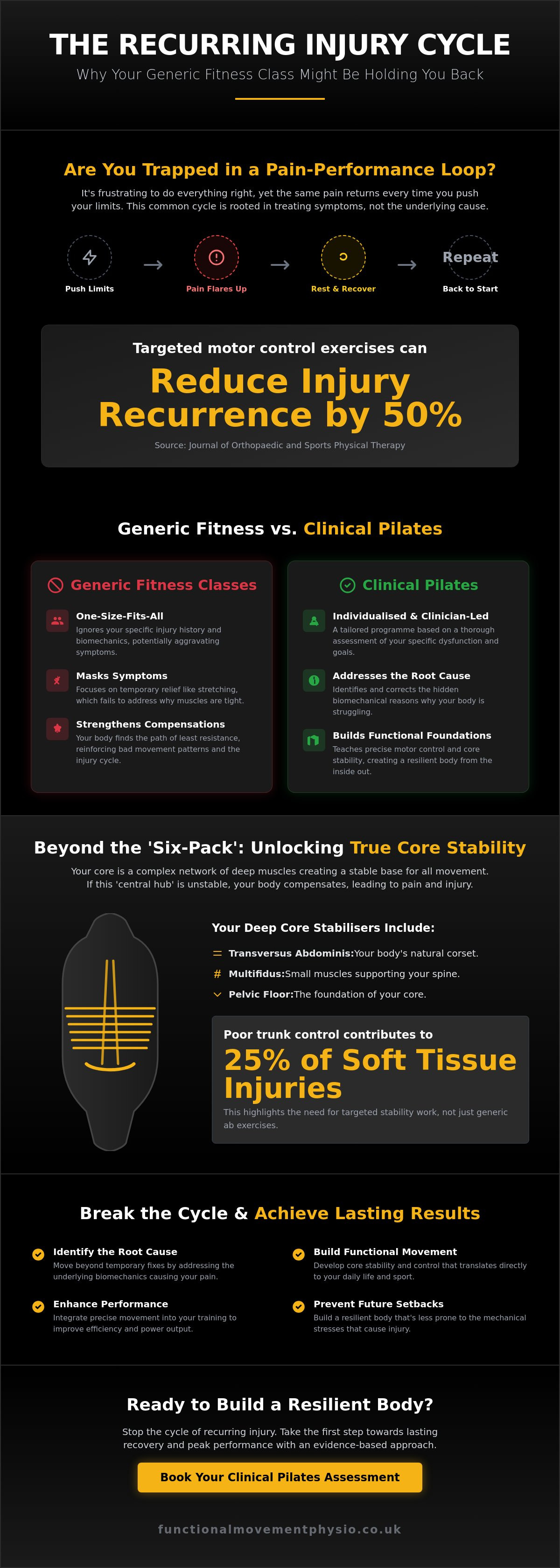
Your generic fitness class might be the very thing keeping you trapped in a cycle of recurring injury. It's frustrating to feel like you're doing everything right, yet still find yourself sidelined by the same lower back or hip pain every time you try to push your limits. If you've been searching for pilates liverpool options, you've likely noticed that most studios offer a one size fits all approach that ignores your specific injury history. Research published in the Journal of Orthopaedic and Sports Physical Therapy shows that targeted motor control exercises can reduce injury recurrence by 50%, yet many people still rely on generic movements that aggravate their symptoms.
We understand that feeling stuck is exhausting, especially when you just want to get back to the gym or out on the road. You deserve a strategy that respects your body's unique biomechanics rather than just masking symptoms with temporary stretches. This article will show you how clinical Pilates moves you beyond quick fixes to achieve lasting, functional results.
We'll break down why traditional therapies often fail and how a root cause assessment can finally unlock the core stability and posture you need for peak performance.
Key Takeaways
- Understand why generic exercise classes often fail to resolve chronic pain by overlooking the hidden biomechanical compensations that cause recurring injuries.
- Discover how clinician-led pilates liverpool sessions identify the root cause of your dysfunction rather than simply providing a temporary fix for your symptoms.
- Learn the fundamental difference between standard fitness routines and an evidence-based rehabilitation approach focused on functional movement and core stability.
- Gain practical strategies to integrate clinical Pilates into your existing gym or running programme to enhance your performance and prevent future setbacks.
- Find out how precise movement correction and 1:1 clinical guidance can help you break the cycle of pain and return to the activities you love.
Clinical Pilates in Liverpool: Why Your Core Stability is the Key to Recovery
Many people in Liverpool struggle with recurring back pain or sports injuries that never quite seem to clear up. You might have tried rest or general exercises, but the discomfort returns as soon as you increase your activity level. Clinical Pilates offers a different path. Unlike standard gym classes, this is a clinician-led system of functional movement designed to address the specific biomechanical reasons why your body is struggling. It moves beyond the traditional "mind-body" fitness approach, focusing instead on evidence-based rehabilitation to restore your physical capacity.
When exploring What is Pilates?, it's clear the method has evolved from its early 20th-century roots into a sophisticated tool for modern physiotherapy. In our clinic, we use these principles to help you regain control over your body. Professional athletes across Merseyside are increasingly integrating clinical pilates liverpool into their training schedules. They don't just use it for recovery; they use it to refine their movement patterns and prevent the 25% of soft tissue injuries that often stem from poor trunk control.
Movement is the foundation of your long-term health. When you move well, you reduce the mechanical stress on your joints and tissues. This proactive approach ensures that you aren't just reacting to pain but building a body that is resilient enough to handle the demands of your daily life and sporting goals.
The Difference Between Fitness and Clinical Pilates
Standard fitness Pilates focuses on general conditioning, flexibility, and burning calories. It's often delivered in large groups where the instructor cannot monitor every individual's alignment. Clinical Pilates prioritises an individualised assessment and specific corrective exercises tailored to your injury history. For someone with an acute disc injury or a complex pelvic misalignment, a generic group class in Liverpool can actually aggravate symptoms. You need a programme that respects your specific pathology and load tolerance while focusing on pilates liverpool techniques that promote healing.
How Core Stability Supports Your Daily Movement
Your core is far more than just the visible "six-pack" muscles. It includes a complex network of deep stabilisers, such as the transversus abdominis, multifidus, and the pelvic floor. These muscles work together to create a stable base for your limbs to move from. The pelvis and spine act as the central hub of all functional movement. If this hub is unstable, your body compensates by overworking other areas, leading to pain and dysfunction.
Core stability is the ability to control your trunk during activity. It ensures that your spine remains protected whether you are lifting a heavy weight in the gym or simply picking up a child. By mastering this control, you move from a state of vulnerability to one of resilience. Our approach ensures you understand how to engage these deep muscles effectively, turning core stability into a natural part of how you move every day.
Why Generic Exercise Classes Often Fail to Resolve Chronic Pain
You might have spent months attending a high-intensity gym or a generic fitness class, yet your chronic back or neck pain remains unchanged. This is a common frustration for many active individuals seeking pilates liverpool. When you follow a "one size fits all" routine, you're essentially gambling with your musculoskeletal health. These classes are designed for the average person, but if you're dealing with an injury or a specific movement dysfunction, you aren't average.
Generic exercises often mask underlying issues by allowing your body to find the path of least resistance. You might feel like you're working hard, but your brain is simply using stronger muscles to bypass the weak or inhibited ones. This creates a recurring injury cycle where you strengthen your compensations rather than your foundations. Stretching alone rarely solves this. While it might provide temporary relief for 15 minutes, it doesn't address why the muscle felt tight in the first place. Without a strategy to improve functional control, you'll remain stuck in a loop of stiffness and discomfort.
The Trap of Treating Symptoms Instead of Causes
A sore lower back is rarely just a back problem. In many cases, it's a symptom of poor hip mobility or a stiff thoracic spine. When you attend a standard fitness class and push through the discomfort, you risk turning a minor irritation into a long-term injury. Pushing through pain isn't a badge of honour; it's a signal that your biomechanics are failing under load.
Common cues used in a typical pilates liverpool studio can also be problematic if they aren't tailored to your specific needs. For instance, the instruction to "pull your navel to spine" is frequently misinterpreted. Without professional guidance, this can lead to excessive abdominal bracing that actually increases spinal pressure and restricts natural breathing patterns. This is why research on core stability emphasises the need for precise, deep muscle activation rather than just tensing the midsection. Clinical Pilates focuses on this nuance to ensure you're supporting your spine rather than compressing it.
Why Your Previous Pilates Experience Might Have Failed
If you've tried Pilates before and didn't see results, it likely wasn't the method that failed, but the delivery. Many studios prioritise high attendance numbers over high-quality movement. This often leads to several critical oversights:
- Lack of Assessment: Starting a class without a thorough initial assessment means your instructor doesn't know your injury history or your specific movement blind spots.
- Large Group Sizes: In a room of 15 or 20 people, an instructor cannot see if your pelvis is tilting or if your shoulder blades are winging during a complex movement.
- Incorrect Resistance: Using a spring or weight that is too heavy forces your body to compensate, which reinforces the very pain patterns you're trying to break.
True recovery requires a clinical approach that looks at how your whole body moves as a functional unit. If you're tired of feeling stuck and want to understand the mechanics of your own body, you can book a comprehensive assessment to begin your transition from pain to performance.
The Root Cause Approach: How We Use Pilates to Fix Dysfunction
Generic exercise often masks pain rather than fixing it. At Functional Movement Physio, our approach to pilates liverpool focuses on the deep-seated biomechanics of how you move. We don't just give you a list of exercises to follow. Instead, we identify the biomechanical weak links that lead to injury. This might be a stiff thoracic spine causing compensatory lower back pain or poor hip stability that irritates your knees during a run. By integrating physiotherapy expertise with specialised Pilates equipment like the Reformer and Cadillac, we help you transition from basic pain management to true functional mastery.
Our method is built on the belief that movement is the foundation of health. We use the resistance of the equipment to challenge your body in a controlled environment, allowing us to isolate specific muscle groups that have become dormant due to pain. This isn't about fitness for the sake of it; it's about restoring the natural efficiency of your musculoskeletal system so you can return to the activities you love without the constant fear of a relapse.
Your Initial Assessment in Liverpool
Before you step onto a Reformer, you need a clear roadmap. Every journey at our clinic starts with an Initial Physiotherapy Consultation in Liverpool. During this 60 minute session, we map your movement patterns to find the exact origin of your pain. We look at your posture, joint mobility, and strength balance to see where your body is overworking.
We don't believe in one size fits all solutions. Whether you are a competitive athlete or someone struggling with the physical demands of a desk job, we set realistic goals based on your specific needs. This assessment ensures that every pilates liverpool session you attend is targeted toward fixing your unique dysfunctions rather than following a generic protocol. It is this level of clinical detail that separates our practice from a standard gym class.
Tailored 1:1 Clinical Pilates Sessions
The biggest limitation of group classes is the lack of individualised attention. In a 1:1 Clinical Pilates session, the focus is entirely on your form and recruitment patterns. We use manual cues and tactile feedback to ensure you are engaging the correct muscles at the right time. This precision is vital for long term recovery. A scientific review on Pilates for back pain confirms that this structured approach leads to significant improvements in functional ability and pain reduction.
We adjust every exercise in real time based on how your body responds during the session. If a particular movement causes a flare up, we regress it immediately to find a pain free range. If you are progressing quickly, we increase the spring tension or complexity to keep your nervous system challenged. This bespoke programming ensures that you are always working at the edge of your capability without risking further injury. It is a partnership designed to help you master your own body and build lasting resilience.
Practical Steps to Integrate Pilates into Your Training Routine
Integrating Pilates into your existing lifestyle isn't about adding more volume to an already packed schedule; it's about making your current training more efficient. If you're currently lifting weights or training for a half-marathon, pilates liverpool sessions act as the mechanical glue that holds your biomechanics together. You don't need to sacrifice your gym time or your morning run. Instead, use Pilates to refine the movement patterns that allow you to lift heavier and run further without physical breakdown.
To see sustainable results, we recommend a frequency of two dedicated sessions per week. This consistency allows your nervous system to map new movement patterns and build the necessary muscle memory to support your joints. Between these sessions, you can maintain progress by implementing simple postural resets during your working day. Try "unzipping" your spine by imagining a string pulling the crown of your head toward the ceiling. Another effective cue is "softening the ribcage" to prevent your lower back from over-arching while you sit at your desk. These 5 second adjustments prevent the accumulation of micro-trauma that often leads to chronic discomfort.
Pilates for Liverpool Runners and Athletes
Running is a repetitive, high-impact activity that demands exceptional pelvic stability and force distribution. Pilates improves your running economy by ensuring your glutes and deep core muscles fire in the correct sequence. This specific strengthening significantly reduces the risk of runners knee by controlling the alignment of the femur during the loading phase of your stride.
For those involved in explosive sports or heavy resistance training, Pilates builds the foundational trunk stiffness required to transfer power from your legs to your upper body safely. You can use a 10 minute Pilates sequence as a dynamic warm-up to "switch on" your stabilisers before a session. Alternatively, use it as a low-intensity recovery session to restore tissue length and mobility after a high-intensity workout. This proactive approach ensures you spend more time training and less time in the treatment room.
Sustainable Habits for Long-Term Progress
Consistency always outperforms intensity when you're trying to change how your body moves. A single, exhausting session once a fortnight won't rewire your movement habits as effectively as shorter, regular bouts of focused work. We encourage you to monitor your progress through functional milestones rather than just tracking pain levels. You might notice that you can sit through a two-hour meeting without stiffness, or that your recovery time after a long walk has decreased by 50 percent.
True progress is measured by your ability to return to activity and perform the movements you love without the constant fear of relapse. By focusing on these functional wins, you build the confidence to push your boundaries safely. If you're ready to build a more resilient body and move with total confidence, book your initial assessment to start your tailored programme.
Book Your Clinical Pilates Session at Our Liverpool Clinic
Choosing a specialist movement clinic means you are no longer settling for temporary relief or generic exercises that fail to address your unique biomechanics. Clinical Pilates is not just a fitness class; it is a targeted therapeutic intervention designed to dismantle the movement patterns that cause your pain. By focusing on the structural root cause, we help you transition from a state of limitation to one of high performance and long term resilience.
Our approach ensures that every movement has a purpose. We don't just want you to feel better for an hour after your session. We want to equip your body with the stability and strength required to handle the demands of your daily life, whether that involves intense training or simply moving through your day without the constant shadow of discomfort. You deserve a recovery plan that is as ambitious as your personal goals.
Expert Care in the Heart of Liverpool
Located centrally to serve the active community, our clinic provides a sophisticated environment for your rehabilitation. Our clinical team brings together years of experience in musculoskeletal health, combining advanced anatomical knowledge with a passion for functional movement. We regularly support local marathon runners, competitive triathletes, and dedicated gym-goers who refuse to let injury dictate their lifestyle. By choosing our expert physiotherapy Liverpool services, you are accessing a level of care that prioritises logic, evidence, and sustainable results.
Our practitioners understand the specific pressures of the Liverpool sporting landscape. We know that a recurring hamstring strain or chronic lower back stiffness isn't just a physical issue; it's a barrier to the activities that define you. When you join us for pilates liverpool, you aren't just another client on a mat. You are a partner in a clinical process aimed at total physical optimisation.
Take Control of Your Recovery Today
It is time to move away from the cycle of short term fixes and conflicting advice. If you have been frustrated by treatments that only mask symptoms, our 1:1 Clinical Pilates sessions offer the clarity you've been seeking. We begin with a comprehensive assessment to identify your specific movement dysfunctions. From there, we build a bespoke programme that evolves as you get stronger, ensuring you always have a clear path forward.
Booking your initial consultation is a straightforward step toward reclaiming your freedom of movement. You can select a time that fits your schedule through our digital platform. Don't wait for your symptoms to worsen or for another season to pass by while you remain on the sidelines. We invite you to book an appointment today and start the journey toward a body that feels powerful, capable, and pain free. Our pilates liverpool clinic is ready to help you master your movement for the long term.
Reclaim Your Movement and Master Your Body
Chronic pain doesn't have to be your permanent reality. By shifting your focus from temporary relief to core stability and biomechanical efficiency, you address the underlying dysfunction that keeps you sidelined. Generic gym classes often overlook these specific musculoskeletal imbalances. Our targeted approach ensures every movement serves your recovery and optimises your functional capacity.
Since 2018, our lead clinical specialists have helped athletes and active individuals move beyond symptom management. We provide 1:1 sessions that prioritise your unique physical goals, ensuring you receive the personalised clinical care you deserve. Integrating pilates liverpool into your routine is about more than just exercise; it's about building a resilient foundation for long-term health and peak performance.
You've spent enough time feeling frustrated by recurring injuries and conflicting advice. It's time to stop guessing and start following an evidence-based path to freedom. We're here to help you unlock your true potential and get back to the activities you love without the fear of a relapse.
Book your Clinical Pilates assessment in Liverpool today
Frequently Asked Questions
Is Pilates in Liverpool suitable for beginners with no experience?
Yes, Clinical Pilates is perfectly suited for beginners with no prior experience. We focus on foundational movement patterns to ensure you build strength safely and effectively. Unlike generic classes, our 1:1 approach means you won't feel lost or overwhelmed. We'll assess your current biomechanics and tailor every exercise to your specific needs. This individualised focus ensures you master the basics before progressing to more complex movements.
How is Clinical Pilates different from the classes at my local Liverpool gym?
The main difference lies in clinical supervision and personalisation. While gym classes often follow a "one size fits all" routine for 20 or 30 people, Clinical pilates liverpool sessions are led by qualified physiotherapists. We use your medical history to target the root cause of your pain. This ensures every movement supports your rehabilitation rather than risking further injury in a high-volume, unsupervised environment.
Can I do Pilates if I have a current injury or chronic back pain?
Yes, Clinical Pilates is one of the most effective ways to manage chronic back pain and recover from acute injuries. Research indicates that targeted core stabilisation exercises can reduce lower back pain recurrence by up to 70 percent. We don't just mask your symptoms. We identify the specific musculoskeletal imbalances causing your discomfort and provide a structured path to restore your functional capacity and long-term health.
How many sessions of Pilates will I need before I feel a difference?
Most patients report a noticeable improvement in their mobility and comfort within 4 to 6 sessions. Joseph Pilates famously stated that you'll feel the difference in 10 sessions and see it in 20. However, our focus is on long-term results. By attending weekly sessions, you'll establish the muscle memory required to maintain a pain-free lifestyle and improve your postural alignment permanently without relying on quick fixes.
Do I need to be flexible to start Clinical Pilates?
You don't need any pre-existing flexibility to start your journey. In fact, many people join pilates liverpool specifically because they feel stiff or restricted in their daily lives. We work within your current range of motion to gradually increase your suppleness. By focusing on functional movement, we help you unlock your body's potential, making daily tasks like reaching or bending feel significantly easier and more fluid.
What should I wear to my first 1:1 Pilates session in Liverpool?
Wear comfortable, breathable athletic clothing that allows you to move freely. Leggings, joggers, or shorts paired with a fitted t-shirt are ideal choices. This helps your physiotherapist observe your joint alignment and muscle engagement during exercises. You don't need special footwear as sessions are typically performed in socks. We recommend socks with grip on the bottom for better stability on the equipment and to prevent any slipping.
Is Clinical Pilates covered by private health insurance?
Many private health insurance providers in the UK, such as Bupa or AXA, cover Clinical Pilates when it's delivered as part of a physiotherapy treatment plan. You should check your specific policy details to confirm your level of outpatient cover. We can provide the necessary receipts and clinician registration numbers required for your claim; ensuring your journey toward recovery is as seamless and stress-free as possible.
Can Pilates help with my sports performance or running gait?
Pilates is a vital tool for enhancing sports performance and refining your running gait. By strengthening the deep stabiliser muscles, you can improve your power output and reduce energy waste during your stride. Studies show that runners with better core control experience fewer overuse injuries. We'll help you build the resilience needed to hit your PB and get back to doing what you love with confidence.