Improving Ankle Mobility for Squats: A Clinical Checklist for Better Depth

What if the hours you spend stretching your calves are actually doing nothing to fix your squat depth? You might be following the common advice found on social media, yet you still feel that familiar, sharp pinch in the front of your ankle or a stubborn tightness that stops you mid-descent. If you are frustrated by a plateau and worried that your form might eventually lead to a knee or back injury, you aren't alone. Most people focus on the symptoms of tightness rather than the mechanics of the joint, which is why improving ankle mobility for squats often feels like an unexpected hurdle.
We understand how discouraging it is to feel stuck in your training despite your best efforts. You deserve a clear, evidence-based path to better movement that doesn't involve generic drills or guesswork. In this guide, you will learn how to identify the actual root cause of your restriction through a professional lens. We will walk you through a clinical checklist designed to unlock your range of motion, ensuring you can achieve a full-depth squat comfortably. By the end, you will have a sustainable strategy to transition from physical limitation to peak performance, keeping you safe and strong under the bar.
Key Takeaways
- Learn why ankle dorsiflexion is the mechanical foundation of a deep squat and how it keeps your centre of mass balanced over your midfoot.
- Understand why traditional static calf stretches often fail to create lasting change and why your muscles might be overworking to compensate for joint issues.
- Discover how to use the Knee-to-Wall test to differentiate between a joint restriction and soft tissue tightness when improving ankle mobility for squats.
- Follow a clinical five-step checklist that includes banded distractions and targeted soft tissue release to restore your natural movement potential.
- Identify the specific signs that your restriction requires a professional assessment or a detailed biomechanical analysis to ensure long-term, pain-free results.
What is ankle dorsiflexion and why does it limit your squat?
Ankle dorsiflexion is the movement where your shin travels forward over your foot while your heel remains firmly planted on the floor. In the study of anatomical terms of motion, this is a fundamental action required for any activity that involves lowering your centre of gravity. If you can't move your shin forward, your body has to find that range of motion elsewhere, usually by compromising your hip or lower back position. This is why improving ankle mobility for squats is often the single most effective way to fix a "stuck" squat depth.
When you squat, your goal is to keep your centre of mass balanced directly over your midfoot. This creates a stable base of support. If your ankles are stiff, your shins stay vertical, forcing your hips to move much further back to maintain balance. This shift often leads to the "heels lifting" phenomenon, where your body physically runs out of room in the joint and pulls your heels off the ground just to get a few inches lower. It's a clear sign that your mechanics are fighting against your anatomy.
It's also vital to understand that the "stiffness" you feel isn't always a physical limit of the muscle. Often, it's a protective signal from your brain. If your nervous system senses instability or a mechanical block in the joint, it will create a sensation of tightness to stop you from moving into a range it doesn't trust. We aren't just stretching tissue; we're retraining the joint and the brain to accept a new, deeper position.
The mechanics of a deep squat
To achieve a full, deep squat, your knees must be allowed to travel forward. This forward knee travel creates the space necessary for your hips to descend vertically rather than just backwards. During the eccentric phase, the angles at your ankles, knees, and hips must close in a coordinated rhythm. If the ankle joint stops moving too early, the entire chain breaks down, forcing your torso to collapse forward to prevent you from falling. Dorsiflexion is the fundamental gateway to vertical squat mechanics.
Signs you have limited ankle mobility
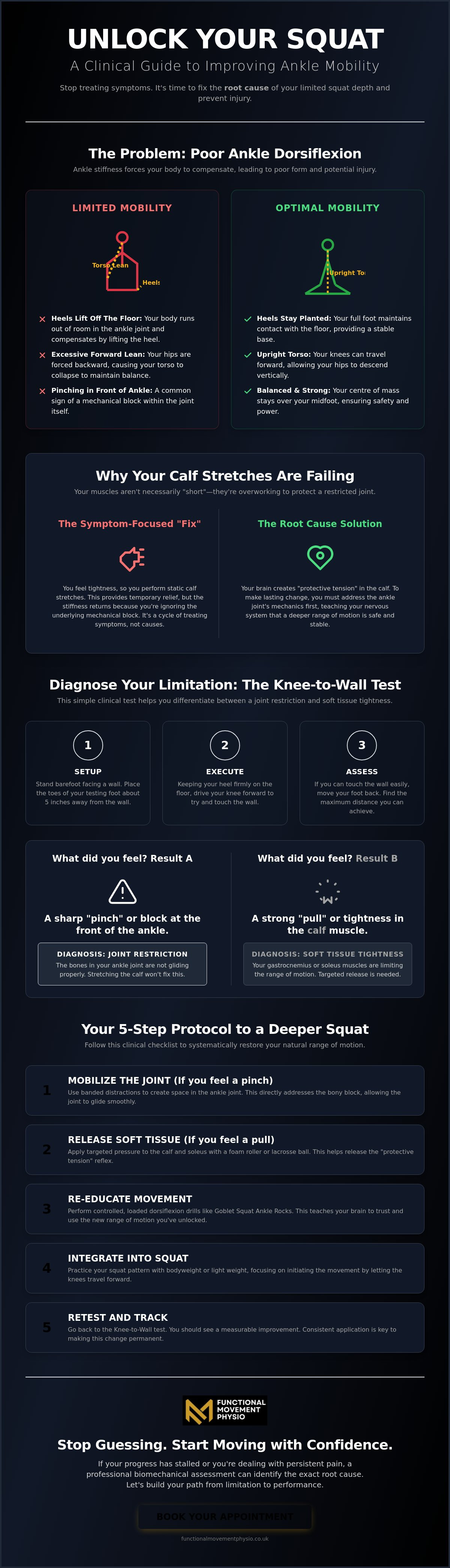
You can usually spot ankle restrictions by looking for a few specific compensations in your form. The most obvious sign is your heels rising off the floor at the bottom of the movement. You might also notice an excessive forward lean of your torso, making your squat look more like a "good morning" exercise. Finally, pay attention to what you feel. If you experience a sharp "pinch" at the front of the ankle or a stubborn tightness in the calf that never seems to release, you're likely dealing with a mobility restriction that needs a root cause approach.
The Problem: Why generic calf stretches often fail to fix your squat
Many gym-goers fall into the trap of performing the same static calf stretches every session, yet they never see a lasting change in their squat depth. You might hold a stretch for 30 seconds, feel a temporary release, and find that the stiffness returns by the time you reach the squat rack. This happens because your gastrocnemius and soleus muscles aren't necessarily short. Instead, they are often overworking to provide stability where the ankle joint itself is restricted. Improving ankle mobility for squats requires looking beyond the muscle belly to understand why your body is creating this tension in the first place.
Relying on "quick fixes" like heel wedges or weightlifting shoes can be a useful tool, but they shouldn't be a permanent substitute for function. When you elevate your heels, you are simply bypassing a mechanical restriction rather than fixing it. This approach often leads to a cycle of recurring stiffness because the underlying joint mechanics remain unaddressed. Research into sports performance and injury risk shows that sufficient dorsiflexion is vital for both power output and long-term joint health. Ignoring the root cause doesn't just limit your depth; it increases the stress on your knees and lower back.
The protective tension reflex
Your nervous system is highly intelligent. If it perceives that your ankle joint is unstable or moving into a range it can't control, it will "lock down" the surrounding muscles to protect you. This is known as a protective tension reflex. If you try to stretch through this sharp pain or discomfort, you're actually fighting your own brain. This often makes the restriction worse. True mobility is impossible without stability. Your brain will only grant you access to a deeper range of motion once it trusts that you are strong enough to control it.
When foam rolling is not enough
Foam rolling or using a lacrosse ball on your calves can provide a temporary "window of opportunity" by reducing muscle tone. However, these are surface-level interventions. If your limitation is caused by a structural joint block, no amount of soft tissue work will permanently change your squat. You need to look deeper than the muscle. If you feel like you've tried every stretch and roller in the gym without success, it might be time for a professional Initial Physiotherapy Consultation to identify the specific mechanical block holding you back.
The Root Cause Approach: Identifying joint blocks versus soft tissue tightness
To make real progress in improving ankle mobility for squats, you must first understand why your movement is restricted. It isn't always about tight muscles. In many cases, the limitation is mechanical, occurring deep within the joint itself. For your shin to travel forward, the talus bone must glide backward into the ankle mortise. If this glide is restricted, you will feel a sharp "pinch" at the front of your ankle. This is a classic joint block, often the result of old ankle sprains. These injuries are incredibly common, yet if they aren't fully rehabilitated, they can leave the joint stiff and poorly positioned for years.
Conversely, if you feel a pulling sensation in your calf or Achilles, you are likely dealing with soft tissue tightness. Distinguishing between these two sensations is vital. Stretching a joint block will only increase your frustration and potentially lead to more inflammation. By identifying the specific nature of your restriction, you can choose the right intervention to finally unlock your squat depth and move with confidence.
The Knee-to-Wall assessment
The Knee-to-Wall test is the gold standard for measuring your current range. Place your foot perpendicular to a wall and attempt to touch your knee to the surface while keeping your heel firmly planted. Measure the distance from your big toe to the wall. For most individuals, a distance of 10 to 12 cm is generally considered adequate for achieving a full-depth squat without compensation. If you are currently below this range, focus on consistent, targeted mobility work. Real structural changes take time when improving ankle mobility for squats, so we recommend tracking this measurement weekly rather than daily. Millimetre gains are hard to see in 24 hours, but they add up significantly over a month.
Compensations: How your knees and back pay the price
When your ankles refuse to budge, your body finds the required range elsewhere. This usually manifests as "butt wink," where your lower back rounds at the bottom of the squat to gain extra depth. Over time, this repetitive flexion under load can lead to significant disc stress and discomfort. You might also notice your knees caving inward, known as knee valgus, as your body tries to bypass the ankle restriction. While fixing your ankles is a priority, you must also ensure your trunk is stable enough to handle these mechanical shifts. You can learn more about this in our guide on how to build core strength to prevent back pain, which explores how to protect your spine while working on your mobility.
Checklist: 5 practical steps for improving ankle mobility for squats
Once you have identified whether your restriction is a joint block or soft tissue tightness, you need a structured plan to address it. Improving ankle mobility for squats is not a one-time event; it is a process of clearing the joint, releasing tension, and then loading the new range of motion to make it permanent. This checklist follows a logical progression that moves from mechanical clearance to functional integration. Use these five steps as your definitive guide to deeper, more stable squats.
- Step 1: Clear the joint with banded ankle distractions. If you felt a "pinch" during your assessment, this is your priority. A heavy resistance band helps encourage the backward talar glide that is often missing.
- Step 2: Release soft tissue tension. Focus on the soleus, which is the deeper calf muscle. Use a lacrosse ball or foam roller to find sensitive spots and hold pressure for 30 to 60 seconds to reduce overactive muscle tone.
- Step 3: Perform eccentrically loaded calf raises. Strength is the key to lasting mobility. Slow, controlled lowering phases (3 to 5 seconds) signal to your brain that this new range of motion is safe and stable.
- Step 4: Practice Goblet Squat Prying. This move forces you to maintain an upright torso while using a weight to gently "pry" your hips and ankles into deeper positions.
- Step 5: Use pauses at the bottom of your squats. Don't just bounce out of the "hole." Spending 3 seconds at your maximum depth helps you "own" the range and build the specific strength required to stay there.
Step-by-step exercise guidance
For the banded distraction, the setup is critical. Secure a thick band to a low anchor point and place the other end around your ankle. It must sit low on the joint, below the bony bits of your ankle, rather than up on the shin. As you drive your knee forward, the band pulls the talus bone backward, clearing the mechanical block. Avoid bouncing or pulsing during these movements. Slow, rhythmic repetitions are far more effective for retraining the joint. The Goblet Squat Pry is the best way to marry mobility with stability, as it teaches your body to remain tight while exploring new depths.
Frequency and consistency
Consistency is the only way to achieve structural change. We recommend performing this checklist as part of your warm-up before every lower body session. If your stiffness is chronic, "micro-dosing" these movements throughout the day can prevent the joint from tightening back up between workouts. Real, lasting change in connective tissue and joint mechanics typically takes 6 to 8 weeks of consistent input. If you are struggling to apply these steps or aren't seeing progress, book a Follow-up Physiotherapy Treatment to refine your technique and ensure you are targeting the right tissues.
Beyond the checklist: Professional gait analysis and physiotherapy in Liverpool
While the clinical checklist provides a powerful foundation for improving ankle mobility for squats, there are times when self-help measures reach a plateau. If you have been consistent with your drills for several weeks but your squat depth remains unchanged, it's likely that your restriction is part of a more complex movement strategy. Your body is an interconnected chain. Sometimes the ankle isn't the primary problem; it's simply the joint that is locking up to provide stability because of a weakness elsewhere, such as in the hip or the foot arch.
Professional intervention moves you beyond guesswork. By using diagnostic tools like gait analysis or a Runner’s Assessment, we can see exactly how your joints interact under load. This level of detail reveals hidden biomechanical links that a standard gym mirror cannot catch. We don't just look at the ankle in isolation. Our goal is to understand why your nervous system is choosing to limit your range of motion and then provide the specific input needed to change that decision.
Clinical tools such as manual therapy and medical acupuncture play a vital role in this process. These interventions can help "reset" the protective tension reflex we discussed earlier, opening a window of opportunity for you to strengthen your new range. When combined with targeted rehabilitation, these treatments ensure that your progress is both rapid and sustainable. We focus on fixing the movement pattern as a whole, ensuring you can return to the activities you love without the constant fear of injury.
Why a specialist assessment matters
Old injuries often cast long shadows. A previous knee strain or a chronic hip restriction can force your ankle into a compensatory position that eventually feels like permanent stiffness. A specialist assessment identifies these global patterns. We use video analysis to break down your squat frame by frame, pinpointing the exact millisecond your mechanics begin to fail. This precision is what sets our Physiotherapy Liverpool service apart. We are dedicated to delivering long-term results by addressing the systemic causes of your limitation rather than just rubbing the spot that feels tight.
Taking the next step in your recovery
You don't have to accept a shallow squat or recurring pain as your baseline. If you feel stuck despite your best efforts at improving ankle mobility for squats, it's time to shift from a symptom-based approach to a root-cause solution. Stop wasting time on generic stretches that don't stick. By measuring your progress with expert help, you can gain the clarity and confidence needed to push past your current limits. We invite you to visit our clinic in Liverpool to undergo a thorough evaluation. Let's work together to unlock your full physical potential and restore purposeful, pain-free movement to your daily training. You can start your journey by booking an appointment through our secure portal today.
Master your movement and squat with confidence
Achieving a full-depth squat is about more than just persistence; it's about precision. You now understand that improving ankle mobility for squats requires a targeted strategy that differentiates between mechanical joint blocks and soft tissue tension. By applying the clinical checklist and focusing on stability alongside mobility, you can finally move past the plateaus that have held your training back.
While self-management is a powerful tool, some restrictions require a deeper look. Our evidence-based root cause approach utilizes specialist biomechanical gait analysis to identify exactly where your movement chain is failing. We combine this with expert clinical pilates for long-term stability, ensuring you don't just find temporary relief but build a foundation for sustainable performance.
If you are tired of feeling restricted in the gym, book your initial physiotherapy consultation in Liverpool today to find the root cause of your stiffness. We are ready to help you restore your purposeful movement and unlock your full physical potential.
Frequently Asked Questions
How long does it take to improve ankle mobility for squats?
It typically takes 6 to 8 weeks of consistent, daily input to see permanent structural changes in your connective tissue and joint mechanics. While you might feel a temporary release after a single session, improving ankle mobility for squats requires long-term commitment to retrain the nervous system. Tracking your progress weekly using the Knee-to-Wall test is the best way to monitor these gradual, lasting improvements.
Can I squat with a heel lift if my ankles are stiff?
You can use a heel lift as a temporary training aid to maintain depth while you work on the underlying restriction. It acts as a bypass for limited dorsiflexion, allowing you to train your legs without compromising your lower back. However, relying on them indefinitely ignores the root cause. You should gradually reduce the height of the lift as your natural mobility improves through targeted exercises.
Is it possible to have naturally stiff ankles that cannot be fixed?
True naturally stiff ankles caused by bony anatomy are relatively rare. Most restrictions are actually functional blocks or soft tissue adaptations resulting from past injuries or lifestyle habits. Even if you have a deeper socket anatomy, most individuals can significantly improve their range through specific joint mobilizations. A professional assessment can help determine if your limit is structural or something we can successfully change.
Why do my knees hurt when I try to squat deeper?
Knee pain during deep squats is often a direct result of your ankles failing to provide enough range. When the ankle is stiff, the knee often caves inward or takes on excessive shear force to find the required depth. This places undue stress on the patellofemoral joint and surrounding tendons. Fixing your ankle mechanics often resolves this knee discomfort by restoring a more efficient load distribution throughout the leg.
Do I need to wear weightlifting shoes to help with ankle mobility?
You don't need weightlifting shoes to achieve a deep squat, though the elevated heel can certainly make the movement feel more comfortable. They are a tool for performance rather than a cure for mobility. If you find you can only squat well while wearing them, it's a sign that you still have a mechanical restriction that needs addressing through clinical intervention rather than just equipment.
Can an old ankle sprain affect my squat depth years later?
An old ankle sprain is one of the most common reasons for long-term squat restrictions. If the injury wasn't fully rehabilitated, the talus bone may not glide backward correctly, creating a permanent pinch at the front of the joint. This mechanical block doesn't resolve on its own with time. It requires specific banded distractions to restore the joint's natural sliding and gliding mechanics for better depth.
What is the best exercise for ankle dorsiflexion?
The best exercise depends on your specific restriction, but the banded ankle distraction is highly effective for clearing joint blocks. It directly encourages the talar glide needed for the shin to move forward. For soft tissue issues, eccentrically loaded calf raises are superior. These exercises build strength in the end-range, which is the most effective way to create lasting mobility gains while improving ankle mobility for squats.