Shin Splints Prevention Clinic Liverpool: Your Essential Checklist

Rest is not a recovery plan. If you've been told to just stop running to fix your shin pain, you've been given a temporary bandage for a structural problem. As a specialist shin splints prevention clinic Liverpool, we see runners every day who are frustrated because the ache along their inner shinbone returns the moment they step back onto the pavement. You aren't failing; your current approach is simply missing the root cause of why your body isn't managing the load.
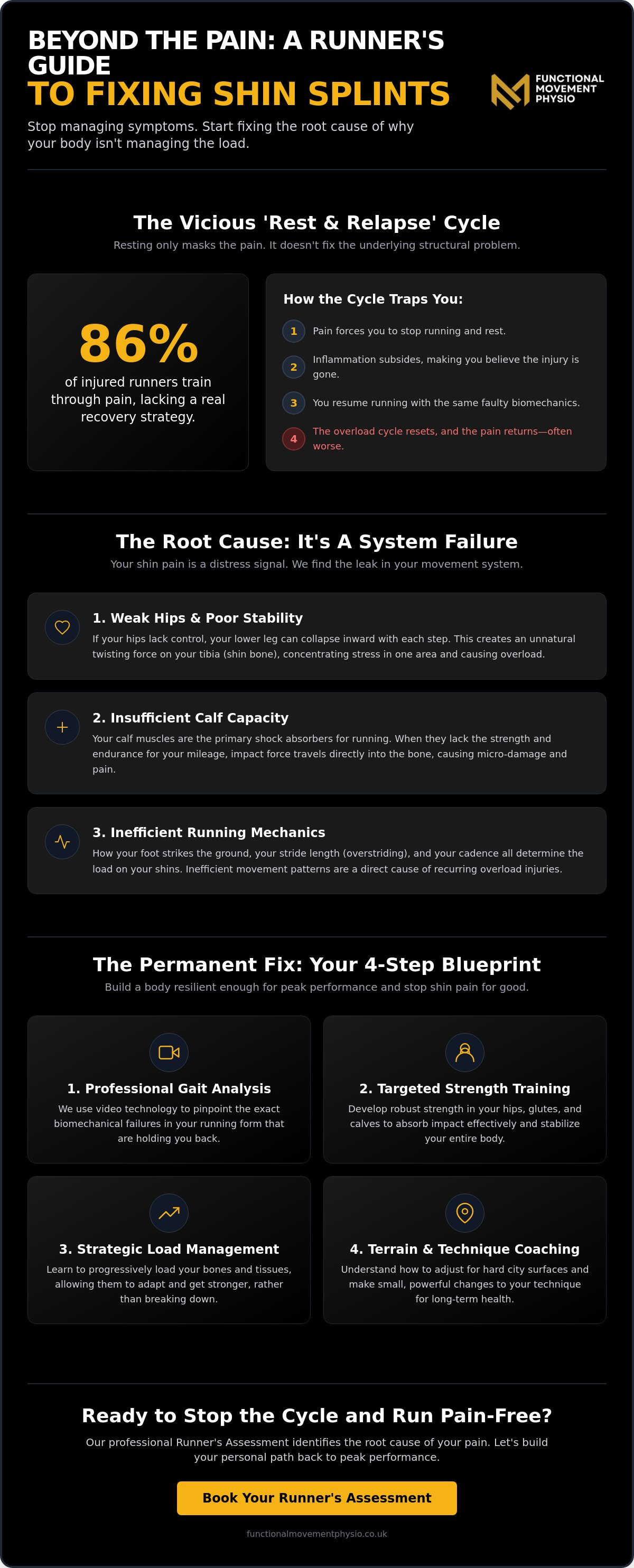
Recent research indicates that 86% of injured runners continue to train through their pain, often because they lack a clear, evidence based strategy to fix it. We're here to change that narrative. Our goal is to help you stop shin pain for good by shifting the focus from overuse to biomechanical optimization. You'll discover how to identify the specific triggers of your injury with our specialist Liverpool prevention guide.
This checklist moves beyond generic advice about footwear or icing. We'll explore the technical methodology behind professional gait analysis and strength training to ensure you can return to full, purposeful movement. It's time to stop managing symptoms and start building a body that's resilient enough for peak performance.
Key Takeaways
- Learn why resting only masks Medial Tibial Stress Syndrome and how to transition toward a solution that addresses structural load.
- Understand the critical link between hip stability and lower leg pressure to stop your shins from working harder than they should.
- Access a 2026 prevention checklist designed to turn sustainable habits into a permanent shield against recurring injury.
- Discover how local terrain choices and specialist gait analysis at our shin splints prevention clinic Liverpool can transform your recovery path.
- See how a professional Runner's Assessment uses video technology to pinpoint the exact biomechanical failures holding you back.
Understanding Shin Splints: Why Rest Is Not a Long-Term Cure
If you are a runner in Liverpool, you have likely experienced that nagging ache along the front or inside of your lower leg. This condition is formally known as Medial Tibial Stress Syndrome (MTSS). For many, the standard response is to stop running for two weeks and apply ice. While this might quiet the inflammation, it rarely fixes the problem. When you visit a shin splints prevention clinic Liverpool, we focus on why your shins are overloaded in the first place, rather than just waiting for the pain to fade.
Ice is excellent for numbing pain, but it does nothing to strengthen the bone or improve your running mechanics. For a deeper look into the pathophysiology of this condition, Understanding Shin Splints can provide additional clinical context. Essentially, your shin pain is a distress signal. It is your body telling you that the forces being applied to your tibia are exceeding its current ability to recover and adapt. When you rest, the inflammation subsides and the pain disappears, leading you to believe the injury is gone. However, the moment you resume your previous mileage with the same faulty mechanics, the cycle resets.
The Problem with Quick Fixes
Many runners try to buy their way out of pain. You might have invested in high stability shoes or expensive compression socks hoping for a miracle. These tools can sometimes provide a small buffer, but they don't change how your foot hits the ground or how your hips stabilize your stride. Relying on these is a gamble that creates a false sense of security. It often leads you back into a frustrating "boom and bust" cycle where you feel okay for a few miles before the pain returns. Ignoring these early niggles is how a minor irritation evolves into chronic MTSS.
Recognising the Symptoms Early
Distinguishing between simple muscle soreness and bone stress is vital for your long term health. Muscle soreness usually eases as you warm up or after a day of light movement. In contrast, bone related pain often feels sharp or deep along the bone itself. A major red flag is pain that disappears ten minutes into your run but returns with a throbbing intensity as soon as you cool down. Medial Tibial Stress Syndrome is a cumulative load issue on the tibia where the bone tissue cannot keep pace with the repetitive stress of impact.
Liverpool runners often struggle with the hard surfaces of the city, which exacerbates the issue. Whether you are training for a local race or just enjoy a loop around the docks, the repetitive impact on concrete demands high level biomechanical efficiency. At our shin splints prevention clinic Liverpool, we see this pattern constantly; runners who are fit and motivated but are being held back by a structural leak in their movement. True recovery starts by identifying these leaks and building the resilience needed to handle the pavement.
The Root Cause Approach: Why Your Shins Are Overloading
Stop blaming your arches. While many runners are told that "flat feet" are the sole reason for their discomfort, this is often a simplification that ignores how your entire body moves as a single unit. Shin pain is rarely a foot problem alone; it is a system-wide failure to manage impact. At our shin splints prevention clinic Liverpool, we look beyond the site of the pain to identify the mechanical leaks that are forcing your shins to do more work than they were designed for. Understanding the mechanics of your stride is the first step toward a permanent solution.
Your calf muscles act as the primary shock absorbers for your lower limbs. When these muscles lack the endurance or strength to manage the repetitive force of running, that energy has to go somewhere. Usually, it is transferred directly into the tibia and the surrounding connective tissue. This is why following standard NHS guidance on shin splints is helpful for immediate relief, but long term prevention requires building a body that can withstand the specific demands of your training volume. If your hips are weak, your lower leg often compensates by rotating or collapsing inward, which puts an unnatural "torsional" or twisting stress on the bone.
Calf Capacity and Bone Loading
Weakness in the calf complex is a major predictor of injury. If your soleus and gastrocnemius muscles cannot absorb the vibration of each foot strike, that vibration travels into the bone, causing the microscopic damage associated with Medial Tibial Stress Syndrome. Ankle mobility also plays a vital role. If your ankles are stiff, your foot may strike the ground in a way that increases the "braking force" of your run. Without targeted strength training to increase this capacity, your shins will remain the weakest link in your physical chain.
Biometrics and Running Cadence
Movement flaws like "overstriding" significantly increase the load on your shins. When your foot lands too far in front of your centre of mass, it acts like a brake, sending a massive shockwave up the leg. Increasing your cadence, or the number of steps you take per minute, can often reduce this impact by encouraging a more efficient foot strike. For a deeper look at how these movement patterns affect you, read our guide on Finding the Root Cause of My Running Pain. Identifying these flaws through professional gait analysis is the gold standard for creating a sustainable recovery plan.
If you are tired of the cycle of re-injury, a specialist Runner's Assessment can provide the clarity you need to move forward with confidence.
Your 2026 Shin Splints Prevention Checklist
Success in running isn't measured by a single fast workout but by the months of uninterrupted training that lead to your goal. To achieve this, you need a system that prioritises bone health and mechanical efficiency. As a leading shin splints prevention clinic Liverpool, we recommend moving away from reactive treatments and adopting a proactive checklist that keeps you moving with purpose. This 2026 guide focuses on sustainable habits that build resilience rather than temporary fixes.
Effective management requires a balance between the stress you put on your body and your capacity to recover from it. For more detailed clinical advice on managing your own recovery, you can refer to this resource on Shin Splints Prevention and Self-Care. By following a structured plan, you can avoid the common pitfalls that lead to recurring pain. Consistency is your most powerful tool in the fight against Medial Tibial Stress Syndrome.
Training and Load Management
- The 10% Rule: Never increase your total weekly mileage or intensity by more than 10%. Sudden spikes in volume are the most common cause of bone stress injuries.
- Dedicated Strength Training: Incorporate at least two sessions per week focused on calf endurance and hip stability. Stronger muscles act as a shield for your tibia, absorbing the vibration that would otherwise damage the bone.
- Optimise Your Cadence: Monitor your steps per minute using your running watch. Aiming for a range of 170 to 180 steps per minute helps reduce the "braking force" and impact on your shins.
Equipment and Environment
Your gear and your surroundings play a vital role in force distribution. While shoes aren't the only factor, they are your primary interface with the ground. At our shin splints prevention clinic Liverpool, we often see injuries caused by equipment that no longer provides the necessary support or terrain that is too unforgiving for a recovering runner.
- Track Shoe Mileage: Check your footwear for visible wear and loss of cushioning every 300 to 500 miles. Foams degrade over time, even if the tread looks fine, which reduces their ability to dissipate shock.
- Gait Matching: Ensure your shoes match your specific movement patterns. A professional Runner's Assessment is the most reliable way to determine exactly what your feet need to function optimally.
- Surface Variation: Avoid doing all your runs on hard tarmac or concrete docks. Mix in softer trails, such as those found in Sefton Park, to give your bones a break from repetitive high impact stress.
By ticking off these points weekly, you transform your training from a gamble into a calculated path toward peak performance. If you are struggling to implement these changes on your own, professional guidance can help you bridge the gap between physical limitation and your next personal best.
Practical Guidance for Running in Liverpool
Liverpool offers some of the most scenic running routes in the North West, but the terrain can be unforgiving if you are managing a bone stress injury. The long, flat stretch of Otterspool Promenade is a favourite for many, yet its hard tarmac surface provides zero shock absorption. If you are currently recovering, this repetitive impact can be a primary trigger for flare ups. Shifting your training to the softer trails of Sefton Park or using the grass verges along the park's perimeter can significantly reduce the vibration sent through your tibia. These small adjustments in your environment can make the difference between a successful run and another week of frustration.
A visit to a shin splints prevention clinic Liverpool provides you with a bespoke analysis of how you interact with these local challenges. Generic advice cannot account for the specific way you tackle the hills of Woolton or the flat stretches of the docks. We understand the local landscape and how it dictates the stress placed on your body. By identifying the root cause of your pain, we can help you navigate the city's streets without the fear of re injury.
Choosing Your Liverpool Running Routes
The transition from a controlled environment like a gym treadmill to the uneven Liverpool streets is where many runners stumble. Treadmills offer a consistent, cushioned belt that returns energy to the runner. In contrast, the concrete of the city centre requires your muscles and bones to do all the work. If you are moving outdoors, start with shorter loops on mixed terrain to allow your body to adapt slowly to the change in surface density.
Hills in areas like Everton or Woolton also change the demand on your lower legs. Running uphill increases the work of the calf muscles, while downhill running puts immense eccentric stress on the front of the shin. This eccentric load is often where Medial Tibial Stress Syndrome begins to flare. If you aren't prepared for these gradients with specific strength training, they can quickly turn a minor niggle into a chronic issue that stops you from training altogether.
Local Climate and Preparation
Our local weather adds another layer of complexity to your recovery. Damp, cold Liverpool winters can lead to increased muscle stiffness, making your calf complex less efficient at absorbing force. A dynamic warm up is essential before you hit the cold air. You need to ensure your muscles are pliable and ready to manage the load of the hard pavement. For more specific insights on mastering your movement in the city, check out our guide on Expert Physiotherapy Liverpool.
Ready to stop guessing and start running pain free? Book your Initial Physiotherapy Consultation today to get a plan tailored to your Liverpool lifestyle and your specific physical goals.
Professional Support at Our Liverpool Shin Splints Prevention Clinic
Managing a recovery alone is often the slowest path to the finish line. While the checklist provided earlier offers a solid foundation for daily management, a specialist shin splints prevention clinic Liverpool provides the clinical precision needed to bridge the gap between injury and peak performance. We don't just want to stop your pain; we want to optimize your physical capacity so you can return to the activities that give your life purpose.
Our approach is built on a partnership between expert guidance and your personal goals. At our shin splints prevention clinic Liverpool, we move beyond static testing. We utilize high-speed video gait analysis to observe your movement in real time. This allows us to identify biomechanical leaks, which are specific points in your stride where energy is wasted and load is inappropriately transferred to your shins. By seeing exactly how you move on the treadmill, we can create a roadmap that is unique to your body.
Our Specialist Runner’s Assessment
This assessment is a deep dive into your physical mechanics. We look at everything from your big toe mobility to your lateral hip stability to ensure your entire kinetic chain is functioning correctly. If we find that your injury has become chronic or resistant to standard rehab, we may incorporate advanced interventions like Shockwave Therapy. This technology helps stimulate a healing response in stubborn tissues, ensuring that your recovery doesn't stall. Our goal is to move you through clinical rehabilitation and straight into a high-performance strength and conditioning plan that protects you for the long term.
Taking the Next Step
It is tempting to rely on generic online tutorials or conflicting forum advice, but guessing often leads to further frustration. A professional consultation provides immediate clarity, saving you weeks of trial and error. We focus on keeping you as active as possible during your recovery, modifying your training rather than demanding total rest. This structured approach ensures you can return to your favourite Liverpool running clubs with the confidence that your shins can handle the pace and the pavement.
The restoration of full, purposeful movement is within your reach. You don't have to stay stuck in a cycle of recurring pain and forced rest. By identifying and fixing the root cause of your overload, you can finally master your physical capabilities and run without limits. Book your appointment online today and take the first step toward a sustainable, pain-free future.
Take Control of Your Running Future Today
Shin pain doesn't have to be a permanent obstacle in your training journey. By shifting your focus from temporary rest to identifying the root cause of your injury, you've already begun the transition toward long term resilience. You now understand that sustainable movement relies on a precise balance of load management, strength training, and biomechanical efficiency.
As a specialist shin splints prevention clinic Liverpool, our expert Liverpool-based physiotherapy team is dedicated to helping you master your physical capabilities. We utilize a Red Dot standard biomechanical analysis to pinpoint exactly where your movement is failing you. This isn't just about managing pain; it's about unlocking your potential through our Specialist Runner’s Assessment Package. We provide the structured guidance you need to move beyond physical limitations and achieve your next personal best.
Book your specialist Runner’s Assessment at our Liverpool clinic today and start building a body that is truly ready for the pavement. You have the power to run with confidence again, and we are ready to help you find the way.
Frequently Asked Questions
Can I still run with shin splints if the pain is only mild?
You can often continue running if the pain is low level and doesn't worsen during or after your session. We generally use a scale where pain under three out of ten is acceptable as long as it disappears once you warm up. However, if the ache lingers the next morning or changes your running stride, you are likely overloading the bone and need to reduce your mileage immediately to prevent a stress fracture.
How long does it typically take to recover from shin splints?
Recovery usually takes between three and twelve weeks depending on the severity of the bone stress and how quickly you address the root cause. Minor irritations might settle within a month if you adjust your mechanics and training load. Chronic cases often require a longer, structured period of progressive loading to safely rebuild bone density and muscle endurance without risking a secondary flare up.
Are certain running shoes better for preventing shin pain?
No specific shoe model is a universal cure for shin pain. The most effective footwear is the one that matches your individual gait and provides comfort during impact. While maximalist, cushioned shoes can reduce the initial shock, they don't fix the underlying movement flaws that cause the injury. It is better to focus on your running mechanics than to rely on a specific brand of trainers.
Does running on grass really help prevent shin splints in Liverpool?
Running on grass significantly reduces the peak impact forces compared to the hard tarmac found along the Liverpool waterfront. The softer surface acts as a natural shock absorber, which is why we often recommend the trails in Sefton Park for recovery runs. It provides your tibia with a much needed break from the repetitive vibration of concrete while allowing you to maintain your aerobic fitness.
What is the best exercise to strengthen my shins at home?
Targeted calf raises are the most effective way to build resilience in your lower legs. You should perform both straight leg raises for the gastrocnemius and bent knee raises to target the soleus muscle. Strengthening these muscles improves their ability to absorb the vibrations of each foot strike. This prevents that energy from being transferred directly into the bone, which is the primary cause of Medial Tibial Stress Syndrome.
When should I see a specialist at a Liverpool prevention clinic?
You should seek professional advice if your pain persists for more than two weeks or if it returns as soon as you try to run. Visiting a shin splints prevention clinic Liverpool early can stop a minor niggle from developing into a chronic issue. A specialist assessment identifies the structural leaks in your movement before they lead to significant physical limitations or a forced long term break from activity.
Can gait analysis actually fix my recurring shin splints?
Gait analysis is the most reliable way to identify the mechanical failures, such as overstriding or poor hip stability, that are causing your pain. By seeing your movement in real time, we can provide specific cues to change how your foot hits the ground. This approach fixes the root cause of the overload. It transforms your running style into one that is more efficient and significantly less stressful on your shins.
Is shockwave therapy effective for treating chronic shin pain?
Shockwave therapy is an excellent option for stubborn, chronic cases where traditional rest and stretching have failed. It uses acoustic pulses to stimulate blood flow and trigger the body's natural healing response in the affected tissue. At our shin splints prevention clinic Liverpool, we often use this technology to kickstart recovery in runners who have been stuck in a cycle of pain for several months.